
Chest and breast reconstruction · Madrid
Poland syndrome treatment in Madrid, Spain
There is no single operation for Poland syndrome. Treatment depends on what is missing—muscle, volume, breast tissue, the areola, or part of the chest wall—and the change each patient hopes to achieve.
Several techniques alone or combined
Dr. Gorka Ibarra assessment and surgery
A direct answer
What is Poland syndrome?
It is a congenital condition characterized by underdevelopment or absence of part of the pectoralis major muscle, almost always on one side. It may affect the muscle alone or involve differences in the breast, areola, ribs, subcutaneous tissue, arm, or hand.
Two people with the same diagnosis may therefore need very different treatments. In most cases, the main concern is contour and symmetry; complex cases also require assessment of chest wall and upper-limb function.
The most important step
Before choosing a technique, we need to identify what is missing
The examination goes beyond comparing volume. We assess the entire chest, movement, skin, and anatomy of the opposite side.
Pectoral muscle
We identify which part is absent or underdeveloped and how this affects the transition between the chest, armpit, and arm.
Breast and subcutaneous tissue
In women, we assess breast tissue, the lower pole, the breast crease, the areola, and any differences in size or position.
Ribs and chest wall
A depressed rib cage or chest wall deformity may influence implant selection and, in uncommon complex cases, require a multidisciplinary approach.
Unaffected side
Reconstructing one side is not always enough. A breast lift, reduction, implant, or reshaping of the unaffected side may help bring the two contours closer together.
Skin and donor fat
Their quality and amount determine whether fat grafting can be the main treatment, an additional technique, or require several sessions.
Arm and hand
Associated upper-limb differences are not corrected by chest reconstruction and may require a separate assessment.
Timing of reconstruction
When is surgery appropriate?
Reconstruction is usually considered once chest growth—and breast development in women—is complete. This allows a more accurate assessment of the final difference and reduces the chance of growth changing the result.
Exceptions may be considered when the condition has a significant psychological impact or causes a functional problem. In younger patients, the potential benefit must be weighed against the possibility of further stages or adjustments after growth is complete.
Development, anatomical complexity, the ability to understand the process, and realistic expectations all matter.
Personalized reconstruction
Four approaches, used alone or together
No technique is best for everyone. The aim is to address the specific defect with a proportionate surgical burden.
Your own fat
Fat grafting
Fat grafting can gradually add volume and soften transitions. It is especially useful for mild defects or as an additional layer of coverage over an implant.
- Can provide a natural feel.
- Requires enough donor fat.
- May need more than one session.
A simpler option
Standard implant
An off-the-shelf implant can address chest or breast volume when the anatomy is well suited to the available shapes.
- A simpler planning process.
- Lower cost than a custom design.
- May not reproduce a complex defect.
Individual design
Custom-made implant
The implant is designed around the patient’s anatomy when a standard shape cannot adequately address a depression, an edge, or chest asymmetry.
- Tailored to the specific defect.
- Requires planning and manufacturing.
- Can be combined with fat grafting.
Complex reconstruction
Autologous tissue or latissimus dorsi flap
Larger defects may require tissue with its own blood supply, additional coverage, or a latissimus dorsi flap, alone or combined with an implant or fat grafting.
- Provides your own tissue and coverage.
- More extensive surgery and recovery.
- Reserved for appropriate indications.
Different goals
Reconstruction in men and women
The diagnosis is the same, but the desired contour and the techniques used can differ substantially.
Rebuilding the pectoral contour
The priority is often to restore the transition between the breastbone, chest, armpit, and arm. A standard or custom implant, fat grafting, or a combination may be appropriate.
Reconstructing the breast and chest foundation
Missing muscle is often accompanied by a smaller breast, a different breast crease, or a different areola. Treatment may involve an implant, fat grafting, a breast lift, tissue expansion, or surgery to improve symmetry on the opposite side.
A reduction, lift, implant, or reshaping of the opposite side can improve symmetry. Even so, no technique can promise identical sides.
Our approach
We start with your anatomy, not a preselected implant
“First, we identify the structures responsible for the asymmetry. Only then do we decide which combination can restore a balanced contour with a proportionate operation.”
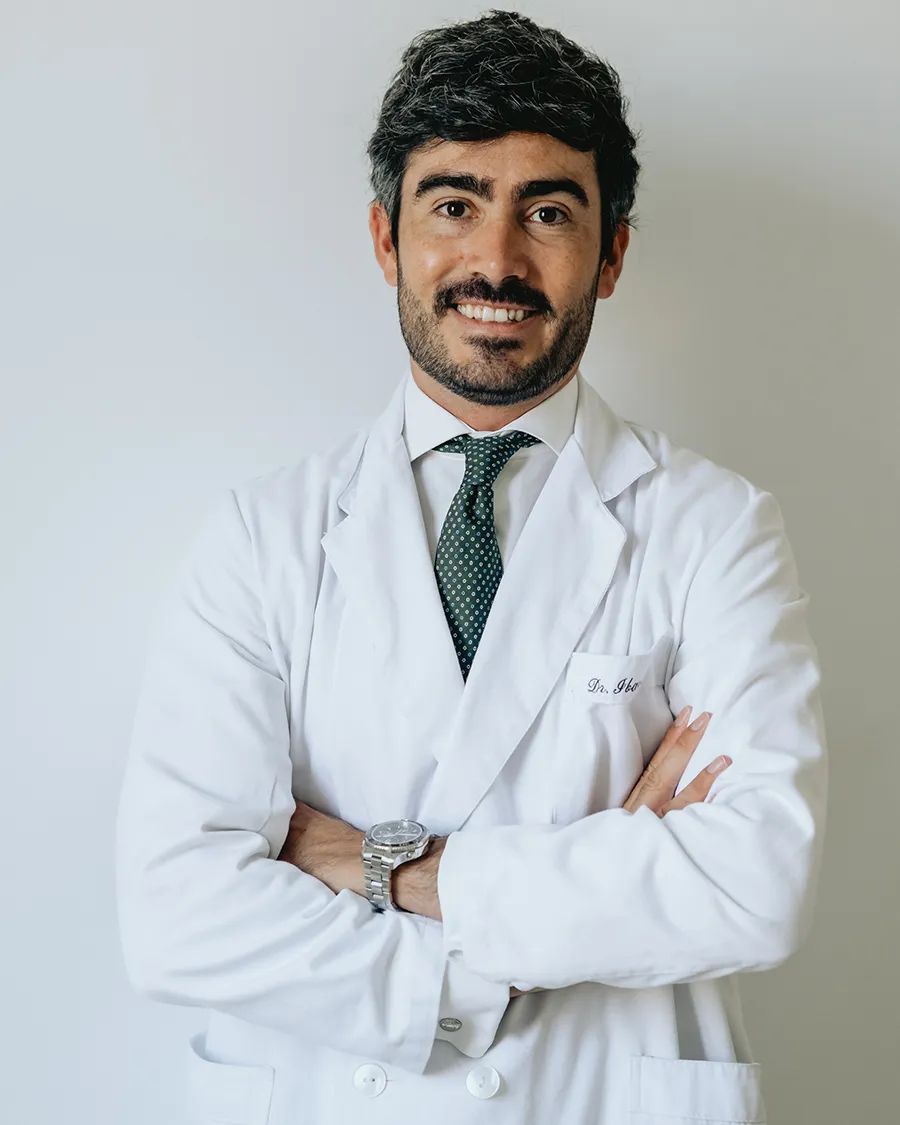
Your surgeon
Assessment and surgery with Dr. Gorka Ibarra
At Dr. Aso Clinic, Poland syndrome cases are assessed and operated on by Dr. Gorka Ibarra. His work focuses particularly on breast surgery and reconstruction, where planning must bring together tissue, implants, and symmetry.
He completed specialist training through Spain’s MIR pathway at Hospital Universitario Gregorio Marañón. He is a SECPRE member and a specialist at Hospital Universitario Donostia, and has worked within Dr. Aso Clinic’s surgical team since 2021.
Safety and setting
General anesthesia and an overnight stay in most cases
These procedures are performed at Hospital Universitario HLA Moncloa, with an anesthesiologist and hospital-based planning. General anesthesia and an overnight stay are usual, although the final plan depends on the technique and any combined procedures.
The hospital has 14 operating rooms for major surgery, a postoperative recovery unit, and 13 intensive care beds. Its intensive care department is accredited for specialist training through Spain’s MIR pathway.
- Fat grafting or an implant alone
- ≈1–1.5 h
- Complex reconstruction
- ≈3 h
- Usual anesthesia
- General
- Usual hospital stay
- One night
Two recovery pathways
Recovery depends on the extent of reconstruction
Fat grafting alone is not comparable to reconstruction using a tissue flap. These timelines are guides and are adjusted after surgery.
Simpler procedure
Fat grafting or an implant alone
- Day 1Walking and light activities at home.
- 7–10 daysOffice work and driving, depending on comfort and clearance.
- 3 weeksLight exercise, resumed gradually with clearance.
- ≈6 weeksStrenuous exercise and upper-body training, with clearance.
Complex reconstruction
Autologous tissue or latissimus dorsi flap
- First few daysEarly mobilization and prescribed shoulder exercises.
- 2–3 weeksAn approximate timeframe for returning to office work.
- 3–4 weeksDriving and light exercise if recovery permits and your surgeon clears you.
- 6–12 weeksGradual return to strenuous upper-body training and contact sports, with clearance.
Compression garments, drains, and shoulder restrictions are individualized. Not all Poland syndrome reconstructions follow the same recovery plan.
Results and limitations
Better symmetry does not mean identical sides
The goal is a balanced chest or breast contour at rest and during movement, with a natural transition toward the shoulder and armpit. The congenital muscle absence remains: volume, coverage, or anatomical reconstruction helps compensate for it.
Results evolve over several months. Grafted fat gradually stabilizes, and the tissues settle around implants. With staged treatment, each procedure should provide a meaningful improvement in its own right.
Fat grafting and some breast reconstructions benefit from more than one session.
Possible adjustments to volume, contour, the areola, or the opposite side are discussed from the outset.
An implant or fat grafting can improve contour but does not create a contracting pectoral muscle.
Indicative pricing
How much does Poland syndrome surgery cost?
The same diagnosis may involve very different operations, so costs vary. These starting prices provide an initial guide before examination.
One fat-grafting session for a suitable defect.
An off-the-shelf implant when the anatomy suits an available model.
Design and manufacturing tailored to the specific chest defect.
Autologous tissue, a latissimus dorsi flap, or combined reconstructive techniques.
Personal assessment
Tell us what feels different and what you would like to improve
You do not need to know which implant or technique you want. The consultation is an opportunity to assess your anatomy and explain the options that make sense for your case.
Planning your visit from abroad. For patients considering Poland syndrome treatment in Spain, the first step is an individual discussion of the chest or breast features they would like assessed. Before arranging a visit to Madrid, contact the clinic about the appropriate consultation, the information needed for assessment by Dr. Gorka Ibarra, and follow-up after returning home. Read our international patient guide.
Full chest examinationMuscle, ribs, breast tissue, areola, skin, and the opposite side.
A plan matched to complexityOne technique, a combination, or several stages when appropriate for safety.
Transparent quoteIncluding hospital care, anesthesia, and reconstructive materials when applicable.
Choose “Another treatment or general question” in the form and mention Poland syndrome in your message.
Frequently asked questions
Questions about Poland syndrome and surgery
Is Poland syndrome a disability?
For many people, it mainly causes a difference in chest or breast appearance without a substantial functional limitation. Cases involving the ribs, arm, or hand may have different implications and require a specific assessment.
What causes Poland syndrome?
The exact cause is not known. The leading hypothesis involves a disruption in blood supply during embryonic development. Most cases are sporadic; a small proportion occur in families.
Can it be completely corrected?
Contour and symmetry can improve considerably, but a congenitally absent muscle cannot be turned into a normal pectoral muscle. The aim is to compensate for the difference with a natural, balanced contour—not to promise identical sides.
Is an implant or fat grafting better?
It depends on the defect. Fat grafting is useful for gradual changes and natural transitions; an implant provides more defined volume and shape. In many cases, a combination is the most suitable approach.
Does the implant always need to be custom-made?
No. If the defect suits a standard implant, this can be a simpler, lower-cost option. Custom design is reserved for anatomy that cannot be adequately addressed by available standard shapes.
Does fat grafting need several sessions?
It may. Some grafted fat is reabsorbed, and the amount that can safely be transferred in one session is limited. This is explained from the beginning so that a further session is understood as part of the plan, not necessarily a failure.
At what age is surgery performed?
Usually after chest and breast development is complete. Earlier treatment may be considered for significant psychological impact or a functional need, with the understanding that growth may require further adjustments.
Can the unaffected side also be operated on?
Yes. In women, a lift, reduction, implant, or reshaping of the opposite side may substantially improve symmetry. The need and extent are agreed with the patient.
How long are surgery and the hospital stay?
Fat grafting or an implant alone usually takes approximately one to one and a half hours. Complex reconstruction may take around three hours. General anesthesia and an overnight stay are usual.
How much does Poland syndrome surgery cost?
As a guide, fat grafting starts at €5,000, a standard implant at €7,000, a custom implant at €8,500, and complex reconstruction using autologous tissue or a latissimus dorsi flap at €12,000. Your assessment determines the actual quote.
Sources and transparency
This page combines consensus recommendations, a recent systematic review, and the team’s clinical protocol. Treatment is always individualized.
Authorship of the Spanish original
Specialist in plastic, aesthetic, and reconstructive surgery through Spain’s MIR training pathway
Medical registration no. 2828/73985 · Madrid
Poland syndrome: anatomical assessment, fat grafting, standard or custom implants, autologous reconstruction, age, anesthesia, recovery, realistic results, and pricing.
English translation of the original Spanish clinical information, supported by institutional and scientific sources. Translation is not a new medical review and does not replace an individual assessment.

Selected interviews, mentions and third-party articles. Coverage is in Spanish.