

Preservé breast augmentation in Madrid, Spain
Breast augmentation for patients seeking natural-looking proportions and a tissue-preserving surgical approach.
Request a Preservé assessment
What is the Preservé technique?
Preservé is an innovative surgical technique designed for women seeking a minimally invasive aesthetic procedure with natural and harmonious results. It is a technique developed in collaboration with specialized plastic surgeons, aiming to maximize the preservation of the patient’s breast anatomy during breast remodeling procedures.
Preservé aims to preserve breast structures, including the pectoral muscle, while creating space for the implant. The goal is to limit tissue disruption and support recovery in suitable patients. Changes in breast or nipple sensation can still occur, and preservation of sensation cannot be guaranteed.
The Preservé technique in 3D
This animation illustrates the Preservé approach: minimally invasive breast augmentation designed to preserve tissue, limit surgical trauma and support a more comfortable recovery in appropriately selected patients.
The animation explains why Preservé involves more than a small incision: it requires planning, dedicated instruments, appropriate implant selection and a clear clinical indication.
Video summary: understanding the technique
At our clinic in Madrid, Spain, Preservé aims to perform breast augmentation with a tissue-preserving approach. Individual planning and controlled dissection create space for the implant while aiming to limit surgical trauma. Suitability depends on anatomy, skin quality, breast tissue, desired volume and expectations.
 Preservé by Motiva
 Less invasive surgery, with medical supervision
Preservé takes a tissue-preserving approach to breast augmentation. Although it may offer a more comfortable experience for selected patients, it is still surgery and requires surgical planning, an anesthesiologist and a hospital setting.
Potential benefits of Preservé
Preservé was developed with a clear aim: breast augmentation that is more respectful of breast tissue, seeking a more comfortable recovery, smaller incisions and natural-looking proportions in appropriately selected patients.
Preserving anatomy
Preservé aims to limit surgical trauma and preserve the patient’s anatomy. Detailed planning and controlled dissection create space for the implant while minimizing disruption to surrounding tissue.
In an appropriate candidate, this may support a more comfortable postoperative experience and less swelling. Recovery and the final appearance vary from person to person.
Smaller incisions
In suitable patients, Preservé may allow smaller incisions than some conventional augmentation approaches. Scarring is still expected, and its appearance varies.
Potentially less swelling
A tissue-preserving approach may reduce early swelling and discomfort, depending on the anatomy, implant and individual recovery.
A potentially shorter recovery
Some patients can return to gentle daily activities sooner. Exercise, lifting and strenuous activity must be resumed gradually according to the medical team’s instructions.
Surgical planning and supervision
Preservé involves more than a small incision. It requires appropriate patient selection, surgical experience and planning to choose the volume, implant and approach for each case.
The key question is whether Preservé is right for you
Its potential benefits may be relevant if you are seeking a moderate increase with natural-looking proportions. A medical assessment is needed to determine whether your anatomy and goals are compatible with the technique.
Potential benefits vary with anatomy, breast tissue, skin quality, implant type and volume, and individual recovery. A recommendation must follow a personalized medical assessment.
Preservé · real patient cases
See real results. Understand what is possible for you.
Explore before-and-after photographs, then discuss the approach that may suit your anatomy, goals and expectations in a personal consultation.
Photographs show individual cases, not a promise of results. A medical assessment is essential.
What are the differences between Preservé and mia-Femtech?
Both Preservé and mia-femtech® are advanced breast augmentation techniques designed for women seeking natural, discreet results with a tissue-preserving approach. However, there are important differences between the two that will help you decide which one best suits your case:
- Access route:
While mia-femtech® is performed through the armpit, with an incision in the armpit rather than on the breast, Preservé uses the submammary fold as the entry point, allowing for more direct surgical control of the breast pocket. This difference can be key depending on your anatomy or preferences. - Type of implant:
Preservé uses latest-generation Ergonomix2® implants, designed to respond to changes in body position. On the other hand, mia-femtech® employs diamond-shaped implants specifically designed to maximize projection with a small volume.
- Available volume:
mia-femtech® is indicated for more subtle augmentations (up to 195cc) and for patients who are not looking for a very obvious change. In contrast, Preservé allows for up to approximately 320cc, which may suit selected patients seeking a moderate increase. - Expected results:
Both techniques aim for natural-looking proportions, but Preservé allows for greater customization in volume and control in implant positioning. Additionally, not all patients are good candidates for mia-femtech®, especially if they have breast sagging or certain anatomical characteristics.
Would you like to compare the two approaches?
We explain it in detail in this article:
3D Simulation in consultation
Visualize different options before deciding on the implant size
During the breast augmentation assessment, we can compare different implant volumes and shapes on a 3D reconstruction of the patient's anatomy. This example shows an illustrative simulation with 250 cc ergonomic implants.
- Compare volume and body proportion
- Assess projection in frontal and oblique views
- Discuss natural-looking, proportionate options
- Combine simulation, measurements, and medical criteria
A tool to help you decide, not a promise of a result 3D simulation does not guarantee an exact result. It is used as support along with medical examination, measurements, external sizers, and the individual assessment of each patient.
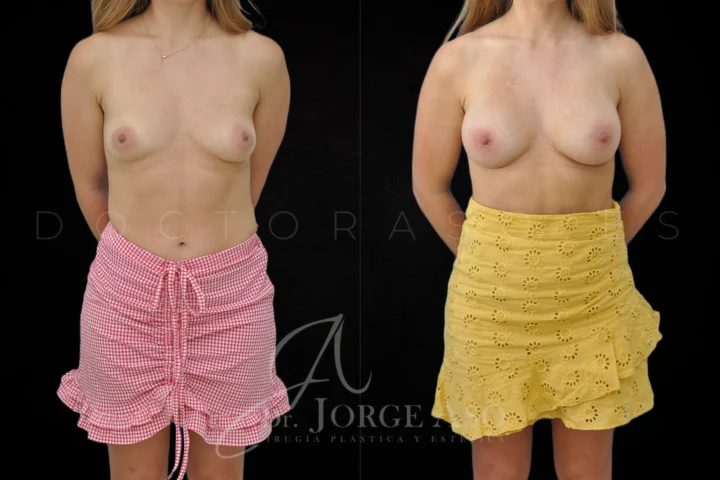
Before and after photos of breast augmentation surgery with the Preservé technique
Before and after
Real Preservé cases


We answer your questions
The procedure will be carried out in a hospital, with all necessary resources (anesthesiologist with extensive experience in Plastic Surgery, expert nursing staff, assistants, etc.)
Preservé is usually performed with local anesthesia and sedation, without intubation or an overnight stay. Discharge is often around two hours after the procedure, but depends on assessment and recovery. A procedure under sedation can require conversion to general anesthesia and intubation for safety. The clinic performs Preservé in a hospital with intensive care facilities.
Ask us any questions you may have
Prices and your quote
How much does Preservé cost?
If you are considering a minimally invasive breast augmentation technique such as Preservé, it is important to understand what your quote includes. The price reflects the dedicated instruments, medical team, hospital setting and implant used.
The clinic’s indicative price, published in July 2026, starts at €7,900 including VAT, for a procedure performed in a hospital with an anesthesiologist. Your final quote depends on your anatomy and individual needs.
Dedicated instruments
The technique uses single-use devices, including insertion sleeves and expansion equipment, to support a controlled surgical approach.
Medical team and hospital
The procedure takes place in a hospital with a surgeon, anesthesiologist and nursing team. The anesthetic plan is individualized after medical and anesthesia assessments.
Which implants does Preservé use?
Preservé uses Motiva Ergonomix2® implants. The range described in the clinic’s practice is 200–320 cc, with 250–285 cc used most often. Their geometry and range differ from the biconvex Diamond implants used for MIA. These differences are explained in the MIA and Preservé comparison.
Indicative starting prices by technique
No technique is universally better. The decision depends on anatomy, desired volume, implant choice and medical assessment. These figures are a starting point for discussion, not a personalized quote.
A wider range of options
Conventional breast augmentation
From €6,400
Allows a broader range of implant volumes, access routes and implant positions to be considered for an individual case.
Conventional augmentationTissue preservation
Preservé technique
From €7,900
A minimally invasive approach intended for a moderate increase with natural-looking proportions in selected patients.
Request a Preservé assessmentAccess through the armpit
mia Femtech®
From €8,995
A minimally invasive approach for selected patients seeking a subtle increase, with an incision in the armpit rather than on the breast.
MIA FemtechYour individual quote. The final cost can vary with anatomy, implant selection and surgical requirements. During your consultation, the team will assess your case and explain the available alternatives. Travel, accommodation and optional premium services are separate unless expressly included in your written quote.
Discuss my casePreservé in Madrid
Dr. Aso’s clinic focuses on breast surgery and minimally invasive approaches such as Preservé. We combine breast augmentation experience, individual planning and clinical assessment to determine whether this technique is appropriate for each patient.
Your assessment considers anatomy, breast tissue, skin quality, desired volume and expectations.
Dr. Jorge Aso and the Preservé approach
Preservé is a minimally invasive augmentation approach, but the outcome depends on more than technology. Important factors include patient selection, planning and surgical experience. At Dr. Aso’s clinic, we introduced Preservé alongside an established breast surgery practice and use our experience with both this approach and conventional augmentation when advising patients.
Breast surgery experience matters
Preservé is a less invasive approach to augmentation, but it remains surgery that requires clinical judgment. Experience from more than 4,000 conventional breast augmentations helps inform the assessment of anatomy, implant selection, limitations and the approach for each patient.
Alongside his clinical practice, Dr. Jorge Aso teaches and provides training in the Preservé technique, participating in courses, conferences and masterclasses for surgeons developing their skills in this approach.
We regard Preservé as one option within a broader breast surgery practice. The important decision is when it may be useful and when another approach is more appropriate.
Our aim is to recommend Preservé when it fits the patient’s anatomy and goals, with careful planning and realistic expectations.
Experience with the technique
Practical experience and a background in breast surgery help inform the use of a technique with its own learning curve.
Training other surgeons
Dr. Jorge Aso participates in educational activities, masterclasses and conferences, sharing his clinical experience with other specialists.
Careful patient selection
Not everyone is a candidate. We assess anatomy, skin quality, breast tissue, sagging, desired volume, previous treatment and expectations before recommending Preservé.
Clinical judgment and realistic expectations
Preservé is not the right approach for every case. If another technique is more appropriate, we will explain the alternatives and their trade-offs.
Would you like to discuss whether Preservé is right for you?
Before choosing implant size or considering price, the first step is to assess whether this approach fits your anatomy, goals and expectations.
Procedure figures are based on the clinic’s internal records and require periodic updating. The teaching activity described refers to Dr. Jorge Aso’s participation in courses, conferences and masterclasses related to Preservé. Suitability requires an individual medical assessment. Results vary with anatomy, skin quality, implant type and volume, and individual recovery.
Planning Preservé in Madrid
Begin with an initial video consultation in English before arranging travel. Dr. Aso speaks English at a native level and has undertaken training in the United States. The clinic team can assist you in English by email and WhatsApp.
A video consultation is an initial assessment, not a substitute for any necessary in-person examination. Agree the required tests, appointments, recovery support and follow-up plan before booking flights or accommodation.
The appropriate length of your stay and return-flight timing depend on your procedure and recovery. Ask about care after returning home, the contact arrangements for concerns and what your quote covers if further care is needed.
Preservé Breast Assessment
Is Preservé right for you?
We will study your anatomy, breast tissue, skin quality, and the volume you are looking for to assess if this less invasive technique truly fits your case.
We listen to your goals What result you are looking for and what questions you want to resolve.
We assess suitability Anatomy, tissues, sagging, previous surgeries, and desired volume.
We plan individually Implant, size, and technique are decided based on medical criteria.
Our team can assist you in English by email and WhatsApp. Ask about an initial video consultation before arranging travel.
For your privacy, wait for the clinic’s instructions before sending clinical photographs or medical records.
Frequently Asked Questions about Preservé
These are the most common questions about the Preservé Experience and minimally invasive breast augmentation.
Does the Preservé treatment use implants?
Yes. Preservé uses Motiva Ergonomix2® silicone gel breast implants. Your consultation will cover the proposed implant, its characteristics, limitations and product information. These are implants placed surgically, not injectable fillers.
Implants are not lifetime devices. Risks include infection, bleeding, changes in sensation, capsular contracture, implant rupture and further surgery. Discuss the full risk information and follow-up requirements before deciding.
Are 30 minutes enough? Isn't it a very fast procedure?
In selected cases, the surgical part of the procedure may take around 30 minutes. The clinic describes approximately 60 minutes including anesthetic preparation, followed by postoperative observation. Your total hospital stay is longer than the operating time.
These are estimates, not guarantees of duration, discharge time or recovery. A short procedure does not mean it is appropriate to fly home immediately afterward.
What anesthesia is used, and what about pain?
Preservé is usually performed with local anesthesia and sedation, supervised by an anesthesiologist. The anesthetic plan is individualized; general anesthesia may be appropriate or become necessary for safety.
Discuss pain relief, sedation and any concerns with the team before surgery. Discomfort during recovery varies, and a pain-free experience cannot be guaranteed.
What is the difference between the Preservé Experience and traditional breast augmentation?
Preservé uses dedicated instruments and controlled tissue expansion to create a pocket for an implant in front of the pectoral muscle. The aim is to limit tissue disruption in suitable patients.
It remains breast implant surgery, with an incision and surgical risks. Conventional augmentation includes several approaches; the appropriate comparison depends on your anatomy and treatment goals.
Could Preservé be right for me?
Preservé may be an option if you want a moderate increase and your anatomy, breast tissue and skin quality are suitable. The implant range described in the clinic’s practice is approximately 200–320 cc, but a volume alone does not determine suitability.
A consultation is needed to consider previous surgery, sagging, medical history and expectations. A busy schedule or a preference for a short recovery does not by itself make you a candidate.
Can I have breastfeeding problems in the future after Preservé?
Some patients can breastfeed after augmentation and some cannot. Preservé should not be presented as a guarantee that breastfeeding will be unaffected. Tell Dr. Aso about any plans for future pregnancy or breastfeeding so these can be considered in your assessment.
Can I have mammograms?
Breast screening remains important after implant surgery. Tell the mammography service that you have implants when arranging an appointment so the examination can be planned appropriately. Follow the screening and implant-monitoring advice agreed with your clinicians.
How long should I wait to see the final results?
You will notice a change in volume early, but swelling, implant position and the appearance of the breasts evolve during recovery. The clinic often assesses early settling around 6–8 weeks, while changes may continue over subsequent months.
There is no guaranteed date for a final appearance. Your follow-up appointments are used to assess healing and discuss any concerns.
Can I have the treatment if I have a history of breast diseases?
Tell the team about previous breast conditions, investigations and treatment before considering surgery. Suitability depends on your medical history and current assessment.
Additional imaging or specialist review may be needed before a recommendation can be made.
Is the Preservé treatment suitable for women who have had children?
Patients who have had children may wish to discuss restoring lost volume, but pregnancy history alone does not determine suitability. Breast tissue, skin quality and the degree of sagging all matter.
Preservé alone adds volume rather than reliably lifting the nipple. A breast lift or another approach may be more appropriate if a lift is needed. Future breastfeeding cannot be guaranteed.
Are there restrictions on the type of physical activity after treatment?
Activity restrictions and the timing of your return to exercise are individualized. Ask the team when to resume walking, work, driving, lifting and sport, and follow your postoperative instructions.
A less invasive approach does not mean there are no restrictions. Do not use a general recovery estimate to plan an early return to strenuous activity or travel.
Can I have a Preservé breast augmentation if I have already had surgery with traditional techniques?
Preservé is not the clinic’s approach for replacing existing breast implants. Implant revision requires a separate assessment and an appropriate revision technique. Tell the team about any previous breast surgery, including procedures that did not involve implants.
Will I need to change my Preservé implants in the future?
Possibly. Breast implants are not lifetime devices, and future removal, replacement or other surgery may be needed. The timing cannot be predicted for an individual patient.
Arrange the follow-up and implant monitoring recommended by your surgeon and report any new symptoms or breast changes promptly.
How does Dr. Aso view the Preservé approach?
Dr. Aso considers Preservé an important addition to his breast surgery practice. Its value depends on selecting suitable patients and understanding its limitations, rather than treating it as the best technique for everyone.
I have always been afraid of an invasive operation with general anesthesia and slow recovery. Could I be a good candidate with Preservé?
It is reasonable to discuss those concerns in consultation. Preservé may be considered for suitable patients, but it remains surgery with anesthesia, recovery requirements and possible complications.
The assessment will compare appropriate options without assuming that a less invasive technique is automatically suitable for you.
Will you do 3D simulations for me like you do for traditional breast augmentation patients?
3D simulation and implant sizing can support the discussion of volume and proportions. The team will explain which photographs, measurements or in-person assessment are needed.
A simulation is an aid to planning, not a prediction or guarantee of the final surgical result.
Can I sleep on my side or stomach after the Preservé treatment?
Follow the sleeping-position advice given by your surgeon. Back sleeping with appropriate support may be recommended initially; the team will tell you when side or front sleeping is appropriate for your recovery.
Do you want to know if you are a candidate for Preservé?
Find out if I am a candidate
Selected interviews, mentions and third-party articles. Coverage is in Spanish.
Medical authorship
Specialist in Plastic, Aesthetic and Reconstructive Surgery (Spanish MIR training)
Medical registration no. 2828/61062 · Madrid
About Preservé Breast Augmentation in Madrid | Dr. Jorge Aso: clinical information, safety and expectations. Based on the original Spanish content.
Translation does not constitute a new medical review. This information does not replace an individual medical assessment.
View profile, training and credentialsMedical sources and editorial standards Selected references for this page 5 references
References support the general medical information. Suitability, alternatives, and risks are discussed individually during consultation.
- Patient information on breast implants Spanish Agency of Medicines and Medical Devices (AEMPS)
- Preservé by Motiva: procedure and technical documentation Establishment Labs / Motiva
- Advancements in Aesthetic Breast Augmentation: Evaluating the Safety, Efficacy, and Naturalistic Outcomes of Ergonomix2 Implants Aesthetic Plastic Surgery / PubMed
- The Study of the Safety and Effectiveness of Motiva SmoothSilk Silicone Gel-filled Breast Implants: 5-Year Clinical Data Aesthetic Surgery Journal / PubMed
- The surface topography of silicone breast implants mediates the foreign body response in mice, rabbits and humans Nature Biomedical Engineering / PubMed