

Eyelid surgery · Madrid
Blepharoplasty in Madrid, Spain
A brighter, more rested appearance without changing your expression. The key is not to remove more tissue: it is to identify the changes in each eyelid and treat only what can support a natural-looking result.
+1,000 performed to date
Natural-looking without hollowing the eyes
A direct answer
What does blepharoplasty actually correct?
Blepharoplasty addresses excess eyelid skin and under-eye bags. A thorough assessment, however, starts not with how much tissue to remove, but with whether a tired appearance comes from the upper eyelid, lower-lid bags, volume loss at the lid–cheek junction, the brow, or the position of the eye itself.
Our aim is a fresher appearance without hollowing the eyelid or erasing the features that make your face your own. Depending on your anatomy, surgery may be limited to the upper eyelid, performed from inside the lower lid, or combined with fat grafting, canthopexy, or skin treatment.
Before recommending surgery
A tired appearance is not always excess skin
A natural-looking result depends on identifying the structure responsible for the change. Operating on the wrong eyelid or removing too much tissue can worsen the outcome.
Upper-eyelid skin
When there is genuine excess skin, we remove a conservative amount to open up the eyes without compromising eyelid closure or creating a hollow appearance.
Lower-lid bags
These result from protruding fat compartments. We approach them from inside the eyelid, through a transconjunctival incision, without a lower-lid skin scar.
The lid–cheek junction
Loss of cheek volume can make a bag appear more prominent. We combine fat grafting with more than 50% of our lower blepharoplasties.
Brow position or true eyelid ptosis
A low brow or an eyelid that does not lift properly cannot be corrected simply by removing skin. These conditions must be identified before surgery.
Laxity and eye shape
Lower-lid support and the shape of the eye corner determine whether supportive canthopexy or a deliberate aesthetic change may be appropriate.
The ocular surface
Dryness, recent eye surgery, thyroid disease, or other eye conditions can change suitability and may require specialist assessment.
Three distinct options
Upper, lower, or combined blepharoplasty
The name is shared, but suitability, approach, and anesthesia differ. Here is how we usually perform each option in our practice.
Upper eyelids
Conservative surgery under local anesthesia
We remove the necessary excess skin while preserving volume. Upper-lid fat removal is very uncommon in our practice, except for a genuinely prominent inner fat pad.
- Duration
- ≈20 min
- Anesthesia
- Local, or local + sedation
- Scar
- Within the natural crease
Lower eyelids
Our transconjunctival approach
We reach the bags from inside the eyelid, without a visible skin scar. Occasionally, we perform a very conservative skin pinch ; for skin concerns, we often prefer subsequent laser treatment coordinated with Dermatology.
- Duration
- ≈40 min
- Anesthesia
- General
- Scar
- Internal, not visible
Upper and lower blepharoplasty
All four eyelids in one procedure
This combines upper- and lower-lid correction. Fat grafting or canthopexy may be added when justified by the assessment, rather than as automatic steps.
- Duration
- ≈60 min
- With fat grafting or other additional procedures
- ≈90 min
- Discharge
- Same day
Our aesthetic approach
Removing only what is needed matters more than removing a lot
“Blepharoplasty should not make someone look obviously operated on. You should still recognize yourself, with a more rested appearance. Preserving volume and respecting eye shape are essential to avoid a hollow or artificial result.”
When the eyelid is not the whole picture
Fat grafting, canthopexy, and skin treatment
These are complementary tools. We add them to address a specific concern, not to increase the number of procedures.
Fat grafting at the lid–cheek junction
In more than half of our lower blepharoplasties, we add small amounts of your own fat to soften the groove and restore midface support. We prefer this approach to aggressive fat removal.
Canthopexy: support or a change in shape
Canthopexy can support an inadequately supported lower lid or deliberately change the outer eye corner for someone seeking a more elongated eye shape. These are different goals and should be discussed before surgery.
Laser treatment for lower-lid skin
When fine wrinkles or skin texture are the main concern, we often prefer resurfacing performed by Dermatology after surgery. The type of laser and timing are individualized.
Before and after
A real result from our clinic
The aim is to improve the eye area while preserving identity and proportions. These are three views of the same patient; every surgical result is individual.
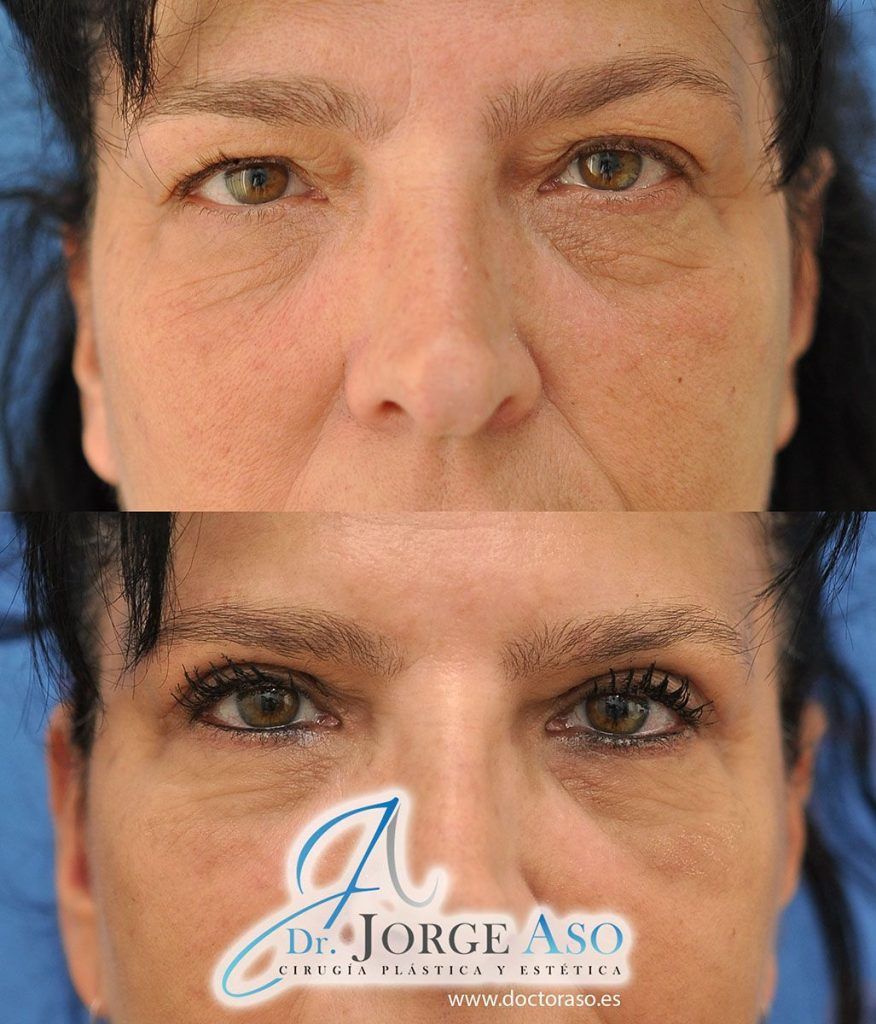
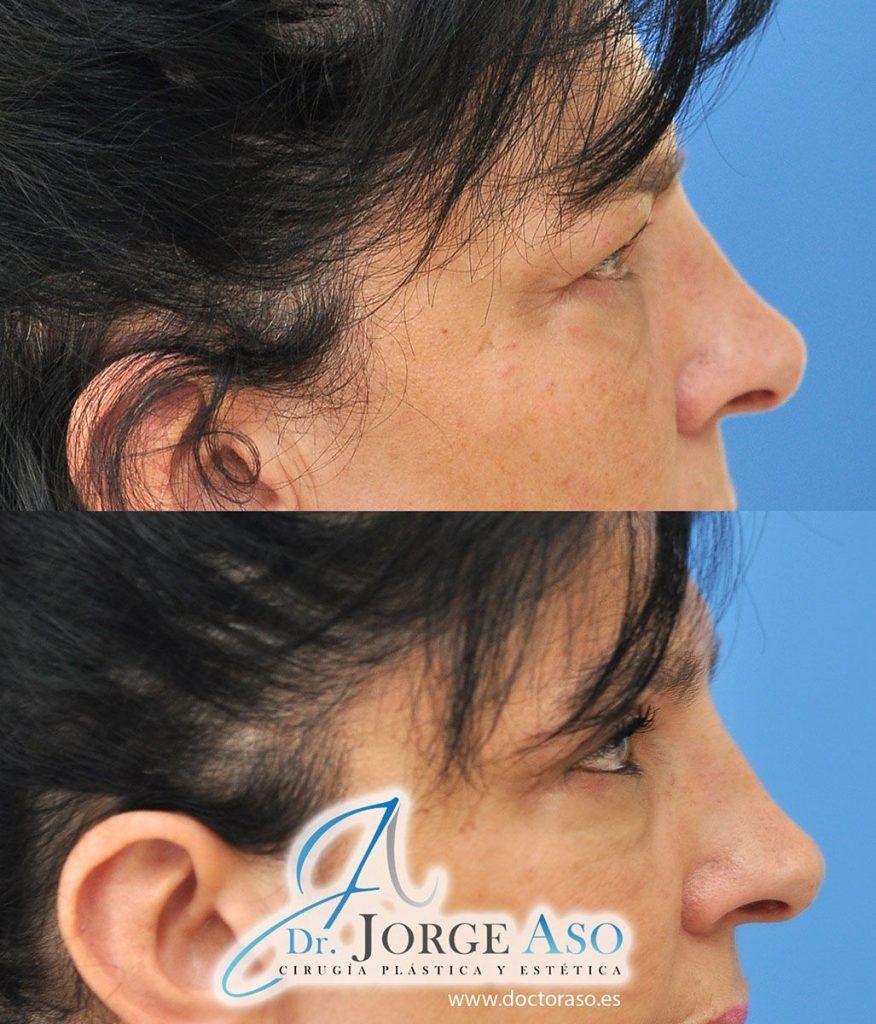
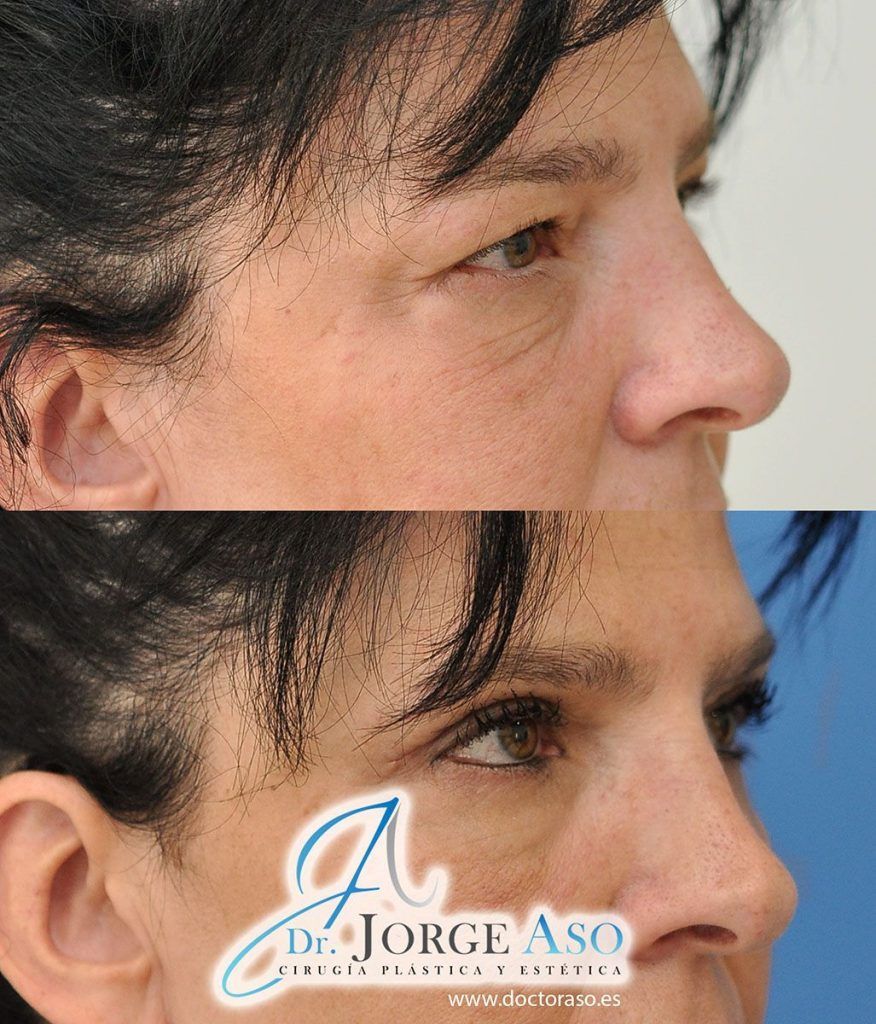
Photographs of a real patient. These images are illustrative and do not guarantee an identical result. The full gallery will be updated as more cases become available using a consistent photographic protocol.

Supporting recovery
Hilotherapy from the outset
We use Hilotherapy in almost all our blepharoplasties. This system provides constant, controlled cooling, starts after surgery, and can be taken home.
We recommend using it for as many hours as possible during the first 48–72 hours. In our experience, it improves comfort and reduces early swelling, making the return to social activities easier. Early clinical evidence is encouraging, but it does not replace rest, medication, or follow-up.
Anesthesia and setting
The setting depends on the procedure
Standalone upper blepharoplasty can be performed under local anesthesia, with or without sedation, at HLA Moncloa University Hospital or in our clinic’s equipped operating room. We perform lower and combined upper/lower blepharoplasty under general anesthesia in hospital, with same-day discharge.
HLA Moncloa has 14 operating rooms for major surgery, a post-anesthesia recovery unit, and 13 intensive care beds; its Intensive Care Unit is accredited to train specialists through Spain’s MIR residency program.
- Upper lids only
- Local · clinic or hospital
- Lower lids
- General · hospital
- Upper and lower lids
- General · hospital
- Hospital stay
- Same-day discharge
A realistic timeline
Recovery after blepharoplasty
Swelling or bruising is usually more noticeable than pain at first. Recovery depends on whether the upper lids, lower lids, or both are treated.
- First 48–72 hKeep your head elevated and use controlled cooling, eye drops, and artificial tears as instructed. We do not schedule a routine review during this period if recovery is progressing normally.
- 5–7 daysThe usual first review and removal of upper-lid stitches. Many people return to office work, although some bruising may still be visible.
- ≈1 weekDriving may resume when vision is comfortable, tearing is not limiting, and you are not taking medication that impairs reactions.
- 2 weeksContact lenses after upper-lid surgery and gentle exercise, depending on recovery.
- ≈1 monthContact lenses after lower-lid surgery and a gradual return to strenuous exercise.
- 6–12 monthsFull scar maturation and final assessment of the result.
severe eye pain, a change in vision, increasing bleeding, marked difficulty closing the eye, or any symptom that concerns you. These symptoms require prompt assessment.
Suitability and expectations
Who may benefit?
There is no universal minimum age. What matters is the anatomical change, eye health, and a goal of improving a specific feature, rather than seeking someone else’s eye shape or unattainable perfection.
Often suitable
- Genuine excess upper-lid skin.
- Visible lower-lid bags.
- A clearly identified tired appearance.
- Natural-looking expectations.
- Stable eye health.
Requires particular assessment
- Significant dry eye.
- Thyroid disease or glaucoma.
- Recent eye surgery.
- Marked lower-lid laxity.
- Anticoagulation that cannot be safely managed.
- Brow or eyelid ptosis.
Clinical transparency
Our experience with more than 1,000 blepharoplasties
Our internal records do not document hematomas requiring surgical review, ectropion or retraction requiring correction, significant infections, permanent dry eye, or serious visual complications. This describes our experience and does not mean that risk is zero.
The issues we most often see are swelling, visible bruising, and temporary dryness. Serious complications are very rare, but patients need to understand them and preventive measures.
Temporary dry eye
This can last weeks and, in some cases, months. To date, we have not recorded permanent cases.
Temporary double vision
This resolved spontaneously within two weeks, without additional treatment.
Aesthetic refinement
Removing a little more skin or correcting a residual bag. This is distinct from a medical complication.
Reoperations for hematoma
A figure from our internal series to date.
These approximate figures come from an internal clinical record. They are not a comparative trial and do not predict individual risk. Patient selection, technique, and follow-up remain essential.

Experience and facial assessment
Meet Dr. Aso
I perform more than 50 blepharoplasties per year and have performed more than 1,000 to date. This experience includes standalone upper-lid surgery, transconjunctival lower-lid approaches, and combined procedures with fat grafting or canthopexy.
Assessing the eye area as a plastic surgeon allows me to consider the eyelids, brows, cheeks, volume, and eye shape together. Sometimes a very limited blepharoplasty is best; at other times, we must recognize that the main concern is not the eyelid.
Indicative pricing
How much does blepharoplasty in Madrid cost?
Your final quote depends on the eyelids treated, anesthesia, and additional procedures. These figures provide a guide before assessment.
Local anesthesia, with or without sedation, and the recommended follow-up.
A transconjunctival approach, anesthesia, and a hospital setting.
Upper and lower lids in one procedure.
Fat grafting, canthopexy, dermatological treatment, and Hilotherapy may carry additional costs when indicated.
A useful conversation
We answer your questions before discussing surgery
A tired appearance can come from skin, bags, brows, volume loss, or dryness. The consultation helps distinguish these causes and explain what could realistically change in your case.
A complete facial assessmentEyelids, brows, cheeks, symmetry, and the ocular surface.
An individualized planUpper, lower, combined surgery, or a more suitable alternative.
Clear recovery advice and pricingIncluding any potential complementary procedures.
Initial assessment
Tell us what concerns you about your eyelids
During consultation, we assess the upper and lower eyelids, brows, lid–cheek junction, and eye health. We then explain which technique may support a natural-looking result and what should be avoided. The first consultation costs 100 EUR.
Planning your visit from abroad. For patients exploring eyelid surgery in Spain, the assessment should include existing eye-health concerns as well as appearance. An initial consultation in English can help start that discussion. Before traveling to Madrid, agree the in-person examination, postoperative reviews and follow-up arrangements; a general recovery timeline is not clearance to fly. Read our international patient guide.
We listen to your goalsTiredness, bags, skin, shape, or asymmetry.
We assess the whole eye areaThe diagnosis is not limited to skin.
We create a proportionate planTechnique, anesthesia, recovery, and pricing.
In the form, select “Another treatment or general question” and mention blepharoplasty in your message.
Frequently asked questions
Questions about blepharoplasty
Does blepharoplasty change eye shape?
It should not when that is not the goal. A conservative technique aims to rejuvenate without changing expression. If someone deliberately wants a more elongated eye shape, that is a different discussion and may involve canthopexy.
Does lower blepharoplasty leave a visible scar?
In our practice, we always use a transconjunctival approach from inside the eyelid. This does not leave a lower-lid skin scar. An external skin pinch is reserved for selected cases and is very conservative.
When are the stitches removed?
Upper blepharoplasty stitches are usually removed at the 5–7-day review. Transconjunctival lower blepharoplasty has no visible skin stitches.
How long does recovery take?
Many people return to office work after 5–7 days, although some bruising may remain. Driving is often possible around one week; gentle exercise resumes at approximately two weeks and strenuous exercise around one month, depending on recovery.
When can I wear contact lenses?
As a guide, around two weeks after upper blepharoplasty and approximately one month after lower blepharoplasty. Dryness and eye comfort take priority over the calendar.
Can dry eye develop?
Yes. In our experience, up to 15% report temporary dryness, which may last weeks or months. We have not recorded permanent dryness, but pre-existing dry eye requires particularly careful assessment.
Is it better to remove or reposition the fat in under-eye bags?
There is no universal answer. We perform lower blepharoplasty through a transconjunctival approach and rarely reposition fat. We often prefer to combine it with fat grafting at the lid–cheek junction to avoid a hollow appearance.
Is Hilotherapy included?
It is optional and carries an additional cost. We start it immediately after surgery, and you can take the equipment home to use for as many hours as possible during the first 48–72 hours.
Can blepharoplasty improve my visual field?
When excess upper-lid skin genuinely obstructs the visual field, removing it may offer a functional improvement. Not all cosmetic blepharoplasty has this component. Any visual limitation should be documented and distinguished from other eye conditions.
When will I see the final result?
Improvement is visible early, but swelling and scars continue to change. We review patients at one month and three months, with a useful final assessment between 6 and 12 months.
Sources and transparency
This page combines published evidence, clinical experience, and Dr. Jorge Aso’s own protocol. Internal figures are approximate and do not guarantee an individual result.
- Safety and Complications in Lower Eyelid Blepharoplasty: A Systematic Review
- Cosmetic blepharoplasty and dry eye disease: a review of the incidence, clinical manifestations, mechanisms and prevention
- Eyelid edema reduction following blepharoplasty: a 3D imaging-based pilot study on the efficacy of Hilotherapy
- American Society of Plastic Surgeons: eyelid surgery recovery
- HLA Moncloa University Hospital
Medical authorship

Specialist in Plastic, Aesthetic and Reconstructive Surgery (Spanish MIR training)
Medical registration no. 2828/61062 · Madrid
About Blepharoplasty in Madrid: clinical information, safety and expectations. Based on the original Spanish content.
Translation does not constitute a new medical review. This information does not replace an individual medical assessment.
View profile, training and credentialsMedical sources and editorial standards Selected references for this page 5 references
References support the general medical information. Suitability, alternatives, and risks are discussed individually during consultation.
- Safety and Complications in Lower Eyelid Blepharoplasty: A Systematic Review PMC
- Cosmetic blepharoplasty and dry eye disease: a review of the incidence, clinical manifestations, mechanisms and prevention International Journal of Ophthalmology / PMC
- Eyelid edema reduction following blepharoplasty: a 3D imaging-based pilot study on the efficacy of Hilotherapy PMC
- Eyelid surgery recovery American Society of Plastic Surgeons
- HLA Moncloa University Hospital HLA Hospital Group

Selected interviews, mentions and third-party articles. Coverage is in Spanish.