
Tissue-preserving breast surgery · Madrid
Preservé Mastopexy in Madrid, Spain
A breast lift with implants for selected patients with mild or moderate sagging: controlled tissue expansion, prepectoral Ergonomix2® implants and a breast lift tailored to your anatomy.
- Around 90 minutes on average
- Usually home about 3 hours afterward
- No routine drains or compression dressings

The short answer
Can Preservé be used to lift sagging breasts?
Yes, but not for every patient. Preservé can be combined with a breast lift when sagging is mild or moderate, the breasts are not too large or heavy, and the tissues provide adequate coverage for an implant above the chest muscle.
We call this combination Preservé Mastopexy or Preservé-pexia and begin by creating the implant space through controlled expansion, then inserting the implant using a no-touch technique. We then lift the breast and remove only the excess skin and tissue.
The aim is not a substantial increase in size. We seek to improve the position, firmness, upper-breast fullness and natural movement of breasts affected by sagging, laxity or loss of volume. The final size may be similar to the starting size, around one cup size larger at most as a general guide, or even slightly smaller if that is your preference.
Careful patient selection
Who may benefit from Preservé-pexia?
A suitable candidate wants a meaningful improvement in position, shape and upper-breast fullness, rather than a large increase in size. Typically, the breasts have mild or moderate sagging, are not heavy and have adequate tissue coverage in all areas.
Limited sagging
Grade I or II ptosis in a breast that allows a limited reshaping procedure.
Adequate coverage
A pinch test is assessed in all quadrants. Our practical minimum is approximately 1.5 cm; around 2 cm provides a greater margin of coverage.
Moderate volume
A preference for a modest implant size and a natural appearance, including when the breasts move.
An introductory guide
Degrees of breast ptosis
The classification is based on nipple position relative to the breast crease, shown by the blue dashed line. A photograph alone cannot determine suitability: breast weight, tissue coverage, lower-pole length and skin quality also matter.

The nipple is level with or slightly below the crease, but still above the lowest point of the breast.
The nipple is clearly below the crease, but is not yet at the lowest point of the breast contour.
The nipple is at the lowest part of the breast and often points downward.
When we consider it
Potential indications
- Nipple level with or above the crease: MIA or Preservé alone may be sufficient. Where there is laxity, this may be an interim option before a future breast lift.
- Grade I ptosis: Preservé-pexia may be suitable if tissue coverage and breast weight are appropriate.
- Grade II ptosis in a breast that is not heavy: one of the more promising indications in our early experience.
- Pseudoptosis: assessed individually, because nipple position alone does not tell the whole story.
When we choose another approach
Not our preferred technique for
- Substantially sagging or heavy breasts, or grade III ptosis.
- Insufficient tissue coverage for a prepectoral implant.
- Patients who will not stop smoking for the required period.
- Marked asymmetry requiring different implants or individually designed pockets.
- Previously irradiated breasts or patients seeking a large implant.
Implant first · breast lift second
How do we perform Preservé Mastopexy?
The order matters: the implant is positioned and its pocket closed off before the breast lift incisions are made. This keeps the tissue-preserving approach while allowing a true lift.
-
01
Infiltration and preparation
Local anesthetic is infiltrated into the breast. Although most procedures use general anesthesia, this supports pain control during surgery and the early postoperative period.
-
02
Controlled expansion
A dedicated balloon creates the prepectoral pocket by expanding the tissues in a controlled way. The pectoral muscle is left intact, and we aim to preserve the medial and lateral nerve supply.
-
03
Implant insertion: no-touch technique
We insert the Ergonomix2® implant using the dedicated system, without handling it directly. It sits beneath the anterior lamella, an anatomical tissue layer that provides containment. At this point, a scar-tissue capsule has not yet formed.
-
04
Closed-off implant pocket
We complete and close off the pocket before starting the lift. The breast lift wounds do not communicate with the pocket, and the implant is not exposed again during the procedure.
-
05
Lifting and reshaping
Excess skin is removed, along with a moderate amount of fat or glandular tissue if needed. The areola is lifted on a superior or, more commonly, superomedial pedicle. Bipolar coagulation can slightly contract the anterior lamella, and barbed sutures are used to complete the closure.
An important qualification
A careful surgical sequence does not mean zero risk
Closing off the implant before tissue removal may have a technical advantage in reducing contamination, but it does not make infection impossible. No infections were observed in our first 12 patients; the series is still too small to establish a comparison.
What we aim to preserve
Less internal dissection, with a true breast lift
Less dissection
Tissue expansion instead of extensive dissection of the implant pocket.
Pectoral muscle left intact
Avoids placing the implant beneath the muscle, where muscle contraction can distort its shape.
Nerve supply
An approach intended to respect medial and lateral nerves, although moving the nipple still carries a risk of sensory changes.
Natural movement
Prepectoral Ergonomix2® placement, in the same general plane as the breast gland.
Recovery
An early return to everyday movement in our initial experience, without a submuscular pocket.
Day-case protocol
No routine drains or compression dressings, with discharge usually on the same day.
These points describe our protocol and early clinical experience. They do not demonstrate superiority over every other breast lift technique.
Scars help shape the result
A mini-T is our most frequent choice
For most Preservé-pexia procedures, we use a scar around the areola, a vertical line and a short horizontal section in the breast crease.
The short horizontal component has a purpose: it allows better shortening and rounding of an elongated lower pole and can help stabilize the implant. It lies in the new crease and is often the least visible part of the scar.
Mini-T
Our usual choice to control and round the lower pole.
Circumvertical
For very mild ptosis, an already short lower pole, a small lift or a minimally tuberous component.
Implant size and tissue removal
Long-term planning favors a moderate implant
The newly lifted skin and tissues will need to support the implant for years. This technique therefore aims for proportion rather than a large increase in size.
- 175–300 cc
- Implant range used in our initial patients
- 250 cc
- Approximate median implant volume
- ≤280 cc
- Usual recommendation; 300 cc only in selected anatomy
- 50–200 g
- Typical tissue removal per breast in selected candidates
Grams and cubic centimeters can be numerically similar because of tissue density, but they are not interchangeable units. Final breast size cannot be calculated simply by subtracting removed tissue from implant volume: shape, projection and distribution also affect appearance.
Three different indications
Preservé, Preservé-pexia or a conventional breast lift
Comparison of 3 techniquesSwipe to compare→
| Feature | Preservé alone | Preservé-pexia | Conventional breast lift |
|---|---|---|---|
| Aim | Add volume without actually lifting the nipple | Lift mild or moderate sagging and add a modest amount of volume | Correct substantial sagging or more complex reshaping needs |
| Candidate | No clear breast ptosis | Grade I–II ptosis, breasts that are not heavy and adequate tissue coverage | Advanced ptosis, heavy breasts or complex anatomy |
| Implant plane | Prepectoral, using tissue expansion | Prepectoral, using tissue expansion | Individualized; we often use submuscular placement when adding an implant |
| Scar | Small incision in the breast crease | Circumvertical or, more commonly, a mini-T | Vertical or inverted-T, depending on the case |
| Indicative implant volume | Usually 200–320 cc | 175–300 cc; usually 280 cc or less | More variable, depending on goals and coverage |
| Usual anesthesia | Sedation and local anesthesia | General anesthesia, as a day case | General anesthesia |
| Recovery | Usually rapid in suitable patients | Closer to Preservé alone in our initial experience | Often slower where more dissection or a submuscular pocket is needed |
Unsure about the tissue-preserving augmentation options? See our comparison of MIA Femtech and Preservé.
Anesthesia and discharge
Usually a day-case procedure under general anesthesia
We perform most Preservé-pexia procedures under general anesthesia, with an anesthesiologist and full hospital facilities. This provides controlled conditions for tissue removal, reshaping and assessment of symmetry while you are asleep.
General anesthesia does not necessarily mean an overnight stay. If recovery and medical checks are satisfactory, discharge is usually around three hours afterward.
Our clinical impression
Recovery has been closer to Preservé alone than we expected
Our initial patients have returned to everyday movement in a way more similar to Preservé alone than to a conventional lift with a submuscular implant. We have observed less pain and lower use of pain medication than with our conventional technique. These are nonrandomized observations from our own practice, not a comparative clinical trial.
Early gentle movement
Gentle walking and raising the arms to head level, unless advised otherwise. No lifting heavy objects.
Automatic transmission
Typical return to office work during the first week, depending on recovery.
Manual transmission
Drive only when you can react without pain and are no longer taking medication that impairs alertness or reactions.
Gradual return to exercise
Wear the recommended bra during the first month. Exercise can usually restart progressively after that if healing is satisfactory.
An outline of our postoperative protocol
- An upper-breast band may be used according to the initial implant position, usually for one or two weeks.
- Sleep on your back for one month; avoid sleeping on your stomach until three months.
- Do not massage the breasts or implants directly.
- A slightly high implant position in the first days can be part of normal settling and does not necessarily mean persistent malposition.
Internal clinic data · August 2026
Our early clinical experience
The findings are promising but very preliminary. We distinguish what we have observed from what cannot yet be concluded.
Experience behind the approach
A new technique needs breast surgery experience—and judgment about when not to use it
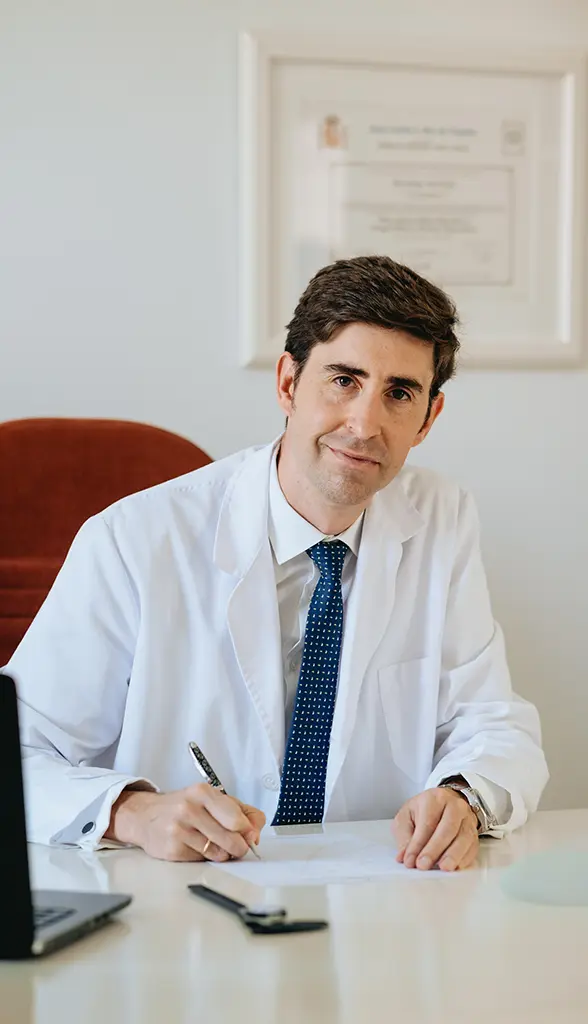
Dr. Jorge Aso is a specialist in Plastic, Aesthetic and Reconstructive Surgery through Spain’s MIR training system and holds a doctorate in Medicine awarded cum laude. According to the clinic’s internal records, he performs more than 500 aesthetic breast operations a year and has performed more than 4,000 breast augmentations.
Preservé Mastopexy is not simply adding a lift to Preservé. Planning involves deciding which tissues to preserve, how far to lift, which scar pattern will best stabilize the lower pole and when a conventional lift is likely to be more appropriate. Dr. Aso assesses these limits personally and recommends another approach when tissue coverage, breast weight or the degree of sagging makes Preservé-pexia unsuitable.
Surgical volume figures come from the clinic’s internal records. The specific experience of 12 Preservé-pexia procedures remains preliminary and is presented with its limitations below.
- 12
- Preservé-pexia procedures
- 6 months
- Median follow-up
- 1 year
- Maximum follow-up
- 12/12
- Reported satisfaction
- 0
- Repeat operations
This series describes Dr. Aso’s experience; it is not a comparative study. Twelve patients with a maximum follow-up of one year cannot establish definitive complication rates or prove superiority over a conventional breast lift.
What did occur
One superficial wound separation
One patient developed a small, clean, uninfected opening below the areola. It healed in approximately two weeks with wound dressings, without additional sutures or another operation.
Not observed in this initial series
- Infections
- Hematomas requiring treatment
- Clinically significant seromas
- Skin or areolar necrosis
- Implant exposure
- Capsular contracture
- Persistent implant malposition
- Repeat operations
Nipple sensation
Expansion preserves tissue, but the lift moves the areola
The pedicle—usually superomedial—maintains the connection to the nipple–areola complex, but does not eliminate the risk of sensory changes. No complete loss of sensation occurred in this series.
Most sensory changes have been improving, but we cannot yet quantify final recovery or permanent changes. Our impression that sensation might fare better than with the conventional technique remains a clinical hypothesis, not a proven advantage.
A balanced explanation of risk
What complications are possible?
Preservé-pexia is still a breast lift with implants. Possible complications include delayed healing, sensory changes, widened scars, asymmetry, infection, hematoma, seroma, implant malposition, capsular contracture, implant rupture and renewed sagging over time.
Careful selection, limiting implant weight, preserving tissue and monitoring recovery are central to the approach. They do not remove the risks. For further implant context, see our article on MIA and Preservé safety.
What we know about the longer term
The new element is how the pocket is created and combined with a lift
In the medium and long term, the patient still has an Ergonomix2® implant with a SmoothSilk® surface above the muscle, with the benefits and risks associated with breast implants.
We were already using this implant family in our practice before introducing Preservé. The newer elements are controlled expansion, the dedicated instruments and combining this approach with a limited breast lift.
Skin quality, implant weight, pregnancy, substantial weight changes and aging will continue to affect the breasts. AEMPS advises that breast implants require informed decision-making and long-term follow-up · Spanish.
Allowing time to assess results
Specific cases will be shown after at least one year of follow-up
We are not presenting specific Preservé-pexia photographs at this stage. We prefer to wait for comparable images and a year of follow-up before showing those results as sufficiently mature.
In the meantime, the general gallery illustrates how breast lifts can change position, upper-breast fullness and scars. These cases may involve other techniques and should not be interpreted as Preservé-pexia results.
View the general breast lift gallery · Spanish Clinical photographs are illustrative. Every patient’s anatomy, procedure and recovery are different.Questions from our consultations
Frequently asked questions about Preservé Mastopexy
Brief answers about what this technique may offer, its limitations and the decisions that require an individual assessment.
Can Preservé lift the breasts?
Preservé alone adds volume but does not truly lift the nipple. For mild or moderate ptosis, it can be combined with a limited breast lift; this combination is called Preservé-pexia.
Is it a scar-free breast lift?
No. A true lift requires skin removal and adjustment. The scar is usually circumvertical or, more often in our practice, a mini-T with a short horizontal section in the breast crease.
Why do you usually prefer a mini-T?
It allows the lower pole to be shortened and rounded and can add some implant stability. The short horizontal section lies in the crease and is often the least visible part.
Can a breast lift use only a scar around the areola?
A periareolar scar can adjust a very small amount of skin, but we do not consider it adequate for genuinely lifting a sagging breast. Pushing this approach too far can widen the areola, flatten the breast and put excessive tension on the scar.
What implant sizes are used?
Our initial series used 175–300 cc implants, with an approximate median of 250 cc. We usually recommend no more than 280 cc, as a moderate implant helps limit the load on the tissues over time.
Will my breasts be larger?
They may be slightly larger, similar in size or even smaller. The main aim is to improve shape, position, firmness and upper-breast fullness, not to achieve a large increase. As a general guide, we usually plan no more than around one additional cup size.
Is sedation or general anesthesia used?
Very limited adjustments, involving approximately 1–2 cm of lift, may use sedation in selected patients. Most procedures use general anesthesia as a day case, with discharge usually around three hours afterward if medical criteria are met.
Are drains or compression dressings needed?
We do not routinely use drains or compression dressings in this protocol. As with any surgery, an unexpected complication could require a change of plan, although this did not occur in our initial series.
When can I return to work and drive?
Office work usually resumes during the first week. As a guide, automatic driving may be possible after 7 days and manual driving after 10–12 days, provided you can react without pain and are not taking medication that impairs your reactions. Individual advice takes priority.
When can I exercise or raise my arms?
We allow raising the arms to head level from the first day unless advised otherwise. This does not mean lifting weight. Exercise usually resumes progressively from the first month if healing is satisfactory.
Could I lose nipple sensation?
Reduced sensation or increased sensitivity can occur. No complete loss of sensation occurred in the first 12 patients, but the series is small and follow-up is short. Moving the nipple on a pedicle means full preservation cannot be guaranteed.
Can it be performed after a breast lift without implants?
Yes, in selected cases. We have added a small implant using Preservé after a previous lift and, in some cases, performed another lift. This is a more complex indication requiring assessment of previous scars and blood supply.
Can I have surgery if I smoke?
Our protocol requires stopping smoking for at least two weeks before and two weeks after surgery; we prefer one month before and one month after. We do not offer this technique if a patient will not stop.
Could it affect future breastfeeding?
Yes. A breast lift moves the nipple–areola complex and may remove breast tissue, which can make breastfeeding more difficult or reduce milk production. If future breastfeeding is a priority, discuss this during your consultation so that timing and alternatives can be considered.
Is it better than a conventional breast lift?
No technique is best for everyone. Preservé-pexia may involve less internal dissection and relatively quick recovery in breasts with limited sagging. A conventional lift is more suitable for substantial sagging, heavy breasts, inadequate coverage or complex reshaping.
How long will the results last?
We aim for lasting results with careful selection and a moderate implant, but our follow-up is not yet long enough to provide a specific estimate for this technique. Skin, weight, pregnancy and aging continue to affect the breasts.
How much does Preservé Mastopexy cost?
The usual indicative range is approximately 9,500–10,500 EUR. It generally costs more than Preservé alone because it includes a breast lift, more operating time and usually day-case general anesthesia. The final quote is confirmed after an in-person assessment.
Medical information from Dr. Jorge Aso Clinic
Adapted from the clinic’s Spanish Preservé Mastopexy guide, including its internal clinical series reported in August 2026. The observations described are preliminary, not comparative evidence or a guarantee of results.
Dr. Jorge Aso: qualifications and experience · Compare breast surgery options
This guide does not replace an individual examination, informed consent or your surgeon’s instructions.
Why consider Dr. Aso Clinic?
Knowing when a technique is appropriate matters as much as offering it
For an operation so dependent on suitability, the aim is not to offer Preservé to every patient. It is to identify when the approach may offer a meaningful benefit compared with a conventional breast lift.
Personal assessment by your surgeon
Dr. Aso assesses sagging, breast weight, coverage, asymmetry and the result you want before recommending an approach.
Experience with the alternatives
We can discuss Preservé-pexia, Preservé alone and conventional breast lift surgery without forcing a single solution onto different anatomy.
Hospital care and specialist anesthesia
The procedure is usually performed under general anesthesia in a hospital, with same-day discharge if recovery is satisfactory.
Clinical and ultrasound follow-up
We assess healing, implant position and integrity, with ultrasound at each scheduled review in our protocol.
A promising approach for a specific indication
Your consultation determines whether this approach is enough
Where sagging is mild or moderate, the breasts are not heavy and tissue coverage is adequate, Preservé-pexia may improve position, firmness and upper-breast fullness without a large implant.
An in-person examination allows us to assess sagging, the pinch test, lower-pole length and asymmetry, and to compare this option with Preservé alone or a conventional lift.
Start with a consultation in English
Dr. Aso speaks native-level English and has trained in the United States. Our team can help by email or WhatsApp in English.
First consultation: 100 EUR. Choose a video consultation to discuss your goals before traveling, or an in-person appointment in Madrid. Final suitability for Preservé Mastopexy requires an in-person examination.
Before booking travel, agree your required stay in Madrid and the plan for follow-up, ultrasound reviews and access to care after returning home with the clinic. Recovery milestones are not automatic clearance to fly.

Selected interviews, mentions and third-party articles. Coverage is in Spanish.
Medical authorship
Specialist in Plastic, Aesthetic and Reconstructive Surgery (Spanish MIR training)
Medical registration no. 2828/61062 · Madrid
About Preservé Mastopexy in Madrid: clinical information, safety and expectations. Based on the original Spanish content.
Translation does not constitute a new medical review. This information does not replace an individual medical assessment.
View profile, training and credentialsMedical sources and editorial standards Selected references for this page 5 references
References support the general medical information. Suitability, alternatives, and risks are discussed individually during consultation.
- Patient information on breast implants Spanish Agency of Medicines and Medical Devices (AEMPS)
- Establishment Labs Launches Preservé Establishment Labs
- Breast ptosis. Definition and treatment Clinics in Plastic Surgery / PubMed
- A systematic review of single-stage augmentation-mastopexy Plastic and Reconstructive Surgery / PubMed
- The Study of the Safety and Effectiveness of Motiva SmoothSilk Silicone Gel-filled Breast Implants: 5-Year Clinical Data Aesthetic Surgery Journal / PubMed