
Breast Surgery · Madrid
Breast lift in Madrid, Spain
With or without implants. Mastopexy lifts and reshapes sagging breasts. It can be performed using the patient's own tissue, combined with implants, or, in selected candidates, planned using Preservé Mastopexy. The technique is decided based on the degree of sagging, volume, coverage, and tissue quality.
- With or without implants
- Scarring adapted to the degree of sagging
- Individualized surgical plan
Lifting and reshaping
What is a mastopexy and what can it correct?
Mastopexy—also called a breast lift or breast uplift—is the surgery that repositions the nipple-areola complex, removes excess skin, and reshapes the tissue to correct breast sagging. It can be performed after pregnancy and breastfeeding, weight loss, or changes associated with aging and tissue quality.
It does not simply consist of "raising the nipple." We also consider the existing breast volume, loss of fullness in the upper pole, an elongated lower pole, and skin that has already shown a tendency to stretch. That is why two patients with similar sagging may require different techniques.
In our practice, we differentiate three main approaches: mastopexy without implants, reshaping the patient's own tissues and, when indicated, adding lipofilling; classic mastopexy with implants, frequently submuscular and reinforced by PEF + internal bra; and Preservé Mastopexy for mild or moderate sagging with favorable anatomy. None is best for all patients.
The appearance of a sagging breast usually combines two phenomena. Knowing which one predominates guides whether it is advisable to provide volume, redistribute the patient's own tissue, or do both.
Loss of volume
The breast can become empty, especially in the upper pole and cleavage, even if the amount of skin has not changed to the same extent.
Skin and soft tissue distension
The envelope loses firmness, the lower pole lengthens, and the nipple-areola complex descends. The weight of the breast and the quality of those tissues condition future stability.
The goal is to build a more proportionate and better-positioned shape, explaining from the beginning the necessary scars and the limits imposed by anatomy, gravity, and tissue evolution.
Initial evaluation
How do we decide which type of mastopexy each patient needs?
In the first consultation, Dr. Aso studies the position of the nipple relative to the fold, the weight and volume of the breast, the length of the lower pole, the coverage, the skin quality, asymmetries, and previous scars. These measurements allow for an honest comparison of what each technique can provide.
Lack of volume. If the breast has become empty, especially in the upper pole, we can consider an implant or lipofilling in addition to lifting it.
Sufficient volume, but sagging. When the size is adequate, we can reshape the patient's own tissue using autologous flaps and avoid an implant.
If a mastopexy with implants is planned, we use measurements, sizers, and 3D simulation to compare volumes and proportions. The simulation helps to visualize the change with clothing and to explain what an implant can achieve, but it does not exactly reproduce scarring or tissue evolution.
Two patients with similar measurements may prefer very different results. The final decision is shared: the surgeon defines an anatomically reasonable range and the patient participates in the choice of shape and volume.


The scar builds the shape
What scar does a mastopexy leave?
There is no mastopexy capable of truly lifting a sagging breast without leaving scars. The necessary length depends on the excess skin, how much the areola needs to be moved, and the shape we need to build. Choosing a scar that is too short for significant sagging can worsen the shape and subject the tissues to unnecessary tension.
Around 85% of our mastopexies use a mini-T or an inverted T. We present this figure as experience from our practice: it does not mean that all patients need the same scar, but rather that we prefer the pattern that allows for good control of the lower pole rather than promising a minimal scar at any price.
Patterns we use
01 · No horizontal section
Circumvertical
The scar surrounds the areola and descends vertically to the fold. It can fit limited sagging and already short lower poles.
02 · Intermediate length
Mini-T
Adds a short horizontal section, hidden in the fold, to the scar around the areola and the vertical one. It allows for better rounding and control of the lower pole.
03 · Greater length
Inverted T
The horizontal section extends to both sides of the fold. It is common when there is more excess skin, a heavy breast, or a more extensive reshaping.
The coral line represents the scar. The drawings are schematic: the exact length is adapted to the anatomy and excess skin of each patient.
In our practice, we routinely treat scars with early laser. Laser treatment and the special bra are not included in the published prices.

Mastopexy in Madrid
The best scar is not necessarily the shortest: it is the one that allows the breast to be reshaped with less tension and is located in predictable places. The indication is explained before deciding, with examples of comparable cases.
Technique and safety
How is the breast lift procedure carried out?
The procedure is usually performed under general anesthesia and lasts approximately between 1.5 and 4 hours, depending on the degree of sagging, whether implants are used, the amount of tissue to be reshaped, and the complexity of the asymmetries.
Without implants, we can redistribute the patient's own tissue using autologous flaps fixed to the muscle and complement the upper pole or cleavage with lipofilling. With implants, we individualize the surface, shape, volume, and plane; in most of our submuscular mastopexies, when there is sufficient skin, we use PEF + internal bra.
Careful tissue handling seeks to preserve vascularization and sensitivity, but no technique eliminates the risks of scarring, sensory changes, asymmetry, or new distension over time.

The technique is adapted to the anatomy; we do not force all patients into the same pattern.
Classic mastopexy is performed in a hospital with an anesthesiologist, specialized nursing, ward admission, and availability of intensive care. Both with and without implants, we usually maintain a one-night stay. Preservé Mastopexy follows a different protocol and is usually outpatient.
Proprietary technique · Presented at SECPRE 2026
PEF: How we extend the lower coverage of the implant
In a mastopexy with implants, the lower pole is one of the most difficult areas to keep stable because the coverage of the pectoral muscle ends there. Dr. Jorge Aso has developed the PEF—Pectoral Extension Flap—, a thin and wide flap of the patient's own tissue that extends that coverage and support system toward the lower part of the implant.
Combined with an internal bra, it is designed to improve the separation between the implant and the superficial planes, contribute to pocket control, and try to reduce the tendency for lower pole descent, bottoming-out, or waterfall deformity. It does not guarantee that the breast will not change again.
Read the video transcript
In a mastopexy with implants under the muscle, the pectoral muscle covers and controls the upper part of the prosthesis. But its coverage ends before reaching the lower pole, an area subjected to greater distension and poor coverage. The PEF technique—pectoral extension flap—developed by Dr. Jorge Aso, preserves a wide and very thin sheet of living autologous tissue there. Subsequently, the fold is reinforced—internal bra—and, after preparing the pocket, the implant is placed under the pectoral muscle while the PEF rises and joins the pectoral muscle, creating continuous coverage that seeks to improve lower control of the implant, avoid problems with the scar, infections, or implant exposure, giving a natural and lasting appearance to the new position of the breast.

The pectoral muscle ends
The implant is covered at the top by the pectoral muscle; it remains exposed at the bottom.

The PEF rises
The PEF rises and covers the visible lower part of the implant.

Continuity is created
Pectoral and PEF form a continuous autologous coverage over the prosthesis.
Two approaches, different indications
Submuscular PEF and Preservé Mastopexy are not two versions of the same operation
The choice does not depend on which is newer or less invasive, but on the degree of sagging, the weight of the breast, tissue coverage, and how much the patient wants to change her volume.
Classic mastopexy for more extensive lifting and reshaping
We use it primarily when the breast is more sagging, heavier, needs complex reshaping, or when coverage suggests protecting the implant under the pectoral muscle. It also allows for a greater volume increase when the anatomy permits.
- Implant under the pectoral muscle.
- PEF as an autologous extension of the lower coverage.
- Internal bra to reinforce the fold and control the pocket.
Enhancement and repositioning with a small implant
We reserve it for breasts with mild or moderate sagging, not too heavy, and with good coverage. Its main goal is to improve position, firmness, and the upper pole with a moderate Ergonomix2® implant; not to achieve a large enlargement.
- Prepectoral pocket created by controlled expansion.
- Pectoral muscle intact, without PEF or submuscular technique.
- Volume usually similar to the initial one and, as a maximum guideline, around one size larger.
They are not rival or interchangeable techniques. Having both allows for a choice between preserving and enhancing a breast with limited sagging or performing a more powerful classic lift when tissues and ptosis require it.
Individual results
Breast lift before and after in Madrid
Real mastopexy cases
Real clinical photographs. Each result depends on the starting anatomy and individual indication.

Three different approaches
Mastopexy with implants, without implants, or Preservé: which one might fit best?
Not all patients need an implant, and not all mastopexies with implants are performed in the same way. The choice depends on the available volume, sagging, breast weight, coverage, and the result to be achieved.
Mastopexy without implants
Indicated when there is sufficient volume and the main goal is to lift and reshape. We use autologous flaps fixed to the muscle to redistribute the tissue; lipofilling can complete the upper pole and cleavage.

Classic mastopexy with implants
Allows for volume recovery or increase and filling of the upper pole. In most of our submuscular pexies, if there is sufficient skin, we use PEF + internal bra to improve coverage and lower control.

Preservé Mastopexy
A different technique for ptosis I–II, non-heavy breasts, good coverage, and moderate volumes. It combines controlled expansion, prepectoral Ergonomix2®, and a true mastopexy, usually a mini-T.
View indications and limitsAvailable volume
If the breast retains enough tissue, it can be lifted and reshaped without an implant.
Desired shape
The upper pole, projection, and final size help decide if it is advisable to add volume.
Tissue quality
Coverage, weight, skin, and the lower pole condition the plane and the support system.
Indicative prices in Madrid
How much does a mastopexy cost?
The cost depends primarily on whether implants and lipofilling are used and the complexity of the reshaping. These are the current estimated figures from Dr. Aso Clinic.
If lipofilling is added, the estimated increase is about €1,500.
The higher figure may correspond to cases that also incorporate lipofilling.
Individualized price according to anatomy and complexity of the lift.
VAT included, surgical team, anesthesia, hospital, stay when applicable, implants if indicated, and clinical follow-ups.
Does not include laser treatment of scars or the special bra.
Price should not decide the technique. In consultation, we compare what result each approach can provide and what compromises it implies in volume, scars, support, and recovery.
When volume needs to be recovered
What implants do we use in a mastopexy?
The choice depends on the anatomy, the plane, and the goal. In primary mastopexy, we usually prefer classic or ergonomic implants of moderate size. Round prostheses are common when we seek to fill the upper pole; MESMO® or other surfaces with minimal friction can provide slightly more control in lax tissues, and Ergonomix2® is a valid alternative when we prioritize feel and dynamic behavior.
Anatomical implants are reserved for specific indications due to their risk of rotation. We also do not routinely use polyurethane in a simple primary mastopexy: it can be very useful in certain secondary surgeries or complex cases, but it requires specific selection.
Breast implants do not have a guaranteed lifespan and are not lifetime devices. Replacement is not automatic at ten years, but further surgery may be needed for a complication or a change in your goals. Regular follow-up remains important.
Learn more about implant follow-up
WeightA moderate volume reduces mechanical load on lax tissues.
ShapeAdapts to the upper pole, the lower pole, and the desired result.
Follow-upClinical review and imaging according to the implant and your individual care plan.

Recovery from classic mastopexy
When will I be able to work, drive, and play sports?
After a classic mastopexy, we usually maintain a one-night stay. The estimated return to the office is usually around one week and tends to be faster and less painful without implants. Individual evolution and the type of work may modify these timeframes.
Preservé Mastopexy has its own protocol and is usually outpatient; its indications and recovery are explained on its specific page.
Our protocol
Important care after a breast lift
- 01
Bra at all times. The chest band is reserved for very selected situations according to the position of the implant.
- 02
During the first month, on your back. We allow turns of approximately 20 degrees to each side. We advise against sleeping face down during the first year, unless indicated physiotherapy and with padding that avoids compressing the breast.
- 03
We do not perform direct massages on the breast or the implant because they can increase inflammation and mobility. Drainage may be indicated on the sides, armpits, arms, or abdomen. More about massage and implants (in Spanish).
- 04
We review the wounds and remove external stitches when appropriate, often around 10–14 days. Specific indications are adapted to the scar pattern.
- 05
The result will continue to change. Inflammation takes months to settle and scars continue to mature. Pregnancies, weight changes, aging, and tissue quality can modify the breast over time.
Specific experience in breast surgery
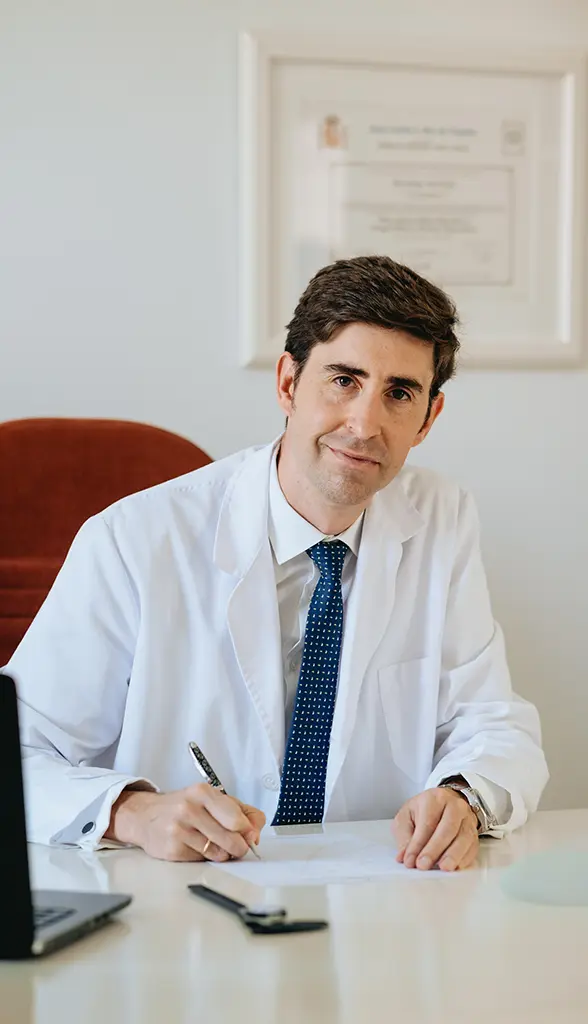
Meet Dr. Jorge Aso
Specialist trained through Spain's MIR residency system in Plastic, Aesthetic, and Reconstructive Surgery and Doctorate in medicine cum laude, Dr. Jorge Aso focuses his surgical activity especially on aesthetic breast surgery. He performs more than 500 aesthetic breast surgeries per year and has more than 15 years of experience, according to the clinic's internal records.
In a mastopexy, he personally studies the sagging, weight, and quality of the tissues, the possible scars, and the volume the patient wishes to preserve or recover. This evaluation allows for a choice between a mastopexy without implants, a classic mastopexy with implants and internal support, or, in specific candidates, a Preservé Mastopexy.
Dr. Aso has developed the PEF technique to extend the coverage and lower control of the implant with the patient's own tissue in selected submuscular mastopexies. He presented this work at the SECPRE National Congress held in Zaragoza in 2026. PEF is not a universal solution: it is part of an individualized surgical plan that can be combined with an internal bra, low-weight implants, or breast tissue remodeling.
* Volume and experience data come from the clinic's internal records, updated in June 2026.
- Specialist trained through Spain's MIR residency system in Plastic, Aesthetic, and Reconstructive Surgery.
- Doctorate in medicine cum laude from the Complutense University of Madrid.
- Registered physician 2828/61062 in Madrid.
- Professor and international speaker in aesthetic breast surgery.
Real consultation questions
Frequently asked questions about mastopexy in Madrid
Direct answers about indications, implants, scars, recovery, risks, and price.
What is a mastopexy?
It is the surgery that lifts and reshapes a sagging breast. It repositions the nipple-areola complex, removes excess skin, and redistributes the tissue to build a more proportionate shape. It can be performed with the patient's own tissue, combined with lipofilling, or incorporate an implant.
Who can be a candidate for a breast lift?
A patient with breast ptosis, good general health, reasonably stable weight, and realistic expectations. The technique depends on the degree of sagging, weight, volume, coverage, skin, asymmetries, previous surgeries, and the desired result. If the patient smokes, we require stopping tobacco for the indicated period due to the increased risk of scarring problems and necrosis.
Can a mastopexy be done without implants?
Yes. When there is sufficient volume, we can reshape and lift the breast using autologous flaps fixed to the muscle. If the patient desires slightly more filling in the upper pole or cleavage without placing a prosthesis, lipofilling can be added. Fat provides a moderate increase and is not equivalent to the volume or projection of an implant.
How much does a mastopexy cost in Madrid?
The clinic's indicative prices for mastopexy without implants or mastopexy-reduction are €6,500–€7,000; adding lipofilling is approximately €1,500 extra. Mastopexy with implants using PEF + internal bra ranges between €8,000 and €9,500, and may include lipofilling in higher-budget cases. Preservé Mastopexy ranges between €9,500 and €10,500. These include VAT and the surgical and care process; they do not include laser treatment of scars or the special bra.
Will there be visible scars?
Yes: there is no real breast lift without scars. Depending on the sagging, we use a circumvertical, mini-T, or inverted T pattern. Around 85% of our practice corresponds to mini-T or inverted T. We hardly ever use isolated periareolar because forcing a significant lift through that route can widen the areola, flatten the breast, and subject the scar to too much tension. We routinely treat scars with early laser, although their evolution also depends on each patient's biology.
What is the recovery like and when will I be able to work?
A classic mastopexy usually includes an overnight stay. Return to office work is often around one week, but the procedure, your healing, and the physical demands of your work may change this. Driving and exercise require individual clearance. If you are traveling, agree your stay in Madrid, follow-up, and return journey with the team; these general guidelines are not permission to fly.
How long do breast lift results last?
The correction can be long-lasting, but it does not stop aging or turn tissues into unalterable structures. Skin quality, breast or implant weight, pregnancies, significant weight changes, and gravity can produce new distension. Maintaining a stable weight and avoiding excessively heavy implants helps reduce mechanical load, without guaranteeing that the breast will not change again.
Can mastopexy affect sensitivity or breastfeeding?
It can produce temporary and, less frequently, persistent sensory changes. The risk increases in very sagging breasts or complex reshapes. By moving the nipple-areola complex, the ability to breastfeed may also decrease, although not all patients lose it. If a future pregnancy or breastfeeding is desired, it should be discussed before deciding on the technique.
What are the risks of a mastopexy?
Possible risks include hematoma, infection, seroma, opening or delayed healing, skin or areolar necrosis, widened scar, asymmetry, sensory changes, and thromboembolic phenomena. When implants are placed, risks such as capsular contracture, malposition, rupture, or the need for replacement are added. Selection, the hospital environment, prevention, and follow-up reduce risks but do not eliminate them.
Are PEF + internal bra and Preservé Mastopexy the same?
No. PEF + internal bra is our standard in most classic submuscular mastopexies with implants when there is sufficient skin to design the flap. Preservé Mastopexy creates a prepectoral pocket through controlled expansion and is reserved for mild or moderate ptosis, non-heavy breasts, good coverage, and moderate volumes. They are different surgical approaches.
How can I schedule a consultation?
Email info@doctoraso.es or contact us on WhatsApp. Our team can assist you in English and explain whether an initial video consultation or an in-person appointment is appropriate.
Individual evaluation in Madrid
The consultation must decide which technique fits your tissues
Dr. Aso will personally evaluate the sagging, weight, coverage, scars, and the result you are looking for to compare a mastopexy without implants, a classic one with implants, or a Preservé Mastopexy.
Contact us in English
Ask us about a video consultation or an in-person appointment. Please wait for our instructions before sending clinical photographs or medical records.
Traveling to Madrid for a breast lift?
Dr. Jorge Aso speaks English at a native level and has undertaken training in the United States. Our team can assist you in English by email and WhatsApp.
An initial video consultation can help you explore your options before traveling. An in-person examination is still needed before confirming the surgical plan. We will discuss the appropriate time in Madrid, follow-up appointments, and your return journey individually. Do not book nonrefundable travel around a general recovery timeline.
Optional premium support with Panathea
A personalized premium program is available from €2,000 in addition to your surgery. A typical program includes a personal nurse during the first postoperative week, daily visits and 24/7 contact, a relaxing massage at your accommodation before surgery, and a premium breakfast for two after discharge. 24/7 contact does not mean a nurse remains onsite continuously.
Accommodation, a chauffeur, transfers, logistics, and other services can be arranged as tailored extras. They are not automatically included in the starting price. Your written quote will specify the services and charges. This optional support does not replace medical follow-up or emergency care.
Before and after · clinical selection
Real breast lift cases
Front view comparisons showing breast lift, shape and proportion in real patients.
selected
 Before
After
Before
After
 Before
After
Before
After
 Before
After
Before
After
Real clinical cases
Real case 01
Breast lift · front view
Selected interviews, mentions and third-party articles. Coverage is in Spanish.
Medical authorship
Specialist in Plastic, Aesthetic and Reconstructive Surgery (Spanish MIR training)
Medical registration no. 2828/61062 · Madrid
About Breast Lift (Mastopexy) in Madrid | Dr. Jorge Aso: clinical information, safety and expectations. Based on the original Spanish content.
Translation does not constitute a new medical review. This information does not replace an individual medical assessment.
View profile, training and credentialsMedical sources and editorial standards Selected references for this page 4 references
References support the general medical information. Suitability, alternatives, and risks are discussed individually during consultation.
- Breast Lift Risks and Safety American Society of Plastic Surgeons (ASPS)
- Systematic review of outcomes and complications in nonimplant-based mastopexy surgery Journal of Plastic, Reconstructive & Aesthetic Surgery / PubMed
- A systematic review of single-stage augmentation-mastopexy Plastic and Reconstructive Surgery / PubMed
- Systematic Review of Patient Satisfaction Following Mastopexy Surgery Plastic and Reconstructive Surgery Global Open / PubMed