
Secondary breast surgery
Breast implant revision in Madrid, Spain
Professionalism, quality treatment, and medical rigor: a precise assessment to plan your implant change based on your anatomy, history, and desired results.
- Individual assessment
- In-hospital surgery
- Postoperative follow-up

Experience and medical judgment
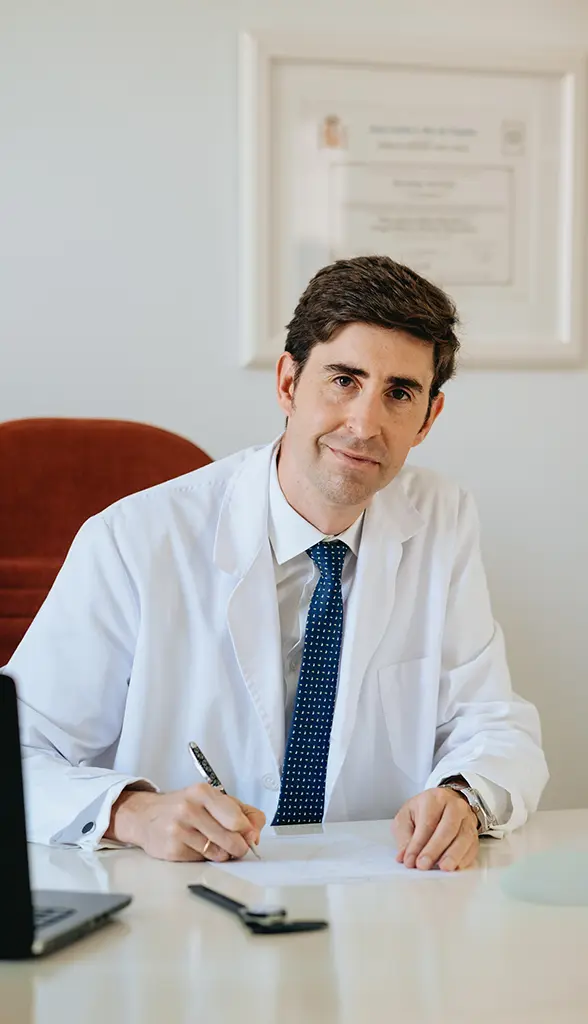
Breast implant revision with Dr. Jorge Aso
A breast implant revision surgery is as important—if not more so—than the initial implantation procedure. That is why it is essential to carefully choose the center and specialist who will study the condition of the implants, tissues, and each patient's needs.
Also known as secondary surgery, this procedure is becoming increasingly common. At our clinic in Madrid, Spain, we offer meticulous work tailored to each case so that the patient feels supported from the first consultation through postoperative follow-up.
Breast implants are not lifetime devices, and some patients will need further surgery. The need for revision is assessed individually; an implant is not replaced solely because a fixed number of years has passed.
Revision may be due to medical, functional, or aesthetic reasons. Whatever the case, we have qualified professionals, experience in breast surgery, and state-of-the-art equipment to determine the most appropriate solution.

Evaluation, planning, and surgery
What does breast implant revision surgery involve?
Revision surgery can be more complex than an initial mammoplasty because the tissues have changed following the previous procedure. One of the procedures that may be part of the treatment is a capsulectomy—that is, the partial or complete removal of the capsule that the body forms around the implant, when indicated.
The surgeon assesses the patient's expectations, the condition of the implants and tissues, the position of the pocket, and the desired result. Based on this assessment, he establishes the most appropriate technique and clearly explains its implications.
The procedure is performed in a hospital under general anesthesia. The goal is to safely remove the implants, treat the implant pocket when necessary, and place the new implants with precise planning.
History, examination, imaging tests, and patient goals.
Choice of implant and decision regarding the capsule, pocket, and possible associated techniques.
Scheduled check-ups to monitor progress and support recovery.

A recommendation for every case
When is a breast implant revision necessary?
There is no single reason. The decision is made after studying the implants, tissues, symptoms, and patient preferences.
Change in volume
Replacement with larger implants or those with a different shape and projection.
Smaller implants
Volume reduction to seek a different proportion or relieve discomfort.
Implant rupture
Detected by symptoms or, frequently, during a routine ultrasound or MRI.
Capsular contracture
Hardening of the capsule around the implant, sometimes accompanied by pain or deformity.
Unsatisfactory result
Asymmetry, displacement, or an aesthetic appearance that no longer meets expectations.
Changes over time
Breast sagging, weight changes, pregnancy, tissue aging, or loss of support.
They are not changed based on a calendar. Regular check-ups allow for a decision on whether it is best to maintain, monitor, or intervene.
Regain confidence in your body with our innovative breast augmentation treatment.
Explore your options with an individual medical assessment.
Assessment before deciding
From symptom to diagnosis: what we study before proposing a revision
An implant is not changed just because it has been in place for a certain number of years. The decision is based on symptoms, examination, documentation of the previous surgery, and necessary imaging tests.
History and documentation
Which implant you have and what surgery was performed
We review the surgical report, the implant card or passport, the date of the procedure, the access route, the placement plane, and any previous incidents.
Clinical examination
Implant, capsule, pocket, and tissues
We assess hardness, pain, changes in shape or volume, asymmetry, crease position, implant mobility, and the quality of the skin and gland.
Imaging tests
Ultrasound and, when it provides information, MRI
Ultrasound is usually a useful initial tool. If there are doubts about a silicone rupture or another finding, an MRI or another targeted test may be indicated.
Shared decision
Maintain, monitor, study, or intervene
With all the information, we explain which options are reasonable, what each can provide, and what risks or scars are involved in your case.
Technique and recovery
Drains when needed, careful implant handling, and tailored aftercare
We adapt each measure to the revision procedure and the findings in your case, aiming for careful surgery and a comfortable recovery.
Recovery tailored to your procedure
Drains are not used routinely. They may be indicated when the findings or extent of surgery make their potential benefit outweigh the associated discomfort.
In our usual revision aftercare, compression bandages are replaced by a postoperative bra and small dressings.
Drains according to clinical need
The decision depends on the tissues, capsule, and procedure performed. Drains are used when they can support safe postoperative care.
Postoperative support
A special bra and small dressings are normally used. Follow the specific instructions provided by your surgical team.
Careful handling of the new implant
When a new implant is placed, contact with the skin and other surfaces is minimized using appropriate devices and gloves as part of measures to reduce contamination.
Planning is individual: drain use and implant insertion depend on surgical findings, the technique, and safety considerations. Your aftercare is explained for your particular procedure.
We answer your questions
Surgery takes place in a hospital with a specialist team, including an anesthesiologist experienced in plastic surgery, nursing staff, and surgical support.
An overnight hospital stay is included when indicated. Hospital facilities include intensive-care support. Your individual surgical and admission plan is discussed before the procedure.
Scheduled recovery
What is the postoperative period for a breast implant revision like?
After the operation and the night of admission, if necessary, the team may prescribe pain relief for the first few days and appropriate rest so that the tissues and implants settle correctly.
Gentle activity may resume as your recovery allows. Return to work, driving, lifting, and exercise depends on the extent of revision and your healing. If you travel from abroad, agree your local stay and follow-up plan before booking a return journey.
Gentle activity only as advised by the team.
Work and routine activities depend on your progress and their physical demands.
Resume strenuous activity only after your surgeon has assessed healing.

Plastic and Aesthetic Surgery Clinic in Madrid
We answer your questions
Contact our English-speaking team to discuss an initial video consultation or an in-person appointment in Madrid. We can explain the assessment process and your individual follow-up arrangements.
Contact our English-speaking team
Please wait for our instructions before sending medical records or clinical photographs.
Your previous surgery is also part of the planWe study the starting point to propose a result that is proportionate, safe, and consistent with you.
Request a no-obligation assessment
Planning and results
Breast implant revision: before and after
The technique is selected based on the specific conditions and needs of each patient. To do this, the breast shape, tissue quality, position of previous implants, the capsule, and the patient's expectations are studied.
The before and after can show an evident change within a few weeks, with a progressive evolution toward greater symmetry and a morphology suited to the agreed goals, always within professional judgment and anatomical possibilities.
Results depend on the starting point and individual progress. Clinical photographs should be interpreted as examples, not as a guarantee of a specific result.
Individualized quote
Price of breast implant replacement
The price of a breast implant change depends on the needs and conditions of each patient. The complexity of the case, the condition of the capsule, the type of implant, and the possible need for associated techniques influence the quote.
After the assessment, we will provide you with a proposal tailored to your surgical plan, with clear information about the treatment and included follow-up.
- Simple revision: size change or rupture with no other problemsfrom €6,500
- Revision with capsule removal, without a breast lift€7,500–8,000
- Revision with a breast liftaround €8,500
- Complex cases: advanced techniques, fat grafting, special implantsover €9,000
- Laser to improve scars (optional)€400–900
Indicative prices, October 2026. All procedures are performed at Hospital Universitario HLA Moncloa.
What changes the price
The ranges above cover most cases. Within them, the price depends on:
- The manufacturer's warranty. If the problem behind the revision is covered by your implants' warranty, the revision costs €600–1,500 less. To check, bring your implant card to the consultation.
- The new implant. Special implants, such as polyurethane or anatomical ones, make the revision more expensive than standard round implants.
- The capsule. With grade III–IV capsular contracture, the capsule has to be removed (capsulectomy). This is the €7,500–8,000 range.
- Rupture. If the implant is ruptured, besides replacing it, the gel and often the capsule have to be removed.
- Lifting the breast. If the breast has dropped, the revision is combined with a breast lift, at around €8,500.
- Fat grafting or mesh. They improve coverage or support the pocket, and usually make it a complex case: over €9,000.
- Scar laser. Optional, €400–900.
You receive a written quote after the assessment and imaging tests.
Long-term safety
Check-ups, implant passport, and signs you should consult
Breast implants are not lifetime devices. This does not mean they must be changed by a fixed date, but they do require follow-up as long as they remain in place.
Planned follow-up
Periodic clinical review
Attend regular reviews with your plastic surgeon, following the schedule recommended for your implants and medical history.
Imaging based on implant and case
Ultrasound or MRI may be recommended for silicone implants, including when there are no symptoms. Your surgeon will explain the appropriate schedule for the device and your circumstances.
Keep the documentation
Keep the implant card or passport and the surgical report: they identify the manufacturer, model, and characteristics of the device.
Implant check-up in Madrid
Do you want to know the status of your implants and your options? The assessment begins with a diagnosis, not by assuming that you need another operation.Traveling to Madrid for implant revision?

Dr. Jorge Aso speaks English at a native level and has undertaken training in the United States. Our team can assist you in English by email and WhatsApp.
An initial video consultation can help you explore your options before traveling. Keep your implant card, previous surgical report, and relevant imaging available; our team will explain how to share them securely. An in-person examination is still needed before confirming the surgical plan. We will discuss the appropriate time in Madrid, follow-up appointments, and your return journey individually. Do not book nonrefundable travel around a general recovery timeline.
Optional premium support with Panathea
A personalized premium program is available from €2,000 in addition to your surgery. A typical program includes a personal nurse during the first postoperative week, daily visits and 24/7 contact, a relaxing massage at your accommodation before surgery, and a premium breakfast for two after discharge. 24/7 contact does not mean a nurse remains onsite continuously.
Accommodation, a chauffeur, transfers, logistics, and other services can be arranged as tailored extras. They are not automatically included in the starting price. Your written quote will specify the services and charges. This optional support does not replace medical follow-up or emergency care.
Frequently asked questions
Frequently asked questions about breast implant revision in Madrid
These are some of the most common questions about breast implant revision surgery, when it may be necessary, what recovery is like, and what aspects should be assessed before the procedure.
How much does breast implant revision cost in Madrid?
It depends on what needs to be done besides replacing the implant. At Dr. Jorge Aso's clinic, a simple revision, for a size change or a rupture with no other problems, starts at €6,500. If the capsule has to be removed, the price is €7,500–8,000 without a breast lift; a revision with a breast lift is around €8,500, and complex cases with advanced techniques, fat grafting or special implants are over €9,000. Scar laser is optional (€400–900). All procedures are performed at Hospital Universitario HLA Moncloa. You receive a written quote after the assessment and imaging tests; the first consultation costs €100 (€70 by video) and is deducted if you decide to have surgery.
Does the manufacturer's warranty cover implant revision?
It depends on the brand, the model and the reason for the revision. Manufacturers' warranties usually cover rupture, and some also cover severe capsular contracture, for a set period. If your case is covered, the revision costs €600–1,500 less. To check, we need your implant card and your surgery report.
Does the Spanish public health system cover revision of cosmetic implants?
It depends on the hospital and the region. In some cases, the public system removes ruptured cosmetic implants, but it usually does not put in new ones. If you want to keep the volume, the revision is done privately.
How long do I have to wait to get pregnant?
Discuss pregnancy plans before revision surgery. Timing depends on the procedure, recovery, and your individual circumstances; surgery cannot guarantee a complication-free pregnancy or breastfeeding. Breastfeeding may be affected by previous or new breast surgery.
The Spanish clinic guidance discusses an interval of approximately 6–12 months after revision before trying to conceive. This should be reviewed with Dr. Aso for your operation and recovery, rather than presented as a universal requirement or a guarantee for pregnancy and breastfeeding.
What are the risks?
Risks include bleeding, infection, wound-healing problems, changes in sensation, asymmetry, implant malposition, rupture, and capsular contracture. Revision and capsule surgery have their own risks, which must be weighed against potential benefits. Your surgeon will explain the risks relevant to your health and proposed procedure.
Your medical history also matters. Conditions such as diabetes or hypertension, and smoking, may affect surgical planning or recovery. Tell the team about these factors so that their relevance and any preparation needed can be discussed before the operation.
How long do the implants used in this operation last?
No implant has a guaranteed lifespan. Implants are not lifetime devices, and further surgery may be needed. Attend the recommended clinical and imaging follow-up even if you feel well.
When is a breast implant revision necessary?
Revision may be considered for rupture, painful or deforming capsular contracture, malposition, changes in the breast, or a wish to change size or remove implants. Assessment may also conclude that monitoring is appropriate instead of surgery.
Changes over time can include sagging or a wish to change implant size or type. The passage of time alone does not establish a need for surgery. Some implant problems can be silent, which is why the examination and indicated imaging matter even when there are no symptoms.
How often should breast implants be changed?
There is no automatic replacement date. The decision depends on symptoms, examination, imaging, device information, and your preferences. Regular review helps identify problems that may not cause symptoms.
The Spanish clinic guidance recommends an annual assessment of implant condition. The clinic describes using ultrasound to help evaluate implants. The actual clinical and imaging schedule must be agreed for your implant, symptoms and history; an annual visit is not an automatic replacement date.
Are scars more noticeable in a revision than in a first operation?
Existing scars can sometimes be reused. Additional incisions may be needed for a breast lift, pocket correction, or another associated procedure. Scar location and appearance depend on the surgical plan and individual healing.
If a breast lift is part of the revision, additional scars may include a vertical scar or an inverted-T pattern. The plan aims to place incisions as discreetly as possible within the breast contours, but scars are permanent and their final appearance cannot be guaranteed.
What is the recovery like after a breast implant revision?
Recovery depends on whether the operation involves a straightforward exchange or more extensive work on the capsule, pocket, or breast tissues. Your team will advise on work, lifting, driving, exercise, time in Madrid, and travel. General timelines are not a promise or clearance to fly.
As a guide:
- Simple replacement, under sedation and without an overnight stay: desk work in 24–72 hours.
- With capsulectomy: like breast augmentation, desk work in 4–7 days.
- With a breast lift: like a lift, desk work after about a week.
- A postoperative bra for one month; on your back for the first month and not on your stomach before one year.
In the vast majority of cases a replacement hurts much less than the first operation, especially if the implant was originally placed under the muscle. See our breast implant replacement recovery guide.
More extensive revision can require a different recovery plan. These examples need the team’s clearance and do not determine when you can fly or leave Madrid.
For patients traveling to Madrid, Dr. Aso generally gives permission to fly home one week after surgery, after assessing recovery. This timing can vary with the procedure and the individual case; one week is not automatic clearance to fly. Confirm your return-travel plan with the team and obtain individual approval before flying.
How long does breast implant revision surgery last?
From about 25 minutes for a simple replacement (for example, changing a ruptured implant with no symptoms) to about 3 hours for the most complex revisions with a lift, capsulectomy and fat transfer. A simple replacement can be done under sedation without an overnight stay; more extensive revisions use general anesthesia and one night in hospital. Your individual plan is confirmed after assessment.
Some revisions include fat grafting using the patient’s own fat to address contour irregularities alongside implant exchange. The Spanish clinic guidance describes discharge on the same day or after approximately 24 hours in some cases; observation and discharge are determined individually.
What are the differences between a first breast augmentation surgery and an implant revision?
Revision starts with previously operated tissues. It may involve the capsule, implant pocket, tissue support, or a breast lift in addition to replacing the device. The plan depends on prior surgery and current findings.
A previous operation changes the starting anatomy. The surgeon may need to address the capsule around the old implant, revise its position or support, and consider a lift if the breast has sagged. An assessment by a plastic surgeon experienced in revision helps establish the appropriate plan.
What symptoms indicate that I should change my breast implants?
New swelling, a mass, hardening, pain, asymmetry, or a change in shape warrants medical assessment. These symptoms do not automatically mean replacement is required. Sudden or concerning symptoms should be assessed promptly where you are, rather than waiting to travel to Madrid.
The Spanish guidance highlights changes in breast shape or size, new hardening or pain, asymmetry or implant displacement, progressive sagging, and a rupture identified on imaging. Some ruptures cause no noticeable symptoms and are detected by ultrasound or MRI when indicated.
Do you have doubts about whether you need a breast implant revision or want to check the status of your implants?
Request a personalized assessment






Selected interviews, mentions and third-party articles. Coverage is in Spanish.
Medical authorship

Specialist in Plastic, Aesthetic and Reconstructive Surgery (Spanish MIR training)
Medical registration no. 2828/61062 · Madrid
About Breast Implant Revision in Madrid | Dr. Jorge Aso: clinical information, safety and expectations. Based on the original Spanish content.
Translation does not constitute a new medical review. This information does not replace an individual medical assessment.
View profile, training and credentialsMedical sources and editorial standards Selected references for this page 5 references
References support the general medical information. Suitability, alternatives, and risks are discussed individually during consultation.
- Patient information on breast implants Spanish Agency of Medicines and Medical Devices (AEMPS)
- Clinical protocol for detecting breast implant-associated anaplastic large cell lymphoma (BIA-ALCL) Spanish Agency of Medicines and Medical Devices (AEMPS)
- Risks and Complications of Breast Implants U.S. Food and Drug Administration (FDA)
- Breast Implants — Certain Labeling Recommendations to Improve Patient Communication U.S. Food and Drug Administration (FDA)
- Consensus Statement on Breast Implant Capsulectomy Definitions and Management Breast Surgery Collaborative Community (BSCC)