It is a common question after a breast lift, a breast reduction or a tummy tuck: the scar seemed healed and, weeks or months later, a stitch pokes out. Here we explain why it happens, what to do and how we close the wound so that no superficial knots are left, since they are the ones that come out most often.
Why does a stitch come out of the scar weeks or months later?
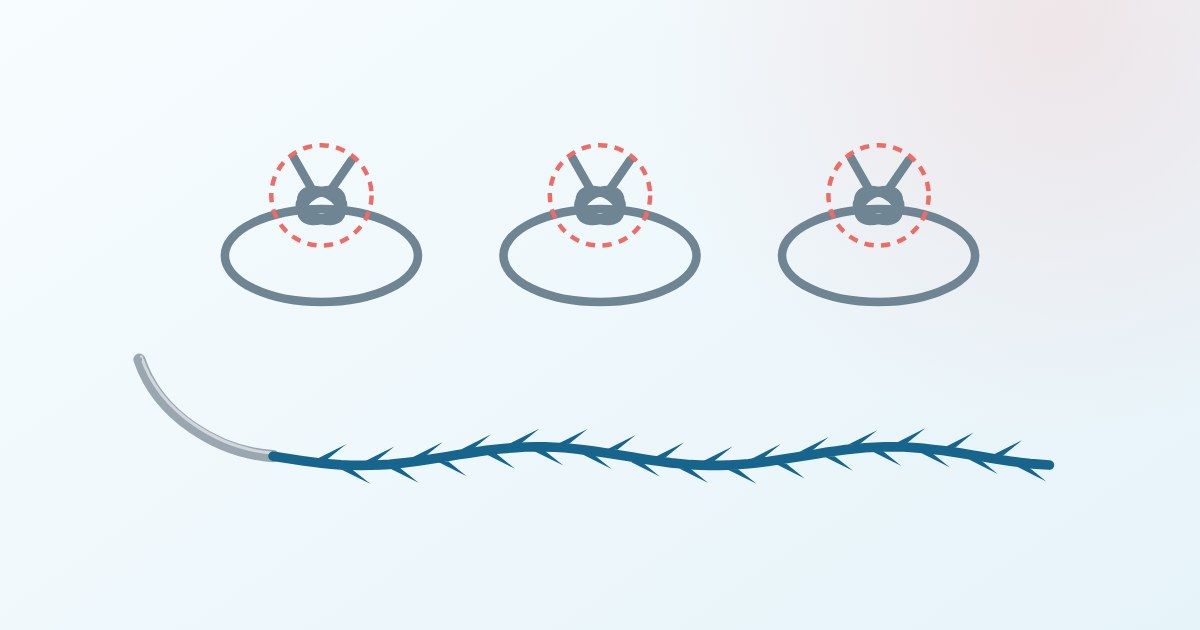
A stitch poking out weeks or months after a breast lift, breast reduction or tummy tuck is common and rarely serious. Your body is pushing out part of an internal suture, usually the knot of a superficial subcutaneous stitch. Even so, it can become inflamed, leave a small mark on the scar and means an extra visit to the clinic. That is why we close the skin with an absorbable barbed suture: one continuous thread, with no knots, that works as both the subcutaneous stitch and the intradermal stitch. It can occasionally poke out too, like any intradermal suture, but there are no longer superficial knots working their way out.
- Usually the knot of an internal stitch
- Rarely serious
- Do not pull it: we trim it in clinic
- We close the skin without superficial knots
What a "spitting" stitch is
A long wound is closed with several layers of internal sutures. Most of them are absorbed without the patient noticing. Sometimes the body treats part of the thread as a foreign body and pushes it towards the skin. This is called suture extrusion, or a spitting stitch.
You may notice:
- a small pimple or scab on the scar that does not heal;
- the tip of a thread poking out;
- a tiny opening that oozes a little.
Why it is mostly knots that come out
Every knotted stitch leaves a small ball of thread under the skin. The closer it is to the surface, the easier it is for the body to push it out. That is why the stitches that come out most often are superficial subcutaneous knotted stitches: the ones joining the layer just beneath the skin.
When a knot comes out, it can open a small track to the surface (a fistula), become infected and leave a mark where it came out. It also tends to happen after the patient has been discharged, which means unscheduled visits, sometimes months later.
How we close the wound
In breast lift, breast reduction and tummy tuck surgery we close in two layers. The difference from a classic closure is in the most superficial layer.
Classic closure, with knotted stitches
- Deep stitches in the superficial fascia.
- Superficial subcutaneous stitch: its knot sits just under the skin and is the one that can come out.
- Intradermal stitch.
Our closure, with no superficial knots
- The same deep stitches in the superficial fascia.
-
Deep absorbable stitches in the superficial fascia
They hold the tension of the closure. They are so deep that they almost never come out.
-
Absorbable barbed suture for the skin
One continuous thread that anchors in the tissue along the whole wound, with no knots. It works as both the subcutaneous and the intradermal stitch, so superficial knotted subcutaneous stitches are no longer needed.
There is no row of stitches to remove. Between day 7 and day 14, depending on the case, we trim the start and end tails of each scar in clinic.
What a barbed suture looks like
A conventional suture is a smooth thread: it has to be knotted to hold, and each stitch leaves a knot under the skin. A barbed suture has tiny barbs along the thread, all facing the same way. The thread moves forward in one direction and the barbs anchor in the tissue in the other, so it holds by itself, with no knots.
It holds the wound during the weeks of highest tension and is then absorbed by the body, over a few months depending on the type of thread.
What it means for the patient
- No superficial knots
- In our patients they were what came out most often, and they are gone. The barbed suture can occasionally poke out, like any intradermal suture. If it does, we trim it in clinic in a few minutes.
- Less time in the operating room
- In a trial of tummy tucks, breast lifts and breast reductions, skin closure took 12 minutes with barbed suture compared with 19 with conventional suture. Less surgical time means less time under anaesthesia.
- Tension is spread along the whole wound
- This lets us close with slightly more tension, which may help the scar widen less. Few studies have measured it, so we do not promise it.
- It costs more than a conventional suture
- We do not pass that cost on in your quote.
We use it in breast lift, breast reduction and tummy tuck surgery. Together with intraoperative laser, when indicated, it is part of how we look after the scar from the operating room. We explain aftercare in our guide to breast lift recovery.
What the evidence says
- Randomised trial by Rubin et al. (Aesthetic Surgery Journal, 2014)
- It included 229 patients having a tummy tuck, breast lift or breast reduction, with barbed suture on one side and conventional suture on the other. Closure was faster with barbed suture: 12 minutes compared with 19. It tested two versions of barbed suture: with the fast-absorbing one, complications were equivalent to conventional suture; with the slow-absorbing one there were more minor extrusions.
- Meta-analysis by Su et al. (JPRAS, 2023)
- It pools 14 studies of aesthetic surgery with 2,259 patients. Barbed suture shortens suturing and operating time, and the overall complication rate does not change. It finds more extrusions and slightly more wound dehiscence, especially with unidirectional barbed sutures.
We are collecting data from our patients and will publish them, as we did with our tummy tuck series in is a tummy tuck dangerous?
What to do if a stitch pokes out
- Do not pull the thread or try to remove it.
- Wash the area with soap and water and cover it with a clean dressing.
- Message us or come to the clinic: we remove or trim it in a few minutes.
Frequently asked questions
Is it normal for a stitch to come out months after surgery?
It is common and rarely serious: your body is pushing out part of an internal suture, mostly the knots of superficial subcutaneous stitches. It is best to have your surgeon see it, remove it and check the scar.
Can I remove the stitch myself?
No. Pulling the thread can break it, leave part of it inside or open the wound. In clinic it is removed or trimmed in a few minutes.
Do barbed sutures need to be removed?
No. They are absorbable: the body absorbs them over a few months. Between day 7 and day 14 we trim the start and end tails of each scar in clinic; there is no row of stitches to remove. If an end pokes out later, it is also trimmed in a few minutes.
Does a barbed suture leave a better scar?
It may help the scar widen less, because it spreads tension along the whole wound, but few studies have measured it. The scar depends mainly on each patient's skin, the tension in the area and care during the first months.
Does surgery closed with barbed suture cost more?
Barbed suture costs more than conventional suture, but at our clinic we do not pass that cost on in your quote.
Sources
- Rubin JP, Hunstad JP, Polynice A, et al. A multicenter randomized controlled trial comparing absorbable barbed sutures versus conventional absorbable sutures for dermal closure in open surgical procedures. Aesthetic Surgery Journal. 2014;34(2):272-283. View article
- Su X, Lin Y, Wu Y, et al. Effectiveness and safety of knotless barbed sutures in cosmetic surgery: a systematic review and meta-analysis. Journal of Plastic, Reconstructive & Aesthetic Surgery. 2023;87:416-429. View article