Implant volume is measured in cubic centimeters, but a single number does not determine the result. Chest width, your starting tissue, implant shape and profile, and your preferences determine how it will actually look.
What breast implant size should you choose?
There is no exact conversion between cc and bra size. Two patients with 300 cc implants can have very different results. Choosing appropriately combines measurements, trying different volumes, 3D simulation, and a specific conversation about the result you want.
The useful question is not just "how many cc?" but which width, projection, shape, and volume fit your tissues and come closest to the breasts you want.
- 250, 300, 350, 400, or 410 cc do not correspond to a universal cup size.
- The same implant looks different depending on chest, height, weight, and existing breast tissue.
- Simulation is very helpful for guidance, but does not guarantee an exact match.
- If you like two suitable options equally, our rule is to choose the larger one.
Our interactive gallery lets you filter cases by volume, height, weight, and implant shape: this is much more useful than looking at a number alone.
What this guide covers
How many cc correspond to a bra cup size?
Cc measure volume; bra size combines band and cup size. Cup sizes are also not standardized identically across brands. That is why 300 cc cannot always be described as a C cup, or 400 cc as a D cup.
A study of breast volume and bra cup sizes estimated a very general average of around 130–150 cc for a one-cup-size increase. The study itself found variation with band size and manufacturer. This is a population reference, not a calculator for choosing implants.
A simple example
In a patient with a narrow chest and little breast tissue, 300 cc may look very noticeable. In another patient with a wider chest, greater height, or more starting tissue, the same 300 cc may produce a subtle change. Final cup size can only be estimated and will also depend on the bra worn.
What results do 250, 300, 350, 400, or 410 cc usually produce?
These ranges help explain the relative extent of the change, but do not, by themselves, predict a specific bra size or appearance. Each volume should be considered alongside implant width and projection and the patient's measurements.
Often a subtle change in many anatomies. It may be enough when the goal is a small enhancement or breast tissue is already present.
A moderate increase in many cases. The difference between 250 and 300 cc is usually noticeable, but rarely changes the result completely.
A common range, because it adds presence without necessarily being large. On a narrow chest, it may look striking.
A fuller result. The breast base, tissue coverage, and skin elasticity need careful assessment.
More emphasis on the breasts. 410 cc falls within this range, but does not, on its own, show whether the result will be a C, D, or E cup.
This may be a valid option for selected anatomies and goals. Dimensions, tissue support, and long-term expectations need careful consideration.
A difference of 20 or 30 cc between two similar implants is usually small. Millimeters of width and projection matter as much or more. Comparing only "350 versus 375 cc" without knowing the model's dimensions can therefore be misleading.
Why the same volume looks different in every patient
Chest width
The same volume is distributed differently over a narrow or wide base. Implant width needs to respect the breast anatomy.
Existing breast and tissue
The amount of gland, fat, and skin coverage affects how noticeable the implant is and the transition at its edges.
Height and weight
These help identify comparable cases, but are not enough to prescribe cc. Two women of the same size may have very different chests and tissues.
Shape and projection
Two implants of equal volume can be wider and flatter or narrower and more projecting; the front and side views will differ.
Skin elasticity
Firm skin, a stretched envelope, and a sagging breast respond differently. Sometimes volume is not a substitute for a breast lift.
Placement plane and technique
Subglandular, subfascial, dual-plane, and other placement options are individualized. No single plane is best for everyone.
To see this variation, use the interactive breast augmentation gallery: choose a cc range and add height, weight, and shape filters.
Tissue-based planning: size starts with measurements
Modern implant selection should not start with a favorite number. Systems for tissue-based planning and decision-making processes such as High Five combine anatomical measurements, tissue characteristics, and patient preferences.
In consultations, we measure the breast base, nipple-to-fold distance, coverage thickness, fold positions, and any asymmetry. This information defines an anatomically reasonable range of implants. Within that range, your preferences play an essential role.
How to explain the breasts you want
The idea of an "ideal" size is subjective. To translate an aesthetic preference into a clinical decision, we usually distinguish three broad goals during the consultation:
Bring examples of results that you like and also those you do not like. Knowing what you want to avoid is as useful as knowing what you want. Our interactive gallery helps you prepare this selection using cases comparable in volume, height, weight, and implant shape.
The surgeon should not impose a size
Our job is to explain which options suit your tissues, what the real differences are, and which trade-offs each may involve. The final decision is made with you, after viewing and trying comparable alternatives.
Sizers and 3D simulation: two complementary tools
External sizers let you feel the volume in clothing and assess overall proportions. To get the most from the trial, we recommend bringing a fitted T-shirt, sweater, or dress to the consultation, preferably without padding: this lets you assess how the silhouette changes in clothes you actually wear.
Three-dimensional simulation helps compare options on a representation of your own chest. Along with sizers, it is a central part of the consultation after measuring the anatomy and defining a safe range. Both tools improve the conversation and reduce decisions based on numbers alone.
A 3D simulation is an estimate, not an exact promise. Living tissue changes, implants settle, and healing cannot be perfectly reproduced on a screen. We use simulation to compare tendencies: more or less volume, width, projection, and fullness in different poles.
If you like two sizes, choose the larger of the two
This is one of the most important rules in our practice. It applies when, after measuring your tissues, trying volumes, and reviewing the simulation, two similar implants remain anatomically suitable and you genuinely like both.
Our long-term clinical experience
Within the small group of patients who later say they would have chosen a different size, approximately 95% say they would have preferred a little more, and only around 5% a little less.
That is why, when genuinely undecided between two similar, safe options, we recommend the larger one. The reason is not that the breasts will "sag" or that the largest possible implant should be chosen, but to avoid falling short when both alternatives have already been accepted by the patient.
An observation from our clinical practice. It does not mean that 95% of all patients want more volume, and does not replace individual assessment.
The rule does not apply if the larger implant exceeds reasonable tissue limits, if you only like it in clothing but not without, or if a very subtle result is your clear priority. Nor does it make a large volume better: it applies only to two similar, suitable options that you find equally satisfying during the trial.
The current trend: somewhat smaller, more natural breasts
A natural appearance in still images and in movement
In recent years, we have seen a general preference for somewhat more restrained, proportionate results with smooth transitions. Many patients do not want the implant to dominate their silhouette and value how their breasts behave when walking, lying down, or exercising.
In our practice, most patients ultimately choose an in-between result: natural but noticeable. Requests for very striking volumes do occur, but less often. This is an observation from our consultations, not a rule for every woman.
It is a trend, not an aesthetic requirement. Every patient is different: a natural result may require different volumes for different bodies, and other women deliberately prefer fuller cleavage.
mia Femtech
A tissue-preserving technique using an axillary approach, intended for subtle increases and a quick recovery in selected patients. Its volume range is limited, and it does not replace every augmentation option.
Preservé
It aims to preserve tissues and ligaments through less traumatic pocket preparation. Natural results can be planned across a range of dimensions that depends on anatomy and the available implant matrix.
These techniques reflect the interest in preserving more tissue and achieving a natural appearance at rest and in movement. Conventional augmentation remains an excellent option when it provides the best control for the anatomy, volume, or correction required.
Round, anatomical, or ergonomic implants
Round
They may emphasize the upper pole somewhat more and, in certain anatomies, look a little more artificial. However, they are a good option in many cases, particularly when the upper pole is empty or the lower poles are long and the aim is to balance the breast. An appropriately selected round implant can also give a natural result.
Anatomical
They distribute more volume toward the lower pole and may be useful when precise shape control is needed. Their indication depends on the starting breast, coverage, and goal, not on being inherently "more natural."
Ergonomic
Their gel distribution changes with body position, which may support dynamic behavior. The final shape still depends on the tissues, pocket, and selected dimensions.
Shape is not decided in isolation
Volume, width, height, projection, and cohesivity work together. Comparing "round versus anatomical" without specifying the other variables oversimplifies the decision.
What do low, moderate, and high profile mean?
Profile describes how much projection an implant offers relative to its width. At roughly equal volume, a high-profile implant is usually narrower and more projecting; a low-profile implant is wider and less projecting. Catalogs may describe low, moderate, high, or even extra-high profiles, but names vary between manufacturers. That is why we always review width and projection in millimeters, not just the commercial name.
The breast's final projection is not just the implant's projection. The implant adds to the patient's existing breast projection and tissue, and the result is also affected by envelope elasticity, technique, and placement plane. Two implants of the same profile can therefore produce different results.
More volume does not automatically mean a better result
A large implant may look balanced and natural when the anatomy provides enough width, coverage, and support. However, if its dimensions exceed what the tissues can reasonably accommodate, edges are more likely to show, skin may stretch, rippling may develop, or stability may decrease over time. A natural appearance depends on the relationship between implant and tissues, not a universal cc limit.
Our protocol for choosing implant size at Dr. Aso Clinic
The decision is made step by step, not through an automatic height-and-weight chart.
The best reference: our interactive breast augmentation gallery
We are not aware of another clinical tool that allows such precise comparison of so many real results using several body characteristics together. Instead of looking for an isolated "300 cc" photo, you can find patients with a build and goal similar to yours.
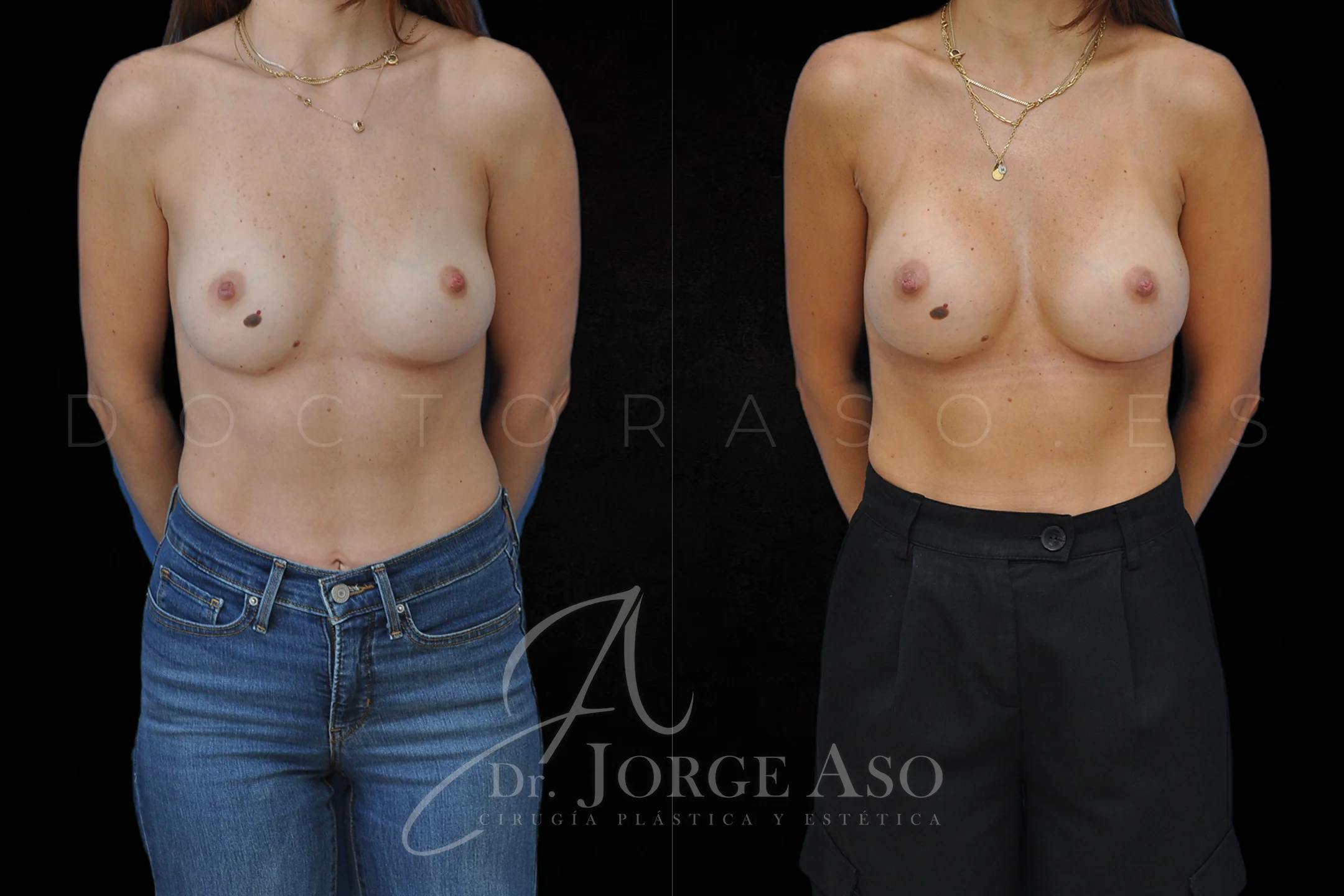 190 cc · mia · low profilePatient: 170 cm, 53 kgView clinical case →
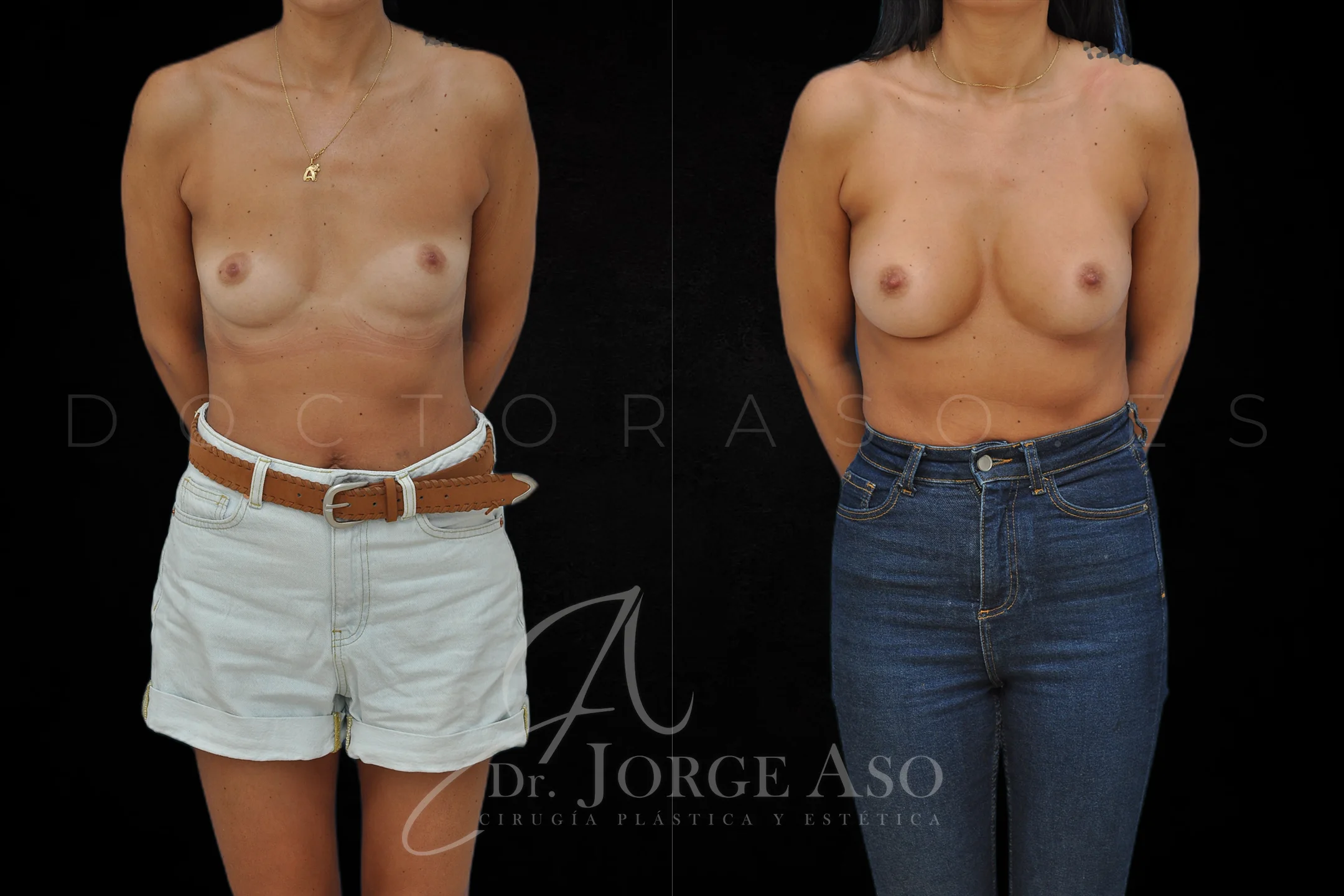 255 cc · anatomical · moderate profilePatient: 167 cm, 54 kgView clinical case →
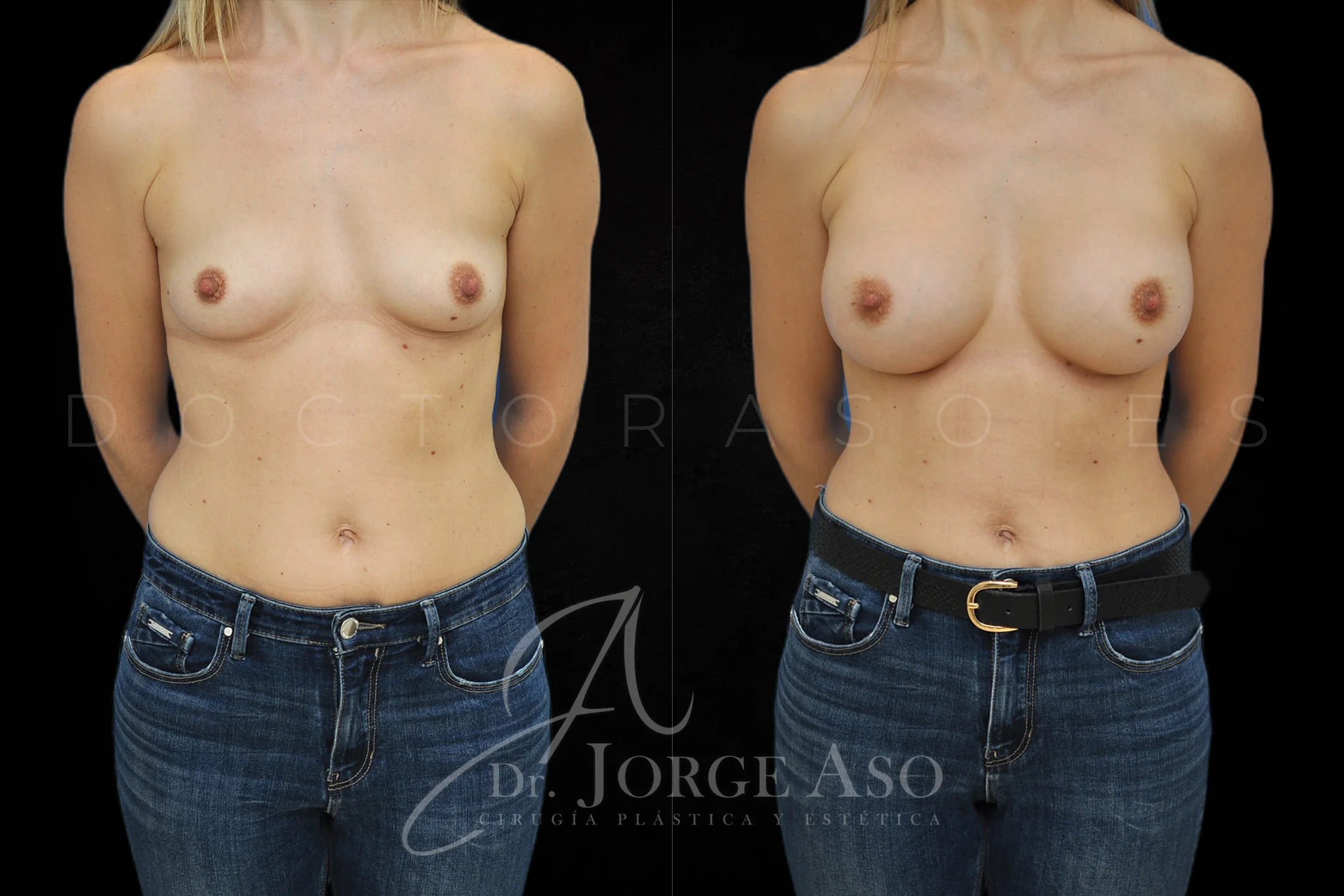 395 cc · anatomical · high profilePatient: 165 cm, 55 kgView clinical case →
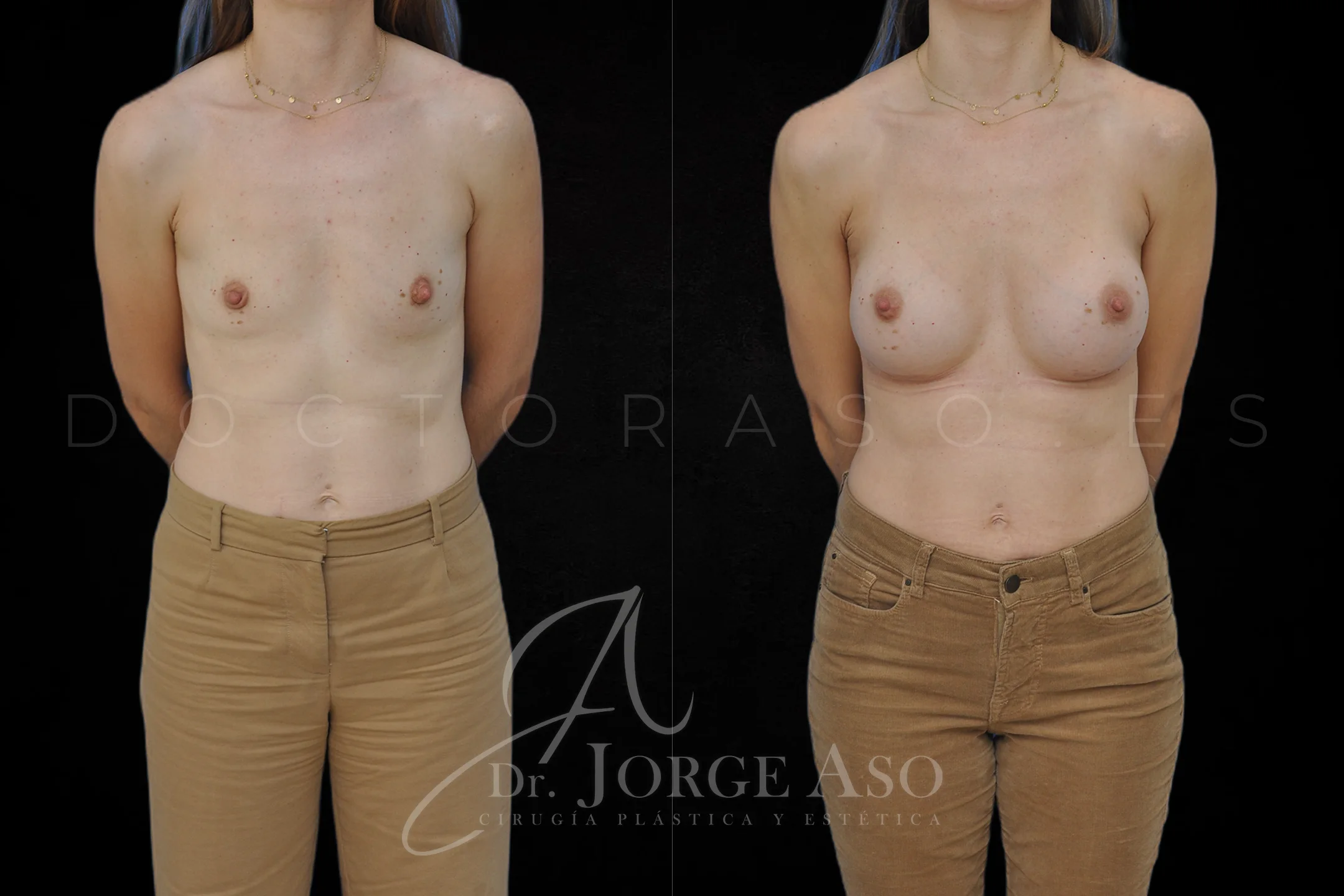 400 cc · ergonomic · high profilePatient: 168 cm, 62 kgView clinical case →
Frequently asked questions about cc, bra size, and implant size
What bra size do 250 cc implants give?
What bra size do 300 or 350 cc give?
What bra size do 400 or 410 cc give?
Can size be chosen using only height and weight?
How can I avoid regretting the size?
Do round implants always look artificial?
Are mia or Preservé suitable for every size?
The decision is refined in consultation
We measure your tissues, compare real cases, try similar volumes, and use simulation to choose a coherent combination of width, projection, shape, and cc with you.