Having one breast that is slightly larger or higher, or an areola that looks different, is very common. When the difference is stable, it usually does not indicate a medical condition. Seek medical advice if asymmetry appears suddenly, increases, or comes with a lump, firmness, skin or nipple changes, discharge, swelling, fever, or persistent pain.
When asymmetry affects how you feel about your appearance or causes discomfort, there is no single "breast asymmetry operation." First, we need to identify whether the difference involves volume, shape, the breast base, the fold, the nipple–areola complex, the chest, or several of these together. Only then can we decide whether to monitor, disguise, augment, reduce, lift, combine techniques, or investigate another cause.
Is it normal for one breast, nipple, or areola to look different?
Yes, mild asymmetry is common. The breasts do not develop or change as mirror images. Differences in volume, shape, sagging, projection, fold height, areola diameter, or nipple position can exist without a medical condition.
The useful question is not simply "are they different?" but "has this difference been stable for a long time, or is it new and changing?". Asymmetry present since breast development has a different significance from a breast that enlarges, becomes firm, or changes shape over a short period.
Article contents
Types of breast asymmetry: more than one breast being larger
During a consultation, we describe each component separately. Two breasts can have similar volume yet look different because of their base, projection, or height. The reverse can also happen: a difference in volume may be relatively unnoticeable if shape and position are similar.
Volume or size
One breast contains more glandular tissue or fat than the other. The difference may be subtle or very noticeable.
Shape and base
One breast may be rounder, more conical, narrower, or wider even when overall volume is similar.
Projection
One breast extends further forward or has more volume concentrated in a different pole.
Height and fold
One breast, its lower pole, or its inframammary fold may sit higher or lower.
Nipple and areola
The height of the nipple–areola complex, the areola diameter, and the nipple's shape or projection may differ.
Chest and pectoral muscle
Differences in the ribs, sternum, scoliosis, or pectoral muscles can make the breasts look uneven.
Why can one breast differ from the other?
Asymmetry may be present from development, become noticeable with hormonal changes, or appear after tissue changes. A systematic review of developmental breast asymmetry found widely varied treatments and no single protocol suitable for all patients.1
Development and puberty
The breasts can grow at different rates. In many adolescents, the difference decreases when development is complete; in others, it remains stable.
Common and generally stable
The menstrual cycle and hormonal changes
Breast fullness can make a difference more noticeable at certain times. A persistent change on one side should not automatically be attributed to the menstrual cycle.
Monitor changes
Pregnancy and breastfeeding
Glandular growth, milk production, and subsequent involution may differ between breasts, affecting volume, skin, and sagging.
Wait for stability
Weight and aging
Fat, skin elasticity, and ligaments change over time. One breast may lose more fullness or descend further than the other.
How tissues change
Tuberous breasts and Poland syndrome
A tuberous breast may have a narrow base, a high fold, and an enlarged areola. Poland syndrome can affect the breast, pectoral muscle, and chest wall.
A specific diagnosis
Surgery, trauma, or disease
Previous surgery, an infection, a hematoma, capsular contracture, a mass, or an inflammatory change can cause acquired asymmetry.
Assess the cause
When to seek advice about new asymmetry
A difference that has been stable for years does not have the same significance as a recent change. The National Cancer Institute lists changes in size or shape, a mass, skin or nipple changes, and discharge unrelated to breastfeeding among the signs that need assessment.2
A change in size or shape
One breast enlarges, becomes distorted, or looks noticeably different over a short period.
A lump or firmness
A new or persistent firm area appears in the breast or armpit.
Skin or nipple changes
Retraction, dimpling, thickened skin, persistent redness, or a lesion that does not heal.
Discharge, pain, or swelling
Spontaneous discharge—especially if bloody—persistent focal pain, warmth, fever, or increasing swelling.
Having one larger breast does not mean you have cancer. It means that if the difference is new or comes with any of these signs, it should be examined before considering cosmetic correction.
How we assess asymmetry before surgery
Planning starts with understanding which structure explains the difference and which part the patient wants to change. We do not decide solely by comparing bra sizes or choosing two implants with different volumes in cubic centimeters.
History and stability
How long it has been present, whether it changes with the menstrual cycle, pregnancy, or weight, any previous surgery, and whether there is pain, discharge, a mass, or other symptoms.
Assessment of each component
Volume, base, projection, skin quality, ptosis, folds, nipples, areolas, chest, pectoral muscle, and possible developmental differences.
Photography, measurement, and simulation
For augmentation, we use Crisalix volume estimates, virtual simulations, and mirror-based trials to compare options, without presenting them as a guarantee.
Imaging when indicated
Ultrasound, mammography, or another test is requested according to age, medical history, examination findings, and symptoms. ACR criteria tailor the assessment of a palpable mass to age and clinical context.3
Can uneven breasts improve without surgery?
A mild difference that does not bother you needs no treatment. To disguise it, a bra with removable padding, an adapted cup, or an external breast prosthesis can balance how clothing fits without surgery. Posture or strength can also be addressed if muscles contribute, while recognizing that exercise does not equalize glandular breast tissue.
A bra or external prosthesis
They visually compensate for volume and are completely reversible.
Areola micropigmentation
It can make a small areola look larger and more similar to the other without creating a new scar. It does not change its anatomical diameter.
Exercise
It can improve the pectoral muscles and posture, but it does not move the nipple, lift the breast, or correct differences in glandular tissue.
Fat transfer is not a nonsurgical treatment. It involves harvesting fat through liposuction, preparing it, and injecting it, and may require several sessions. Its role is explained below.
How breast asymmetry is corrected
Correcting asymmetry does not always require a breast lift. A lift is needed only when a difference in sagging or position requires skin removal and reshaping. Other patients need augmentation, reduction, mastopexy, areola surgery, or a different combination.
| Main issue | Options to consider | An important limitation |
|---|---|---|
| One small breast and one slightly larger breast | Different implant volumes or profiles in a straightforward augmentation | Your own tissues remain different |
| One very flat breast and one with reasonable volume | Selective reduction of the larger breast, followed by matching or similar implants | It involves operating on both breasts |
| Excess volume in one breast | Glandular tissue and skin reduction on one side or an asymmetric reduction on both | The scar depends on tissue removal and sagging |
| One breast sags more or one nipple sits lower | A lift on one or both sides, with or without implants | Actually raising the nipple requires a scar |
| A small contour difference | Fat transfer as an additional refinement | Retention varies and more than one session is often needed |
| Different areola diameters | Areola reduction on one or both sides, or micropigmentation | A scar or an optical correction only, depending on the option |
Incisions may run around the areola, include a vertical line, and, when skin or volume requires it, extend along the fold in an inverted-T pattern. The pattern is not chosen by the name of the asymmetry, but by the amount of skin and tissue that needs reshaping.
Different implants, or reducing the larger breast first?
It depends on whether this is a straightforward augmentation or surgery that will also remove skin or glandular tissue. We do not automatically try to correct every difference by placing a much larger implant on one side.
Two very small breasts
If the main difference is volume and no skin needs removal, we usually use different implant sizes and sometimes different profiles. Crisalix, virtual simulations, and mirror-based trials help estimate the combination.
One flat breast and one with volume
For pronounced asymmetry, we may perform a partial adenectomy—a selective reduction of glandular tissue—in the larger breast to bring it closer to the smaller one first. We then aim for matching implants or implants that are as similar as possible.
Asymmetry with a lift or reduction
First, we reshape both breasts, removing more tissue from the larger one than from the smaller one. With a more similar starting base, we aim to place the same implant or two models with the smallest possible difference.
More similar tissue proportions
Two breasts with a similar balance between implant and natural glandular tissue/fat tend to be more alike in feel, shape, and movement than breasts whose composition remains very different.
Different implants may change differently
A substantially larger implant may descend, shift laterally, or behave differently from the opposite implant. Equalizing tissues first reduces that biomechanical difference, but does not guarantee identical changes over time.
This approach reflects Dr. Aso's judgment and clinical experience. The literature confirms that breast and chest asymmetry is common, but not every patient with a visible difference needs different implants.4
Fold, nipple, and areola: what can actually be moved
Raising the lower fold is generally easier
The strategy depends on the overall anatomy. In our practice, raising and stabilizing a low fold tends to be more predictable than lowering a high one, but this is not a universal rule.
A straightforward augmentation does not move the nipple
We can place an implant, but the nipple retains its position. Placing implants off-center to create apparent symmetry may produce a less natural result. If the nipple actually needs raising, a lift or skin excision is usually required.
Reduce one, treat both, or disguise the difference
The decision is shared with the patient: reduce only the larger one, treat both, or avoid a new scar and use micropigmentation on the smaller one. Micropigmentation creates a closer visual match, but does not change anatomy.
The role of fat transfer in breast asymmetry
Fat transfer can soften a contour, add coverage, or correct a small difference after the main operation. In our practice, we use it as an additional technique or refinement, not as the main solution for major asymmetry.
When the difference is substantial, trying to address it with fat alone may be insufficient and disappointing unless the patient accepts numerous sessions. Graft retention varies, and a recent systematic review highlights the heterogeneity of published techniques, outcomes, and complications.5 In Dr. Aso's experience, needing more than one session is the norm.
Can perfect symmetry be achieved?
No. Absolute symmetry does not exist, even in patients whose breasts are relatively similar to begin with. When there is clear asymmetry, surgery works with different skin, glandular tissue, muscles, folds, and bases, and each side heals and ages in its own way.
The aim is for the breasts to look much more balanced and proportionate, with a residual difference that does not dominate the overall appearance. A patient expecting two identical breasts will probably be disappointed, whatever the outcome.
Adolescence, breastfeeding, and future pregnancies
Wait until development is complete
Whenever possible, we wait until breast development is stable. The decision is not based solely on reaching a particular age, but on maturity, stability, impact, and diagnosis.
At least six months after weaning
This is the minimum in our protocol, allowing volume, glandular tissue, and skin time to stabilize before measuring and deciding.
We do not operate if pregnancy is planned within the next year
If it is not so imminent, we discuss it with the patient. A future pregnancy and breastfeeding may change volume, skin, sagging, and symmetry again.
After breast surgery, one side looks larger, higher, or firmer: is that normal?
A moderate difference during the first few days is common and usually occurs because each breast swells differently. What matters is not a small, isolated difference, but how it changes: mild, stable asymmetry usually improves. If one breast keeps enlarging, becomes firm, or hurts much more than the other, it needs prompt assessment.
During the first few weeks, it is normal for one breast to swell, settle, or soften before the other. Recovery may also differ if different amounts of tissue were removed on each side. The first month often brings substantial improvement, but it is still too early to judge the final result.
One breast looks larger
This is the most common early difference. Swelling is not always symmetric, and the side that already had more glandular tissue may swell more. An increasing or very pronounced difference needs assessment.
One implant sits higher
This can reflect initial tissue tension and an implant that has not yet settled to the native inframammary fold. When its position warrants it, an implant-positioning band may help from the outset.
One breast looks lower and larger
There is not always more volume. A longer lower pole or an implant that has descended can make one breast look larger even with matching implants.
Different shapes, lower poles, and nipples
When tissue has been removed or redistributed, each side may heal and adapt at a different rate. Subtle differences in shape or height usually take longer to assess.
Uneven swelling
Height, firmness, volume, and shape may differ without predicting the final result.
Around 50–80% improvement
In our experience, much of the asymmetry visible in the first few days usually resolves, although both breasts continue changing.
Around 90% improvement
In most cases, we expect the initial postoperative difference to have decreased by around 90%. If it has not, we reassess the cause and its progression.
A stable cosmetic assessment
This is the usual timeframe for judging residual asymmetry and considering a purely cosmetic correction if still needed.
These percentages describe our clinical experience and refer to the reduction of asymmetry visible in the first few days. They do not mean achieving perfect symmetry or replace individual assessment. A complication, clear malposition, or a healing problem is investigated and treated earlier.
A positioning band may help when an implant remains high
If the main difference is vertical and the implant sits above the native inframammary fold, we usually apply a positioning band as early as possible. This pattern often responds very well when correctly identified. The band must be prescribed and adjusted to the actual position of each implant; we do not recommend using one on your own for every type of asymmetry.
The initial appearance does not always explain the cause
One breast much more swollen at one week
The patient had matching implants and mild pre-existing glandular asymmetry. The side with more glandular tissue swelled more. Ultrasound at the consultation showed no fluid collections or complications.
Progress: clear improvement at one month and only very mild asymmetry at six months, equivalent to the original difference. The patient was very satisfied.
The right implant initially sat higher
After surgery, both implants sat high, particularly the right one. Follow-up and use of the positioning band continued according to the protocol.
Progress: the difference had improved by around 50% at one week, and by one month both implants had settled to their native inframammary folds.
It looked larger, but the problem was the lower pole
At six months, one breast looked much larger. Ultrasound ruled out fluid collections; examination showed downward displacement of the right implant, a high horizontal scar, and a longer lower pole.
Progress: an individualized refinement was performed at nine months, repositioning the implant and balancing the lower-pole lengths. Neither implant volume nor breast volume needed changing.
The third patient's surgery at nine months addressed an already identified, stable mechanical cause. It does not replace the usual 10–12-month wait to assess a purely cosmetic difference.
There is no single recovery protocol for "asymmetry"
Garments, incision care, activity restrictions, medication, and follow-up depend on whether you have had augmentation, reduction, a lift, fat transfer, or a combination. Your individual instructions always take priority.
Pain, firmness, or progressive enlargement
Sudden new asymmetry, an enlarging breast, one-sided pain, firmness, redness, fever, or increasing swelling require examination and usually ultrasound. A complication or clear malposition may need early treatment.
If your main concern is that your breasts look widely spaced after surgery or an implant seems displaced, also see the guide to cleavage and breast separation after augmentation.
A breast lift for a patient with pre-existing asymmetry
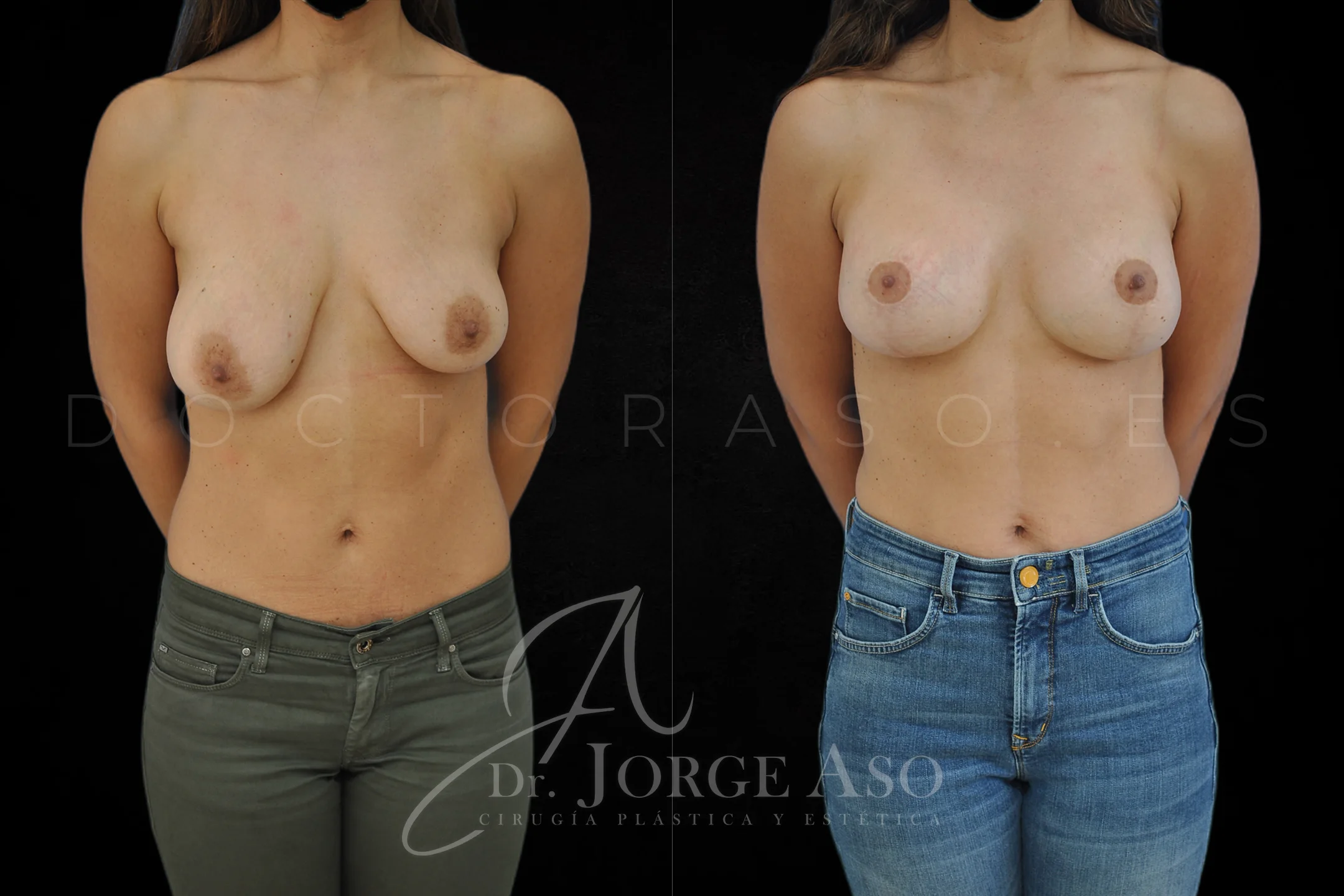
This case shows a visible preoperative difference in shape, volume, and position. The patient underwent an inverted-T breast lift with round 360 cc implants. The result photograph was taken at 12 months.
It illustrates the right expectation: asymmetry improves substantially, but real breasts do not become two geometrically identical shapes. The technique is personalized on each side according to the initial volume, skin, and position.
Breast augmentation and breast lift results galleries
A gallery helps illustrate real variability, but does not replace an examination. Compare patients with a similar starting point, height, weight, volume, and technique; your favorite photograph may not show the right operation for another person's anatomy.

I am Dr. Jorge Aso
I am a specialist in Plastic, Aesthetic, and Reconstructive Surgery through Spain's MIR residency system and hold a PhD in Medicine cum laude. When assessing breast asymmetry, I do not start by choosing an implant: I assess volume, skin, glandular tissue, the fold, nipple, areola, and chest separately to understand what can be corrected and what should be respected.
My goal is for you to understand why I recommend treating one or both breasts, what scars each option requires, and what residual difference I consider likely. Simulation and measurements help, but realistic expectations are as important as the technique.
Frequently asked questions about uneven breasts, nipples, and areolas
Is it normal for one breast to be larger than the other?
Why is one areola or nipple larger than the other?
Could having one larger breast mean cancer?
Can breast asymmetry be corrected without surgery?
Are different implant sizes always needed?
Which breast is operated on: the larger or the smaller one?
Can fat transfer make two breasts equal?
Can an implant be placed higher to even out the nipples?
Is it normal for one breast to be larger after surgery?
Why can one breast look larger with matching implants?
When can symmetry be assessed after surgery?
How long should I wait after breastfeeding?
Selected medical sources
- Suhail D, Faderani R, Kalaskar DM, Mosahebi A. Optimal strategies for addressing developmental breast asymmetry and the significance of symmetrical treatment: A systematic review. J Plast Reconstr Aesthet Surg. 2023. PMID: 37441855.
- National Cancer Institute. Breast Cancer Signs and Symptoms.
- American College of Radiology. ACR Appropriateness Criteria: Palpable Breast Masses.
- Khan UD. Relative Distribution of Common Breast and Chest Asymmetries in 2051 Primary Augmentation Mammoplasties. Plast Reconstr Surg Glob Open. 2024. PMID: 39534067.
- Seth I et al. Autologous Fat Grafting in Breast Augmentation: A Systematic Review Highlighting the Need for Clinical Caution. Plast Reconstr Surg. 2024. PMID: 37166041.
Correcting asymmetry starts with understanding what makes each breast different
Good planning does not pursue two identical breasts at any cost. It identifies the main difference, first rules out anything that needs investigation, and combines only the techniques needed to improve volume, shape, and position without creating new imbalances.
At your consultation, we can measure each component, compare options with and without implants, explain the scars, and define a realistic expectation together before deciding whether surgery is worthwhile.