B-Lite implants retain the same volume in cubic centimeters while reducing implant weight by approximately 25–30%. In our practice, we particularly recommend them from around 450 cc, in breast lifts with implants larger than 300 cc, in revision surgery where the tissues have already stretched, and when minimizing added weight is a priority. Their main trade-off is a slightly firmer, stiffer feel.
Are B-Lite implants worth it?
Often yes, but not simply because they are newer or more expensive. At the same volume, an implant that weighs around 30% less places less continuous and movement-related load on the skin, breast tissue, inframammary fold, and implant pocket. This advantage matters more with large implants or compromised tissues.
Same volume, less weight
Volume in cc and dimensions determine size; the lightweight gel reduces the mass that the tissues support each day.
Sagging is still possible
Skin, implant size, the pocket, surgical technique, pregnancy, and time still have an influence.
A slightly firmer feel
The difference is usually moderate, but it can be noticeable and make the implant easier to feel when tissue coverage is thin.

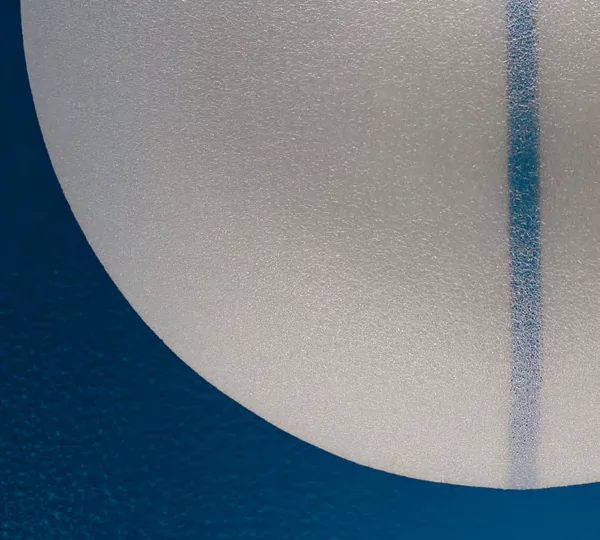
The opaque white color visually distinguishes B-Lite's lightweight gel
Around 500 cc does not have to weigh around 500 grams
With a conventional implant, volume and weight are numerically similar. B-Lite retains comparable volume and dimensions but reduces mass using hollow microspheres integrated into the gel.
For a pair of large implants, the difference can approach several hundred grams. The exact figure depends on the model, volume, and surface: implants of the same volume do not all weigh exactly the same. Comparisons should use specific models, not a generic percentage applied to the volume in cc.
≈ 100% of the weight
≈ 70–75% of the weight
Illustrative comparison of implants with equivalent volumes.

Article contents
What are B-Lite implants, and how do they weigh less?
B-Lite is a family of lightweight breast implants distributed by POLYTECH. The filling incorporates high-purity hollow borosilicate microspheres encapsulated in a cohesive gel matrix.1
The microspheres occupy volume with very little mass and are chemically integrated into the gel, not loose or floating. This allows comparable sizes, widths, and projections with an approximate 25–30% reduction in weight.

A B-Lite implant can be round or anatomical and combined with MESMO or MICROTHANE.
The same cc are still the same cc
A 450 cc implant occupies 450 cc. The weight reduction does not make the augmentation look smaller.
Round and anatomical
Lightweight technology can be incorporated into different bases, projections, and shapes. Geometry is selected for the patient's anatomy, not weight alone.
The gel does not define the surface
B-Lite refers to the lightweight filling. MESMO and MICROTHANE describe surfaces with very different behavior. Both are compatible with B-Lite's lightweight gel.
Do lighter implants prevent breast sagging?
At the same volume, less weight means less gravitational force and less repeated load when walking, exercising, or moving. In mechanical terms, 30% less weight should exert less traction on the tissues.
This is not an anti-sagging system. Skin elasticity, volume, breast tissue, the pocket, support of the inframammary fold, pregnancy, weight changes, and surgical technique still play a role.
Throughout the day
It reduces the mass supported by the skin, ligaments, and inframammary fold without necessarily giving up volume.
During movement
A small biomechanical study found lower breast acceleration while walking, but it included only two patients with B-Lite and two controls.2
For which patients do we recommend or discuss B-Lite?
These are the situations in which we discuss B-Lite more systematically:
Large-volume augmentation
We recommend it or, at the very least, always explain it. The combined difference between two conventional and two lightweight implants becomes clinically relevant.
Breast lift with implants
The tissues of a sagging breast have already shown a tendency to stretch. If the patient chooses a substantial volume, reducing the sustained load is particularly reasonable.
Revision surgery
This is a useful indication after sagging following a breast lift with implants or downward implant displacement. Less weight does not replace reconstruction of the pocket, but it avoids adding the same load again.
Athletes and back problems
For a very active patient or someone with neck or upper-back discomfort, minimizing added weight may be an advantage even at more modest volumes.
B-Lite MESMO or B-Lite MICROTHANE: which do we use?
In Spain, B-Lite is currently marketed with a MESMO surface or a MICROTHANE coating.6 We choose according to the stability required and the tissues, not weight: both use lightweight gel.
B-Lite MESMO
This is our usual choice when we want to reduce weight without strong fixation. We use it in large augmentations, many breast lifts, and revision operations where the pocket can be adequately controlled.
Fine microtexture · a less rigid feel than polyurethane
B-Lite MICROTHANE
We mainly reserve it for revision surgery with malposition, large pockets, or anatomical implants that require a high degree of stability.
Less weight + polyurethane adherence
We stopped using macrotextures years ago following the published evidence, including our series of 621 patients, in which POLYtxt was associated with more late seroma, overall complications, and reoperations than MESMO.5 That decision concerns the surface, not whether the filling is B-Lite or conventional gel.
Our guide to polyurethane breast implants explains in detail when we seek adherence and the additional disadvantages of MICROTHANE.
What is the disadvantage of B-Lite implants?
The main trade-off is consistency: B-Lite usually feels slightly firmer, more compact, or stiffer than an equivalent conventional implant. The difference is not dramatic, but it should be explained before choosing.
Slightly less soft
The structure of the lightweight gel results in a firmer consistency. We recommend comparing actual implants during the consultation.
More noticeable with thin coverage
A firm implant may be easier to feel in slim patients, particularly at the lower and outer parts of the breast. Implant placement and available tissue are key.
We have not observed a specific increase
In our practice, we do not see more rippling or greater movement simply because an implant is B-Lite. Tissue coverage and the pocket still explain much of the risk.
A higher price
Lightweight technology makes the product more expensive. The extra cost only makes sense when lower weight offers value to that patient.
Can B-Lite implants be used with MIA Femtech or Preservé?
No. MIA Femtech uses Diamond Ergonomix implants, and Preservé uses Ergonomix2 implants, so these techniques are not compatible with B-Lite. B-Lite is used in conventional augmentation, breast lifts, and revision surgery.
This is not a comparison between a modern technique and an outdated one. They address different priorities:
Reducing surgical trauma
Small incisions, tissue preservation, moderate volumes, and rapid recovery in selected candidates.
Reducing implant load
It allows larger volumes and complex surgery with less mass than an equivalent conventional implant.
If minimally invasive surgery is your priority, compare MIA Femtech versus Preservé. If weight, tissue laxity, or revision surgery matters more, B-Lite may be a better fit.
Are the microspheres in B-Lite implants safe?
The hollow borosilicate microspheres are bonded to the cohesive gel. Preclinical validation included testing under ISO 10993 and ISO 14607, fatigue resistance, impact and static rupture testing, exposure to fluids, and biological tests under deliberately unfavorable conditions.1
No migration or release of microspheres, granulomas, or relevant gel deterioration was observed; the implants also withstood pressures far greater than those expected during air travel or recreational diving. These findings are reassuring, although some of this characterization comes from the device's developers and does not replace long-term clinical follow-up.
The gel remains cohesive
The bond between the gel and microspheres is designed to prevent them from dispersing as independent particles.
Ultrasound, mammography, and MRI
They can be assessed like other implants. Patients should always tell the radiologist their implant brand and model and keep their implant card.
It is still a breast implant
Infection, hematoma, seroma, capsular contracture, rupture, malposition, palpability, or a need for further surgery can occur.
What studies are available on B-Lite implants?
The evidence has grown, but it does not yet match decades of independent comparative studies. We must distinguish observed safety and satisfaction from specific proof that less weight prevents sagging.
Development and preclinical validation
The initial paper describes composition, weight reduction, and mechanical and biological testing. It is the technical reference for the product, not a clinical outcomes comparison.1
Pilot study of movement
Two patients with B-Lite showed lower nipple acceleration while walking than two comparable controls. The finding supports the mechanical hypothesis, but the sample is too small to estimate clinical outcomes.2
827 patients and 1,653 implants
A retrospective single-surgeon series reported 97.1% freedom from reoperation at five years, five Baker III capsular contractures, and no recorded rupture or BIA-ALCL. It is a large series, but without a parallel conventional-implant group and with links to the product's developers.3
First prospective multicenter follow-up
It included 101 primary augmentation patients followed for three to five years. No ruptures, Baker III–IV capsular contractures, or BIA-ALCL were recorded; mean satisfaction was 98.6%, and the estimated reoperation risk reached 9.9% at five years. It was a single-arm study sponsored by the manufacturer.4
Our preliminary experience with B-Lite
We retrospectively reviewed our medical records to identify operations using B-Lite from 2022 to 2025. The confirmed cohort includes 52 patients, combining primary augmentation, breast lifts, reductions with implants, reconstruction, and numerous revision procedures.
One infection among the 43 cases observed for 90 days
It developed around the eighth week and required temporary removal on one side, followed by reimplantation with the same B-Lite model.
Two corrections of pocket malposition
These were surgically corrected while retaining the implants. After reviewing each record, we classified them as technical pocket problems rather than intrinsic B-Lite failures.
No rupture or Baker III–IV capsular contracture
We also had no chronic late seroma or capsular tumor. Uneven and still-short follow-up means these absences cannot be interpreted as a true risk of zero; other studies have reported capsular contracture with B-Lite, so we know it can occur.
Do the incision, pain, or recovery change with B-Lite?
B-Lite MESMO is inserted using incisions and techniques similar to conventional MESMO. It does not require a larger scar simply because it is a lightweight implant. The approach, placement, and extent of surgery depend on anatomy and whether we perform augmentation, a breast lift, or revision surgery.
Similar to an equivalent implant
Implant size, skin elasticity, and the complexity of the procedure matter more than the type of gel.
We do not observe a major difference
Although one retrospective publication reported less pain and faster recovery, in our experience discomfort depends mainly on implant placement and the surgical maneuvers performed.7
Many patients notice it early
From the outset, patients often say their breasts feel light, but this does not eliminate tightness, swelling, or normal postoperative precautions.
In breast lifts and revision surgery, operating time and recovery depend on skin removal, pocket tightening, changes in implant placement, capsule work, and associated procedures—not on using B-Lite.
How much do B-Lite implants cost, and how long do they last?
≈ EUR 1,000 extra
Indicative additional cost for the pair compared with conventional MESMO, including VAT and referring to the product.
Up to ≈ EUR 1,500 extra
When lightweight gel is combined with a polyurethane coating, including VAT.
Surgery is quoted separately according to its complexity: implant replacement with capsulectomy and pocket reconstruction may cost more than primary augmentation even with the same implant. The figures above are indicative, apply to the pair of implants, include VAT, and may change with the manufacturer's prices.
B-Lite does not have a different clinical expiration date from other modern implants. We do not recommend replacing an otherwise normal implant simply because it is ten years old. Replacement is considered for a complication, breast changes, or a change in the patient's preferences.
Annual follow-up
The AEMPS recommends regular check-ups while a patient has breast implants.8
Annual ultrasound
This allows us to assess the shell, fluid around the implant, the capsule, and position in the clinical context.
For uncertainty and later assessment
We request it if ultrasound cannot resolve a suspected problem and generally consider it around the ten-year mark.
The Implants of Excellence program may cover the product in certain circumstances. The warranty does not cover the hospital, anesthesia, surgeons, or treatment of the capsule—only the implants.
Compare sizes, anatomy, and breast augmentation techniques
Our interactive gallery lets you filter cases by volume, height, weight, shape, and technique. Implant brand or weight is only one part of the result.
Frequently asked questions about B-Lite implants
How much less does a B-Lite implant weigh?
Approximately 25–30% less than a conventional implant of equivalent volume; it depends on model, surface, and size.
Does B-Lite prevent breast sagging?
It does not guarantee this. It reduces mechanical load, but skin, breast tissue, the pocket, surgical technique, pregnancy, and time still have an influence.
Are B-Lite implants harder?
They usually feel slightly firmer or stiffer and may be easier to feel in slim patients. We recommend comparing them during the consultation.
Can you feel less weight after surgery?
Many patients notice it early, although swelling, tightness, and discomfort still depend on the operation.
Does B-Lite cause more rippling?
We have not observed this. Tissue coverage, implant placement, the pocket, and size matter most; greater firmness can make the edge more palpable.
Can B-Lite be round or anatomical?
Yes. For anatomical implants, we use MESMO or, in selected cases, MICROTHANE to limit rotation; never a macrotextured surface.
Are B-Lite and MICROTHANE the same?
No. B-Lite describes the lightweight gel and MICROTHANE a polyurethane coating. Microtextured B-Lite MESMO is also available.
Do smooth B-Lite implants exist?
B-Lite/SL models existed and are confirmed in our cohort. They do not appear in the standard 2025 range, which does not in itself prove a formal withdrawal.
Can they be used with MIA Femtech or Preservé?
Not with the current systems, which use specific implant platforms. B-Lite is reserved for other procedures when reducing weight is a priority.
Are they recommended for athletes?
They may be, even at moderate volumes. They do not replace a sports bra, appropriate surgical technique, or a properly constructed pocket.
How much do B-Lite implants cost?
A pair of B-Lite MESMO implants costs around EUR 1,000 extra; B-Lite MICROTHANE may add up to EUR 1,500. These amounts include VAT and refer only to the product.
Do they need replacing after ten years?
No. Replacement is considered for complications, breast changes, or changed preferences. Ten years is a guide for imaging assessment, not automatic replacement.
References used
- Govrin-Yehudain J et al. Lightweight Breast Implants: A Novel Solution for Breast Augmentation and Reconstruction Mammaplasty. Aesthetic Surgery Journal, 2015.
- Norris M et al. The Kinematics of Breasts Implanted With a Reduced Mass Implant: A Pilot Study. Aesthetic Surgery Journal, 2020.
- Govrin-Yehudain O et al. Five-Year Safety and Satisfaction With the Lightweight Breast Implant. Aesthetic Surgery Journal, 2022.
- Reichenberger M, Hedén P, Germann G. Mid- to Long-term Outcomes Following Primary Augmentation With B-Lite Lightweight Breast Implants. Aesthetic Surgery Journal, 2026.
- Marcelli S, Aso J. POLYtxt versus MESMOsensitive, with particular attention to late seroma: a cohort of 621 aesthetic breast operations. Journal of Plastic, Reconstructive & Aesthetic Surgery, 2021.
- POLYTECH Health & Aesthetics. 2025 product catalog.
- Govrin-Yehudain O et al. Reduced Pain and Accelerated Recovery Following Primary Breast Augmentation With Lightweight Breast Implants. Aesthetic Surgery Journal, 2018.
- AEMPS. Patient information about breast implants, 2026 update.
Is reducing weight worthwhile in your case?
We assess volume, skin, breast tissue, exercise, back concerns, previous surgery, and your preference for feel. Then we compare B-Lite with the alternatives that genuinely suit your anatomy.