Polyurethane-coated implants are not “the perfect implant for every patient” or our usual choice for straightforward breast augmentation, but they can be an excellent solution—a real lifeline—in many complex situations. Their greatest value is in selected cases—particularly revision surgery, recurrent malposition, large implant pockets, or complex reconstruction—because the coating adheres to the tissues and makes further displacement or rotation less likely.
Are polyurethane-coated implants better?
They are not better for every patient. The high friction and subsequent tissue adherence of the coating can be extremely useful when an implant needs to stay exactly where we place it. That same property makes even slight malposition highly noticeable, difficult to correct without surgery, and less forgiving than with other implants.
After using more than 300 polyurethane-coated implants, our current approach is selective: we no longer routinely use them for straightforward primary augmentation, but they remain one of our most effective options for patients who have had multiple operations and whose implant displacement or rotation has returned after other corrections.
Article contents
What is a polyurethane-coated breast implant?
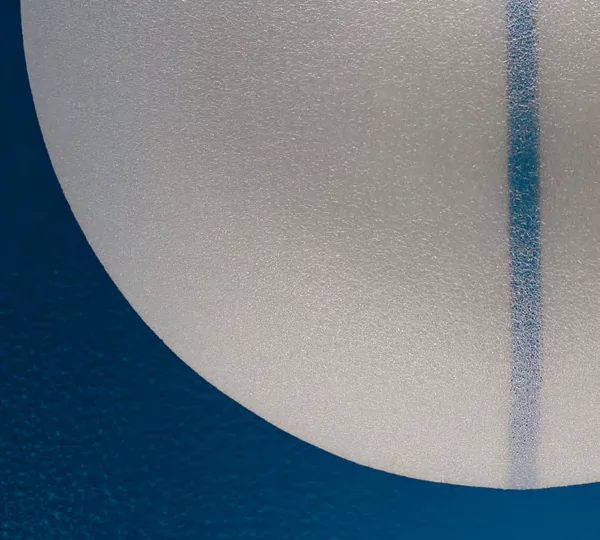
Inside, a polyurethane-coated breast implant is still a silicone gel-filled implant. The difference is the outer polyurethane foam layer covering the silicone shell. It is therefore not accurate to describe it simply as a conventional “ultra-textured” implant: its structure and interaction with the tissues are different.

Silicone gel
Provides the implant's volume, shape, and some of its physical properties.
Silicone shell
Contains the gel and forms the basic structure of the device.
Polyurethane foam
Creates a three-dimensional surface with characteristic friction and tissue integration.
How it behaves in the body
A scar tissue capsule forms around every breast implant. With polyurethane, tissue grows into the foam structure and promotes strong fixation. Over time, the coating gradually breaks down, but the capsule retains the three-dimensional imprint created during that process.

From the first polyurethane-coated implants to today's devices
Polyurethane foam-coated implants have been used for decades. Their commercial history has not been straightforward: the 1992 US moratorium on silicone implants changed the market and contributed to the withdrawal of certain products there. It is not accurate to summarize this history by saying that the FDA “banned polyurethane” because it had been proven to cause cancer.
Fixation and low reported complication rates
Tissue integration attracted interest because of its potential effect on capsular contracture, rotation, and displacement.
2,4-TDA and commercial withdrawal
Breakdown of the coating raised concerns based on animal carcinogenicity data. A subsequent small human study did not find exposure comparable to those animal models.
More selective use
MICROTHANE® and SILIMED continue to offer this technology outside the United States, while evidence, regulation, and understanding of BIA-ALCL have made patient selection more demanding.
There are publications on long-term safety and effectiveness and a reported 30-year follow-up. They help us understand the material's history, but do not prove that a current implant will last thirty years or allow results from one generation, technique, or patient population to be directly applied to another.
MICROTHANE, SILIMED, and B-Lite: what each name means
Two manufacturers currently offer polyurethane-coated breast implants in Spain. POLYTECH calls its surface MICROTHANE®; SILIMED markets its Pure Polyurethane range. Most of our accumulated experience is with POLYTECH. We have used fewer than five SILIMED polyurethane-coated implants, so we cannot claim that one is superior to the other.
MICROTHANE®
This is the polyurethane surface with which we have far more clinical experience. It is available in different shapes, volumes, and product combinations.
Our larger body of experience
Pure Polyurethane
This is another option currently available in Spain, supported by publications and positive professional feedback, but our own series is still too small for a comparison.
Fewer than five cases in our practice
B-Lite® does not mean polyurethane
B-Lite identifies a lighter-weight implant. It can be combined with MICROTHANE®, which is polyurethane, or with MESMO®, which is a microtextured surface.
B-Lite MICROTHANE ≠ B-Lite MESMO
When we currently use polyurethane-coated implants
The indication is not whether polyurethane is newer or more expensive, but whether its fixation offers a solution that other implants cannot provide as predictably. These are our main indications after placing more than 300 implants:
Severe or recurrent implant malposition
Revision surgery for a displaced implant when previous pocket adjustments have not achieved a stable correction. In our experience, tissue adherence makes another recurrence uncommon.
Heavy implants that tend to drop
In selected implant replacements, B-Lite® MICROTHANE® combines a lightweight implant with polyurethane adherence. It can be particularly useful when the tissues have repeatedly stretched.
Replacement with smaller anatomical implants
A small anatomical implant can rotate within a large pocket. In our practice, polyurethane allows us to use a teardrop shape with a very low rate of rotation.
Some tuberous breasts
When we need a clearly anatomical shape to develop an underdeveloped lower pole, and rotation would compromise the result, fixation may justify its use.
Breast reconstruction after cancer surgery
Altered anatomy, difficult pockets, and previous operations can make positional control especially valuable in selected reconstructive cases.
Early bilateral or recurrent capsular contracture
We may consider it when contracture develops on both sides during the first two years without another plausible cause, or when it returns after previous treatment.
Difficult revision surgery
- Repeated malposition or rotation.
- Multiple previous operations without a stable solution.
- A large pocket containing an anatomical implant.
- Sufficient tissue coverage, or coverage that can be reconstructed.
Complex primary procedures
- Tuberous breasts requiring a precise anatomical shape.
- Breast lift with a high risk of implant rotation.
- Selected reconstruction after cancer surgery.
- Contracture without another cause, or recurrent contracture.
Straightforward primary augmentation
- Favorable anatomy and a predictable pocket.
- Thin tissue coverage with easily visible implant edges.
- Indiscriminate use to prevent capsular contracture.
- Choosing it simply because “it moves less.”
- Usual alternative: more conventional implants with less rough surfaces, such as POLYTECH MESMO® (microtextured) or Motiva SmoothSilk® (described as nanotextured).
For primary breast augmentation the choice usually depends more on anatomy, tissue coverage, implant placement, shape, and size than on achieving the strongest possible adherence.
Polyurethane and capsular contracture: what we can say
Several series and reviews have reported low capsular contracture rates with polyurethane. A comparative systematic review found lower reported figures than in certain studies of textured silicone implants, but noted important limitations: heterogeneous study designs, different follow-up periods, and a lack of clear revision surgery data. A 2025 review also describes a low incidence, without making it a guarantee for an individual patient.
Some series report low rates
They suggest that polyurethane can perform well and that contracture is not a common complication in many cohorts.
We do not see a clear difference
Although the rate is not high, primary contracture with polyurethane does not seem very different from what we observe with conventional textured implants.
It does not eliminate the risk
We do not promise near-zero rates or routinely choose polyurethane solely to prevent capsular contracture.
There may be a specific indication in patients who have had radiation therapy, but our first reconstructive choice is autologous tissue whenever feasible. Our article on capsular contracture explains diagnosis, Baker grades, and treatment options.
Advantages and disadvantages of polyurethane-coated implants
Strong fixation
Can stabilize severe or recurrent malposition when the pocket alone has not been enough.
Very little rotation observed
Particularly valuable with anatomical implants in loose tissues or large pockets. In our internal series of approximately 300 patients, we have identified one rotation, occurring in the third year; approximately 70% of the series has ultrasound follow-up.
Control of shape and the lower pole
Helps maintain precise positioning in selected tuberous breasts and reconstructions.
An option after multiple previous operations
Can make highly complex revision surgery technically more predictable.
Firm or palpable edges
With limited tissue coverage, edges may be visible in the upper, inner, and outer parts of the breast.
Less forgiving of malposition
Even a slightly high implant can be very noticeable and usually will not drop with a compression band or simply by waiting.
A slightly longer incision
Friction usually requires approximately 1–1.5 cm more than an equivalent smooth, nano-, or microtextured implant.
More complex early removal
During the first year, adherence makes removal more difficult, although not impossible.
The general complications of any implant can also occur: infection, hematoma, seroma, changes in sensation, scarring, rupture, contracture, asymmetry, and future revision surgery. The surface does not replace careful planning or comprehensive informed consent.
Does polyurethane cause less rippling?

We do not consider polyurethane to reduce rippling on its own. In our experience, the folds may be fewer and broader, but they do not disappear. Tissue thickness, implant placement, volume, gel, an excessively dissected pocket, and changes in the breast remain important factors.
With poor tissue coverage, the relatively firm implant edges can also be very visible in the upper, inner, and outer breast. This makes it an excellent revision option when coverage is adequate, but not an automatic solution for a very thin patient.
Polyurethane-coated implants and BIA-ALCL
Breast implant-associated anaplastic large cell lymphoma (BIA-ALCL, known as LACG-AIM in Spanish) is an uncommon lymphoma mainly associated with certain implant surfaces. Cases have been reported with polyurethane-coated implants; they must therefore not be presented as free of this risk.
2 polyurethane cases out of 102 in total
The 2025 AEMPS report, with data through December 2024, records 102 confirmed cases in total: 88 with textured shells, 2 with polyurethane, and 12 with an unknown surface.
A relevant safety signal
The TGA estimated approximately 1 case per 1,800 patients with polyurethane-coated implants, based on data available through the end of 2021.
≈ 1 per 1,947 implants sold
The longitudinal update reported a wide confidence interval: approximately 1 per 1,199 to 1 per 3,406 implants sold.
This safety signal and the absence of polyurethane-coated implants from the FDA's public list of approved breast implants contribute to our being more conservative than in previous years. This is not the same as saying that polyurethane is “banned” in the United States, nor does it negate its value for a patient with multiple previous operations whose problem may be resolved through its adherence.
What about 2,4-toluenediamine?
The historical concern about 2,4-TDA came mainly from animal models exposed to high doses. A small human study measured degradation products and estimated a very low risk. In our current decisions, this argument carries less weight than the epidemiological BIA-ALCL signal and the clinical balance in each case.
Why we prefer anatomical polyurethane-coated implants
Our clear preference is to combine polyurethane with anatomical implants. As they tend to drop less and have a very low rotation rate in our practice, we can use their stability to maintain the lower-pole shape. We rarely combine round implants with polyurethane because, in our aesthetic assessment, this does not usually provide the natural appearance we aim for.
Conventional or ergonomic implant below the muscle + pectoral extension
This is our most common strategy. The muscle and PEF technique help control the implant and provide coverage.
B-Lite® MICROTHANE®
Can be very useful with loose tissues, implants that drop, or malposition that previous surgery has not successfully corrected.
B-Lite® MICROTHANE® above the muscle
This is our preferred combination if the patient wants an anatomical implant despite the greater rotation risk associated with a breast lift.
A breast lift with implants needs to balance the implant's position with changes in the breast tissue and skin over time; strong fixation does not replace that planning.
The general choice between round, anatomical, and ergonomic implants is explained in our guide to breast implant shapes. Polyurethane is an additional variable, not a substitute for that planning.
Incision, no-touch technique, and initial positioning
Friction from the coating makes it difficult to insert the implant through a small incision. We usually need approximately 1–1.5 cm more than for an implant of the same volume with a smooth, nano-, or microtextured surface. Whenever possible, we use a Keller Funnel® or an equivalent insertion device to maintain a no-touch technique and reduce handling of the device.
A precisely shaped pocket
The implant will not compensate over time for a poorly designed pocket. We check position and symmetry particularly carefully before closing.
A slightly lower initial position
Conventional implants usually drop and stretch the lower pole during the first few months; polyurethane-coated implants do this very little.
Early correction if displacement occurs
If malposition develops in the first few days, we prefer to correct it as soon as possible and, if feasible, within ten days.
We use a postoperative bra, although we rely less on its ability to stabilize the implant. We do not consider a compression band a reliable solution for a high polyurethane-coated implant: once it has adhered, it is unlikely to drop through this measure.
Recovery after polyurethane-coated implant surgery
In general, recovery is no more painful than with an equivalent conventional implant. The implant plane, extent of surgery, and whether this is primary augmentation or complex revision reconstruction have a much greater influence.
Gradual movement and individualized care
Walking and gradually moving the arms according to the procedure. When indicated, lymphatic drainage techniques may be used on the flanks, abdomen, collarbone region, arms, and back.
Direct breast massage
We advise against it after placement of any implant because it can increase implant movement, reactive inflammation, and the risk of malposition.
A mobile lower-pole seroma between 18 and 30 months
With MICROTHANE®, we fairly often observe a non-tense, mobile fluid collection that settles downward and becomes more noticeable in the lower pole when the patient is standing. It usually appears approximately between one and a half and two and a half years, clinically coinciding with the beginning of implant separation from the capsule.
Ultrasound
We confirm and locate the collection, assess the capsule, and plan aspiration.
Ultrasound-guided aspiration
We drain the fluid in the clinic and send a sample for the appropriate analysis.
Rule out underlying disease
A late seroma is not considered benign based on its appearance: it is investigated to rule out infection and BIA-ALCL.
Follow-up and steroids
Our protocol may include a clinician-prescribed course of corticosteroids. Most cases resolve after one or two aspirations.
Is it difficult to remove a polyurethane-coated implant?
More complex removal
Adherence can be strong. Removal is possible, but we avoid it unless strictly necessary. Obvious malposition identified in the first few days is corrected before fixation matures.
Usually easier
Removal is generally relatively straightforward, apart from stronger adherence around the posterior patch. The exact difficulty depends on the implant plane, capsule, and previous operations.
Capsulectomy is individualized. We fairly often perform partial or total capsulectomy when replacing polyurethane-coated implants, but do not consider that removing this surface always requires removing the entire capsule. The decision depends on contracture, calcification, seroma, rupture, suspected disease, and the safety of dissection.
Price, warranty, and lifespan of polyurethane-coated implants
≈ EUR 900 extra
Indicative additional cost for the complete pair compared with conventional implants, including VAT and referring only to the devices.
Up to ≈ EUR 1,500 extra
Indicative additional cost for the complete pair when lower weight is combined with the MICROTHANE® coating.
The complexity of surgery is quoted separately. A procedure can cost more or less regardless of the implant, depending on whether it requires capsulectomy, pocket reconstruction, a breast lift, fat grafting, a change of implant plane, or other procedures.
Implants of Excellence
The program requires implant registration within six months and participation in the annual survey. It provides replacement for loss of shell integrity attributable to the material and certain cases of Baker grade III–IV contracture, subject to its terms.
Product Replacement Program
It offers replacement for rupture due to a manufacturing defect and, for Pure Polyurethane, product coverage for Baker grade III–IV contracture for up to ten years in eligible primary augmentation or first reconstruction procedures, under the program's terms.
Do they last longer than other implants?
There is not enough evidence to say that polyurethane-coated implants inherently last longer. Like any other implant, they may need replacement because of rupture, contracture, seroma, malposition, changes in the breast, or the patient's wishes. We explain follow-up and replacement decisions in our guide to how long breast implants last.
Frequently asked questions about polyurethane-coated implants
What are polyurethane-coated breast implants?
They are silicone gel-filled implants with a polyurethane foam coating over the shell. This three-dimensional surface promotes tissue adherence and makes the implant less likely to move or rotate.
What is polyurethane's main advantage?
Its fixation. It can be extremely useful in revision surgery involving recurrent malposition or rotation, large pockets, and patients with multiple previous operations in whom other corrections have not remained stable.
What are the main disadvantages?
Edges can be firm, palpable, or visible with limited tissue coverage; small positioning errors are poorly tolerated and usually do not improve with a compression band or waiting; the incision is slightly longer, and removal during the first year can be complex.
Does polyurethane prevent capsular contracture?
No. Some publications report low rates, but it does not eliminate the risk. In our experience, although primary contracture rates are not high, they do not seem very different from what we observe with conventional textured implants.
Are they used for straightforward breast augmentation?
They are no longer our usual choice for straightforward primary augmentation because we do not see a favorable routine risk–benefit balance. We reserve them for problems where their adherence offers a specific advantage.
Are MICROTHANE and B-Lite the same?
No. MICROTHANE® is POLYTECH's polyurethane surface. B-Lite® is a lighter-weight implant technology that can be combined with either MICROTHANE® or the microtextured MESMO® surface.
What is the difference between POLYTECH and SILIMED?
Both market polyurethane-coated implants. Our experience is mainly with POLYTECH's MICROTHANE® and fewer than five SILIMED cases, so we cannot make an objective comparison or claim that one brand is superior.
Can polyurethane-coated implants rotate?
Rotation of an anatomical polyurethane-coated implant is exceptional in our experience, but zero risk cannot be promised. Adherence, technique, the pocket, and healing remain relevant.
Do they cause less rippling?
Not necessarily. Folds may be fewer and broader, but still occur. With thin tissues, firm edges can also be visible, which is why coverage is essential.
Are they associated with BIA-ALCL?
Cases have been reported, and Australian data raised a safety signal that needs to be explained. The absolute risk is low and estimates cannot be universally applied to all brands or countries, but polyurethane must not be presented as free of this risk.
Is recovery more painful?
The polyurethane surface does not usually increase pain by itself. The implant plane, extent of dissection, and whether this is primary surgery or complex revision reconstruction have a much greater influence.
Should breasts with polyurethane-coated implants be massaged?
We do not recommend direct breast massage after implant placement. When indicated, techniques can be used on the flanks, abdomen, collarbone region, arms, or back, together with gradually increasing movement.
Does a seroma mean a polyurethane-coated implant must be removed urgently?
We do not decide on removal without first investigating the fluid collection. We perform ultrasound, aspiration, and analysis to rule out underlying disease. Many mobile seromas associated with implant separation resolve after one or two aspirations and individualized treatment.
How much do polyurethane-coated implants cost?
As a guide, a complete pair of polyurethane-coated implants costs approximately EUR 900 more than conventional implants; combined with B-Lite®, the additional cost can reach approximately EUR 1,500. These figures include VAT and refer only to the devices: surgical costs depend on the procedure's complexity.
How long do polyurethane-coated implants last?
They do not have a fixed lifespan, and it has not been demonstrated that they last longer simply because of their surface. They are monitored over time and replaced if a complication develops, the breast changes, or the patient's preferences change.
Medical and regulatory sources
- AEMPS: follow-up of the protocol for detecting breast implant-associated ALCL in Spain, 2025.
- Duxbury PJ, Harvey JR. Systematic review of the effectiveness of polyurethane-coated compared with textured silicone implants.
- Siliprandi M et al. Polyurethane-coated silicone breast implants: a viable option for primary augmentation mammoplasty, 2025.
- Handel N, Gutierrez J. Long-term safety and efficacy of polyurethane foam-covered breast implants.
- Castel N et al. Polyurethane-coated breast implants revisited: a 30-year follow-up.
- Hester TR Jr et al. Measurement of 2,4-toluenediamine in urine and serum samples from women with Même or Replicon breast implants.
- Magnusson M et al. BIA-ALCL epidemiology in Australia and New Zealand and device-specific risk.
- Loch-Wilkinson A et al. Longitudinal study of breast implant surface and BIA-ALCL risk.
- Therapeutic Goods Administration: breast implants and anaplastic large cell lymphoma.
- Batiukov D et al. Removal of Polyurethane Implants.
- Batiukov D, Podgaiski V. Nonadherence of Polyurethane Implants: A Retrospective Cohort Study.
- FDA: labeling for approved breast implants.
Polyurethane is a precision tool, not an automatic choice
Its adherence can resolve malposition and rotation that have persisted despite other surgery, but it requires careful selection, adequate tissue coverage, and very precise placement. The question is not whether polyurethane is “better,” but whether its mechanical advantage outweighs its risks for that particular breast.