Breast implants do not automatically expire after ten years, but no one can guarantee they will last a lifetime. As a practical guide, we explain an approximate average range of 15–25 years. Some patients may never need replacement; others can experience a rupture or another reason for replacement much sooner, even around six years.
The short answer: they last as long as they remain in good condition
In other words, breast implants are not replaced according to a calendar or automatically after ten years. They are monitored, and surgery is considered only when there is a reason for it.
A modern breast implant is designed to remain in the body for many years, but it is not a lifetime device in the sense that it can never fail or require another operation. The FDA notes that complication risks increase over time and that a patient may need one or more additional operations during her life.
This does not mean all patients should undergo preventive surgery when an implant reaches a certain age. If imaging shows intact implants, the breasts remain soft and stable, and the patient is satisfied, replacing normal implants would expose her to new risks of infection, bleeding, capsular contracture, changes in sensation, or malposition without a clear benefit.
In this article
What an average range of 15–25 years really means
Patients understandably want a number to help plan ahead. Despite differences between manufacturers, implant generations, techniques, and published studies, we use 15–25 years as an approximate average range in consultations. It is not a median established by a single study, a warranty, or the point at which every implant should rupture.
A complication, rupture, or wish to make a change can lead to surgery after only a few years. Some patients are unlucky and need replacement around year six.
This is the range we use to set a practical expectation, knowing it brings together very different experiences.
Some implants remain intact and satisfactory for decades, and some patients may keep them for the rest of their lives.
An average describes a group; it does not predict what will happen to one person. Two patients operated on the same day, with the same model and surgeon, can have different outcomes. The important question is therefore not only “How old are the implants?” but “What is the condition of the implants, capsules, and breasts now?”
Do breast implants need to be replaced every ten years?
No. The historical recommendation to replace all implants at ten years is not applied automatically. Ten years is an important point to check them more thoroughly—in our protocol we perform a follow-up MRI—not a surgical indication on its own.
Intact implant, stable breast, satisfied patient
We continue follow-up. Operating solely because ten years have passed adds risk without a corresponding clinical benefit.
Rupture, contracture, malposition, or a wish to change
We tailor the recommendation to the issue, time since implantation, capsule condition, and the patient's goals.
Replacement surgery does not simply “reset the clock” without consequences. New implants can also develop complications, and the operation may require changes to the capsule or pocket. That is why we distinguish between a necessary revision and a preventive operation with no meaningful advantage.
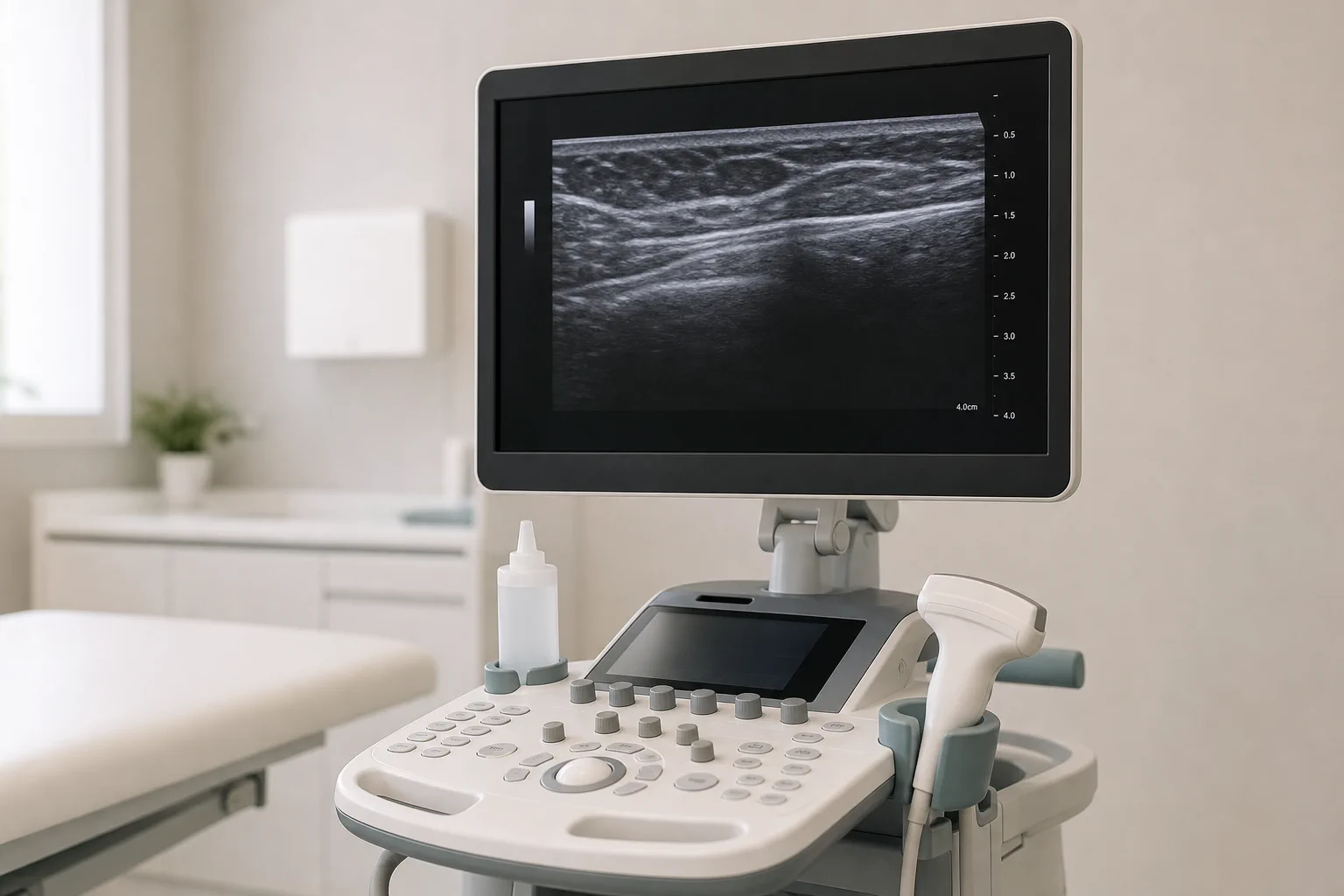
Annual ultrasound and MRI at ten years
A silicone implant rupture can be silent: it does not always change breast shape, cause pain, or become apparent on examination alone. Spain's AEMPS recommends professional follow-up for as long as a patient has implants and explains that ultrasound or MRI can identify problems that are not clinically obvious.
- First year
Postoperative checkups and ultrasound at the clinic.
We assess healing, implant position, the capsule, and any fluid collection or finding that needs monitoring. - Every year
Routine examination and ultrasound.
We review our patients annually even when they feel well. If an image is inconclusive, we request the appropriate additional test. - At 10 years
Follow-up MRI.
We use it to obtain a comprehensive assessment of implant integrity, even without symptoms. - At any time
Checkup if something changes.
New pain, hardening, swelling, asymmetry, or a change in shape should not wait until the annual appointment.
What can affect how long an implant lasts?
There is no single reason for replacement. Some factors relate to the device itself; others involve the body's response, anatomy, or changes in the breasts over time.
Implant model and generation
Shell, gel, surface, and manufacturing controls are not identical across models. Data from an older implant should not automatically be applied to a current one.
Capsule response
Every implant develops a capsule. If it thickens and tightens, it may harden or distort the breast and sometimes require treatment. This is not “rejection”; it is an abnormal scar response.
Anatomy, placement, and technique
Tissue coverage, size, pocket, implant position, and appropriately planned dissection affect stability and the visibility of folds or edges.
Pregnancy, weight, and aging
Breast tissue and skin continue to change even if the implant remains intact. Sagging, asymmetry, or a mismatch between breast and implant position can develop.
Trauma and individual events
A significant impact, infection, seroma, or another complication may require assessment or treatment sooner than expected.
Patient preferences
Over time, a patient may change her mind about volume, a natural appearance, or even whether she wants implants at all, despite them remaining intact.
The brands we currently use most often—Motiva for mia®, POLYTECH, and MENTOR in selected cases—have different ranges, surfaces, and warranty programs. We discuss technical selection in more detail in our article on breast implant brands.
When do breast implants need to be replaced?
Confirmed or strongly suspected rupture
A silent intracapsular rupture generally allows time to plan replacement. An extracapsular rupture, symptoms, or silicone migration may call for more prompt action.
Significant capsular contracture
Hardening, pain, or distortion—usually Baker grade III or IV—may require implant replacement and treatment of the capsule. Read our capsular contracture guide.
Malposition, distortion, or rippling
An implant that sits too high, has shifted or flipped, or is visible or palpable may require pocket correction, a change of placement, a different implant, or an additional technique.
Changes in the breasts over time
Sagging after pregnancy, weight changes, or aging may make a breast lift appropriate even if the implant has not ruptured.
A wish for larger or smaller breasts
A patient may prefer a different volume, shape, or feel. Before surgery, we distinguish what an implant can change from what depends on the skin or breast tissue.
A wish to remove implants permanently
After years of bodily changes, some patients prefer explantation. We assess whether to remove the implants alone or combine removal with a breast lift, fat transfer, or another reshaping procedure.
What we do if an implant has ruptured
A silicone rupture can remain contained within the fibrous capsule surrounding the implant. This is called an intracapsular rupture. If it is found in a patient without symptoms, we recommend replacement, but it can usually be arranged as a planned procedure: it is not a surgical emergency.
Planned replacement
We confirm the diagnosis, explain the options, and schedule surgery without unnecessary alarm, but we do not recommend ignoring the rupture indefinitely.
More prompt assessment
If silicone has escaped the capsule or there is swelling, pain, enlarged lymph nodes, or distortion, we assess the extent and plan removal and replacement according to the case.
The best imaging test depends on the findings. Ultrasound is often the first study, and MRI can confirm or clarify a suspected rupture. Examination and imaging also help assess fluid collections, the capsule, implant position, and lymph nodes when appropriate.
A lifetime warranty does not mean a lifetime implant
A lifetime rupture warranty generally means the manufacturer will provide one or two replacement implants if its conditions are met. It does not mean that rupture is impossible or that the entire new operation will be free. Surgeon, anesthesia, hospital, tests, medication, or capsule treatment may not be covered or may exceed the available financial assistance.
- Implant replacement for rupture during the patient's lifetime.
- Coverage for Baker grade III or IV capsular contracture for ten years.
- May provide a replacement for the opposite side if the surgeon recommends it.
- Up to US$5,000 toward documented surgery costs for rupture or contracture within ten years, subject to conditions.
- Product replacement if the shell loses integrity during the patient's lifetime, subject to registration and conditions.
- Coverage for Baker grade III or IV contracture for ten years with MESMO, POLYtxt, and POLYsmoooth.
- Microthane has specific terms, including extended coverage for contracture and rotation.
- The published coverage focuses on the implants, not every surgical cost.
- Implant replacement for rupture during the patient's lifetime.
- May provide an implant for the opposite side at the surgeon's request.
- Up to €1,000 in assistance if rupture occurs within ten years, subject to conditions.
- Product replacement for ten years in certain cases of Baker III/IV contracture, double capsule, or late seroma after augmentation.
Summary checked in August 2026. Warranties are manufacturer contracts and can change. Before making a surgical decision, we check each patient's exact model, implantation date, registration, and current terms.
If surgery is needed: replacement, a different size, or explantation
A revision does not have to repeat the original operation exactly. Before deciding, we ask what the patient wants now and how her breasts and body have changed since the first surgery.
Our breast implant revision page explains the surgical options. If you are considering a first augmentation, the full planning process is described on our breast augmentation page.
When to request an assessment
Most changes are not emergencies, but they do need an examination and often an ultrasound.
- One breast gradually becomes harder or changes shape.
- You develop new, persistent, or clearly one-sided pain.
- There is new swelling, an increase in size, or recent asymmetry.
- You can feel a fold, edge, lump, or change in position that was not there before.
- The breast changes after a significant injury.
- You have redness, an open wound, discharge, fever, or feel generally unwell.
Spain's AEMPS advises patients to seek medical advice for significant changes in firmness, position, shape, or size, as well as hardening, redness, lumps, or persistent pain. If these signs occur with fever or a general feeling of illness, assessment should be urgent.
Frequently asked questions about implant longevity
Do breast implants need replacing even if they are fine?
No. If the implants are intact, the breasts remain soft and stable, and the patient is satisfied, we do not recommend surgery just because time has passed. We continue follow-up and consider replacement only for a clinical reason or because she wants a change.
How often should breast implants be replaced?
There is no fixed interval. The approximate 15–25-year range helps with long-term planning but is not an expiration date. Replacement may be considered for rupture, significant capsular contracture, malposition, changes in the breasts, or a wish to change or remove the implants.
What is the lifespan of a breast implant?
There is no precise lifespan. As a practical clinical guide, we discuss an approximate average of 15–25 years. One patient may need replacement much sooner; another may keep intact implants for the rest of her life.
Do breast implants expire after ten years?
No. Under our protocol, we perform a follow-up MRI at ten years, but if the implants are intact and the patient is satisfied, we do not recommend replacing them solely because of their age.
How can I tell if an implant has ruptured?
Some ruptures cause distortion, pain, or a change in firmness, but others are silent. Feeling well is therefore not enough on its own: clinical and imaging follow-up matter.
Is an intracapsular rupture urgent?
A silent intracapsular rupture should be addressed with replacement, but surgery can usually be scheduled and is not an emergency. Symptoms, extracapsular silicone, or inflammation may change the timing and surgical approach.
If one implant ruptures, should both be replaced?
In our practice, if both implants have been in place for more than five years, we strongly recommend replacing both. If they are newer, we individualize the decision based on the model, imaging of the other side, and warranty terms.
Does a lifetime warranty pay for the entire operation?
Not necessarily. It may cover a replacement implant and, under some programs, limited financial assistance. Surgeon, anesthesia, hospital, and other treatments may not be included. The specific terms must be checked.
Can I replace my implants with smaller ones?
Yes. We need to assess the amount of skin and breast tissue and whether the breasts will retain an appropriate shape with less volume or need a lift.
Can I remove my implants without getting new ones?
Yes. Permanent explantation is an option. Depending on skin, volume, and changes to the body, it can be done alone or combined with a breast lift and, in some cases, fat transfer.
How often should I have an ultrasound?
Our protocol recommends annual ultrasound, in addition to checkups during the first year, and MRI at ten years. Symptoms or an uncertain finding may call for earlier tests.
Do all implants and brands last the same length of time?
We cannot assume they do. Model, generation, surface, individual response, implant placement, surgical technique, and changes in the breasts all matter. Results from one study should not be applied indiscriminately to every implant.
Medical sources and warranty terms
- AEMPS: information for patients with breast implants.
- FDA: risks and complications of breast implants.
- ACR Appropriateness Criteria® Breast Implant Evaluation: 2023 Update.
- mia® Diamond Comprehensive Coverage and Woman’s Choice Program.
- POLYTECH: Implants of Excellence program.
- MENTOR: warranty information for Europe, the Middle East and Africa.
Implants are monitored and assessed, not replaced by age alone
The 15–25-year range helps with long-term expectations, but it is no substitute for follow-up. An implant in good condition can stay in place; a rupture, contracture, malposition, or a personal wish for change may justify surgery. The best decision combines ultrasound, MRI when appropriate, clinical examination, and the patient's current goals.