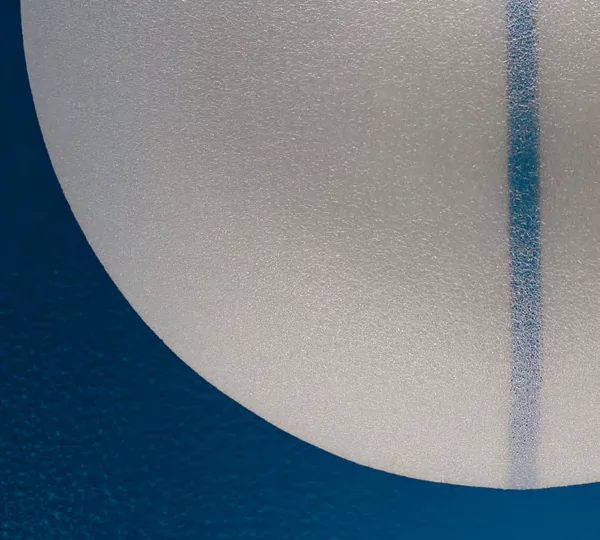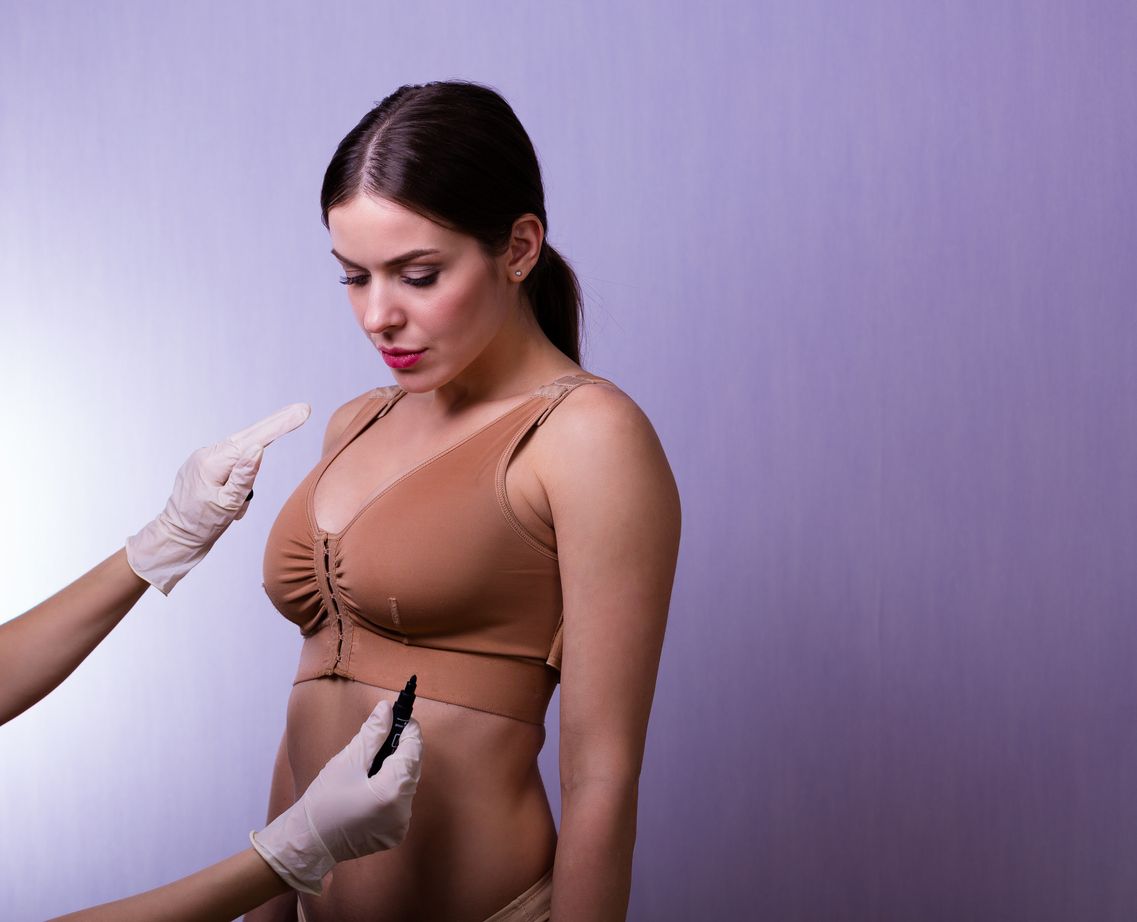
Yes: during the first month, the breasts often gradually look less widely spaced as swelling over the sternum decreases and the implants become more mobile. However, implants do not spontaneously migrate toward the center, and their final position depends on anatomy. In a straightforward breast augmentation procedure, we can place the implant, but the nipple is not moved. For a natural result, the implant needs to be centered beneath it.
That is why we distinguish apparent early separation from naturally wide-set breast bases or true lateral implant malposition. At Dr. Aso Clinic we do not judge cleavage as final during the first few weeks. Although the first month provides a lot of information, the result may take 6–12 months to stabilize, particularly in young patients with tight tissues.
The short answer about cleavage after breast surgery
The breasts may look closer together during recovery, but not because the implants move toward the center on their own. During the first few days, swelling over the sternum blurs the inner contours and the implants are relatively immobile. As swelling decreases and tissues adapt, cleavage usually becomes better defined.
That change has limits: nipple spacing, chest width, each breast's base, implant width, and the surgical pocket. Pre-existing separation does not disappear with time, and established lateral malposition generally does not correct itself either.
Article contents
I have had breast surgery and have no cleavage: is that normal?
During the first few days, the breasts often look higher, firmer, and more widely spaced than expected. Swelling over the sternum flattens the central contours, while the pocket and surrounding tissues keep the implant relatively immobile. This can be particularly noticeable in young women, whose skin and breast envelope tend to be tighter.
Swelling predominates
We do not use maneuvers designed to bring the implants together. A widely spaced appearance is often part of the inflammatory phase.
Review and prescribed garments
If examination findings warrant it, we may prescribe specific bras to gradually guide implant position. Not every patient needs them.
Improvement is usually substantial
Swelling decreases, the implant becomes more mobile, and cleavage becomes more visible. It is still not the final result.
A stable assessment
In our practice, this is a cautious timeframe for judging final separation. In patients with very tight tissues, changes may continue closer to 12 months.
For a natural result, the implant should be centered beneath the nipple
In a straightforward breast augmentation, the surgeon can choose and place the implant, but cannot change nipple position. The nipple retains its position. The implant's center must therefore relate to the nipple and the breast's actual base. This principle allows the added volume to be distributed harmoniously on both sides of the breast axis.
Naturally close-set nipples
The center of each implant is also relatively close, making narrower cleavage possible without changing the breast's axis.
Naturally wide-set nipples
When implants are correctly centered, their inner edges remain farther apart. This is not a mistake: it respects the anatomy.
An implant forced inward
Volume is concentrated medially, but the nipple sits lateral to the point of maximum projection and may appear to point outward.


Why can breasts look widely spaced after surgery?
Before considering treatment, we need to identify the cause. The appearance of "widely spaced implants" may reflect different situations, so they are not all addressed in the same way.
Early swelling and firmness
This is the usual cause at first. It often improves as swelling decreases and implants become more mobile.
May improve with time
Naturally wide-set breast bases
A wide chest, widely spaced breasts, or lateral nipple positions limit the cleavage achievable even with correct surgery.
Waiting does not change it
A narrow-base implant
A highly projecting, narrow implant may add forward volume without extending as far into the medial pole.
Depends on planning
An overly lateral pocket
The implant shifts toward the armpit or sits off-center relative to the nipple. This is malposition, not simply a lack of cleavage.
Requires diagnosis
High or low implant placement
A high implant may look firm and widely spaced; a low one changes the lower pole. These are vertical displacements, different from lateral displacement.
The direction matters
Pre-existing or acquired asymmetry
Different breast bases, capsular contracture, or tissue changes can alter the appearance of cleavage.
Individual assessment
If separation existed before surgery and you want to understand its different forms, see our article about naturally wide-set breasts. Here, we focus on what happens after surgery.
The only geometric way to gain cleavage is to gain base width
If the implant remains correctly centered beneath the nipple, the geometric way to bring its inner edge closer to the sternum is to choose an implant with a wider base. However, that added width extends both inward and outward. No implant can remain centered while growing only toward the cleavage.
Forward volume
Two implants with the same volume can have different profiles. The more projecting one concentrates volume forward and usually has a narrower base.
Medial and lateral base
A wider base extends further into the medial pole, but also the lateral pole. It must fit the breast base without crossing anatomical boundaries.

That is why we do not choose an implant by cc alone. We measure the chest and breast base, assess tissue coverage, and compare width, height, and projection. Sizers and 3D simulation help communicate the goal, but do not replace surgical planning. Read more about this decision in the guide to breast implant size and dimensions.
The placement plane and pocket affect cleavage, but are not chosen just to bring the breasts closer
When an implant is placed beneath the pectoral muscle or in a dual plane, the muscle's medial attachment to the sternum and ribs creates an anatomical boundary that must be respected. Excessive release to move the implant inward increases the risk of disrupting the pocket and losing normal central separation.
Dissection differs with placement above the muscle, and in certain anatomies it may offer a different relationship with the medial pole. However, we do not choose a placement plane simply because it might "bring the breasts closer". Tissue coverage, breast shape, implant type, the risk of visibility or rippling, physical activity, and medical history all influence the decision.
What the pocket determines
- The implant's initial position.
- Its medial, lateral, upper, and lower boundaries.
- How much freedom or stability it has during recovery.
What anatomy determines
- Nipple position and the breast base.
- The width and shape of the chest wall.
- Tissue thickness, tension, and quality.
A classification published in 2024 assesses malposition relative to the ideal breast footprint and distinguishes lateral, medial, upper, and lower directions, because diagnosis and the need for surgery vary with the direction and extent of displacement.1 Our detailed explanation of implant placement is in the article about breast implants above or below the muscle.
What may improve over the months, and what usually does not change on its own?
| Situation | Expected changes | Usual approach |
|---|---|---|
| Swelling over the sternum and early firmness | Usually improve noticeably in the first month | Follow-up and prescribed garments |
| Young, very tight tissues | May take many months to relax | Do not judge too early; assess over 6–12 months |
| Naturally wide-set nipples or breast bases | The underlying anatomy does not change | Realistic expectations and planning |
| A centered implant with a narrow base | Waiting does not add medial width | Consider dimensions only if implant replacement is indicated |
| Established lateral malposition | Usually does not recenter spontaneously | Measure displacement and assess the pocket |
Over the long term, breasts change with aging, weight fluctuations, pregnancy, and skin quality. They may develop a softer or more natural appearance, but these changes do not predictably correct anatomical breast spacing or established malposition.
Can a positioning band or bra bring the implants together?
Garments do not create a new breast base or move the nipple. They can guide an implant during an early, mobile phase, but their effect depends on the direction of the problem and the timing. During the first two weeks, we do not try to bring the implants together: the appearance is dominated by swelling. Afterward, we prescribe specific garments only if examination findings indicate them.
These are not universal percentages or guarantees
of selected early high implant malpositions may respond to a positioning band
Except for polyurethane-coated implants, which behave differently.
of selected early low implant malpositions may respond to an underwire bra
Position, sizing, duration, and follow-up must be directed by the team.
How we correct established lateral malposition
Lateral malposition means that an implant has shifted toward the armpit relative to its appropriate position within the breast base. It may be more noticeable when lying down, but should be assessed standing and in relation to the nipple, fold, and actual breast boundaries. In revision series, lateral and downward displacement often occur together.1
Confirm what has shifted
We distinguish a lateral implant from a lateral nipple, a wide base, pre-existing asymmetry, or a vertical problem.
Measure the base and pocket
We compare the current border with the desired position and assess the implant, placement plane, tissues, capsule, and previous surgery.
Correct the mechanism
Simply "pushing inward" is not enough: the lateral space must be closed and stabilized, and medial space created only if safe.
When revision surgery is indicated, repair in our protocol may include "popcorn" capsulorrhaphy to contract and reinforce the capsule, with or without capsulorrhaphy using several passes of barbed sutures. The literature describes both conventional and "popcorn" capsulorrhaphy for restoring pocket control. A retrospective series of 149 patients and 266 breasts reported a 6% surgical revision rate after "popcorn," which cannot predict an individual patient's result.23
Barbed sutures have also been described for adjusting the pocket in revision surgery. The available study includes few cases and focuses on downward malposition: it supports the use of the technique, but does not show that our particular multiple-pass protocol is superior to other options.4 For recurrence or high-risk cases, we may consider a polyurethane-coated implant to improve fixation after explaining its specific characteristics.
Can fat transfer create more cleavage?
Fat grafting can add some volume to the medial area and soften a visible step or transition. In selected cases, it is a useful addition, particularly when the implant is correctly positioned and the problem involves coverage or contour.
Its limitation is geometric: adding fat at the center still adds medial volume and therefore creates some visual off-centering. It does not move the nipple, narrow the chest, change the breast base, or repair an overly wide lateral pocket. Not all grafted fat retains the same volume, and more than one session may be needed.
Why should the breasts not be brought too close together?
Excessive dissection of both pockets toward the sternum can erase the groove separating the breasts and connect the implant spaces. This complication is called symmastia. It is not strongly defined cleavage: it is an abnormal loss of central separation.
Repair can be complex, and no single technique is accepted for all cases. A series of 100 patients with congenital and acquired symmastia illustrates the need to tailor correction to the mechanism and anatomy.5 That is why augmentation aims not to bring the breasts as close as possible, but to create a natural medial transition without crossing the midline or leaving the nipples off-center.
How we plan natural, safe cleavage
Measure the starting anatomy
Chest, breast base, nipple spacing, asymmetries, and tissue thickness.
Define the center
Relate the implant to the nipple and each breast's actual footprint.
Choose dimensions
Width, height, and projection before a single number of cubic centimeters.
Select the placement plane and pocket
According to coverage, activity, implant, tissues, and anatomical safety.
Simulate within real limits
3D simulation helps compare options, but does not change the available anatomy.
Review progress
Adapt garments and follow-up to how each implant and tissue behaves.
Compare breast augmentation results
The gallery shows how cleavage, width, and shape vary with anatomy, volume, height, weight, implant type, and technique. Use it to understand realistic possibilities, remembering that every person's anatomy is different.
Questions about wide-set breasts and cleavage after surgery
Is it normal to have no cleavage immediately after surgery?
Do implants move closer together as they settle?
When can I reliably assess the separation?
Why are my breasts still widely spaced after surgery?
Can the nipple be moved to create cleavage?
Does a larger implant bring the breasts closer together?
Can a special bra close the cleavage gap?
Can lateral malposition be corrected without surgery?
What surgery corrects implants that are too widely spaced?
Can fat fill the gap between the breasts?
Selected medical sources
The publications support classification and repair options. Postoperative timeframes and garment-use percentages come from our protocol and the team's experience.
- Pacifico MD, Goddard NV, Harris PA. Classification of Breast Implant Malposition. Aesthetic Surgery Journal. 2024;44(10):1032–1042. doi:10.1093/asj/sjae084.
- Calobrace MB, Mays C, Wilson R, Wermeling R. Popcorn Capsulorrhaphy in Revision Aesthetic Breast Surgery. Aesthetic Surgery Journal. 2020;40(1):63–74. doi:10.1093/asj/sjy324.
- Chasan PE. Breast capsulorrhaphy revisited: a simple technique for complex problems. Plastic and Reconstructive Surgery. 2005;115(1):296–301.
- Kim et al. Endoscopically Assisted Correction of Bottoming-Out Deformity Using Absorbable Barbed Sutures. Aesthetic Plastic Surgery. 2023. PMID: 37640813.
- Aquino JU et al. Congenital and Acquired Symmastia: Experience From 100 Cases Treated. Plastic and Reconstructive Surgery. 2024;153(5):873e–883e. doi:10.1097/PRS.0000000000010827.
- Colwell AS et al. Correction of Suboptimal Results in Implant-Based Breast Reconstruction. Aesthetic Surgery Journal. 2020;40(Suppl 2):S38–S49.
Natural cleavage starts with correctly centering the implant
After surgery, separation often improves substantially during the first month, but should not be judged as final until 6–12 months. If the implant is correctly centered, anatomy sets the limit. If it sits laterally, we need to identify the mechanism and repair the pocket, not push volume toward the sternum at any cost.
At a personalized assessment, we can distinguish normal recovery, underlying anatomy, and malposition, measure what width is safe, and explain what result is realistic for you.