Naturally wide-set breasts can look closer together after surgery in selected patients, but no operation can narrow the sternum or move the nipples inward during a straightforward augmentation. For a natural result, each implant should be centered beneath its nipple.
The distance between the breasts depends on chest width, the breast base, nipple position, the amount and distribution of tissue, sagging, and, in some cases, tuberous breast anatomy. That is why two patients asking for "more cleavage" may need completely different plans.
Can very wide-set breasts be brought closer together?
Sometimes the apparent spacing can be substantially reduced, but the result is limited by the starting anatomy. An appropriately sized implant base can fill more of the medial pole, tuberous constriction can be released, and a lift can reshape a sagging breast. None of these changes narrows the bony sternum.
The goal is not to achieve the narrowest possible cleavage at any cost. It is to create two proportionate breasts, with as much medial volume as the tissues allow, without shifting the implants away from the nipple axes or weakening the inner pocket boundaries.
Article contents
Why do some women have very wide-set breasts?
Spacing may simply be an anatomical variation that has remained stable since breast development. To understand it, we measure the chest, each breast's footprint, and the position of the nipple–areola complex separately. Wide spacing is not, in itself, an abnormality that needs correction.
Sternum and chest width
A wide sternum or a particular chest wall curvature leaves more space between the breast bases. Surgery does not change that bony structure.
Breast base or footprint
A narrow base occupies less medial and lateral space. Two small breasts may be centered and still leave a wide cleavage gap.
Nipple position
If the nipples sit farther laterally, the natural center of each breast and any future implant also lies farther laterally. A straightforward augmentation does not move the nipples.
Volume and distribution
A breast with little medial tissue may look more widely spaced even when nipple spacing is not particularly wide.
Sagging and loss of firmness
Ptosis, volume loss after pregnancy or weight changes, and laxity can shift volume downward and outward, visually widening the cleavage gap.
Tuberous anatomy or asymmetry
A constricted base, high fold, enlarged areola, or two different breasts require a specific diagnosis and treatment plan.
Does having wide-set breasts mean they are tuberous?
No. Tuberous breasts may combine a narrow or constricted base, underdevelopment of one or more poles, a high fold, an enlarged or herniated areola, a tubular shape, and asymmetry. One or both breasts may be affected, with widely varying severity.
Recent reviews describe many classifications and techniques, with no single procedure suitable for every patient.12 Isolated spacing, without constriction or other features, should not automatically be labeled tuberous anatomy.
A normal base and wide-set nipples
The anatomy may be proportionate and stable. Planning respects nipple position and considers how much medial fullness can be added without moving the implant off-center.
A constricted base and tubular shape
Treatment may require releasing constriction, reshaping the gland, adjusting the fold, and, depending on the case, treating the areola or adding an implant.
When there is true tuberous anatomy, a periareolar approach may be used if we need to address the areola itself or the gland behind it. This scar is not necessary for every patient with wide-set breasts. Read more about diagnosis and options in the guide to tuberous breasts.
Close-set, moderately spaced, or wide-set nipples: where the implant should sit
The dark dots represent the original nipple positions, and the blue circles the center of each implant. The upper row shows the implant centered beneath the nipple. The lower row shows what happens when it is off-center: with close-set nipples, when moved too far laterally; with wide-set nipples, when moved too far toward the sternum. The nipple does not move with the implant and no longer lies at the point of maximum projection.
Implant: position can be chosen
Centered
Off-center relative to the nipple
Close-set nipples

When the nipples are close together, the implant centers should respect that closeness if the anatomy and breast bases allow it. Moving the implants outward leaves each nipple medial to the point of maximum projection.
Moderate nipple spacing
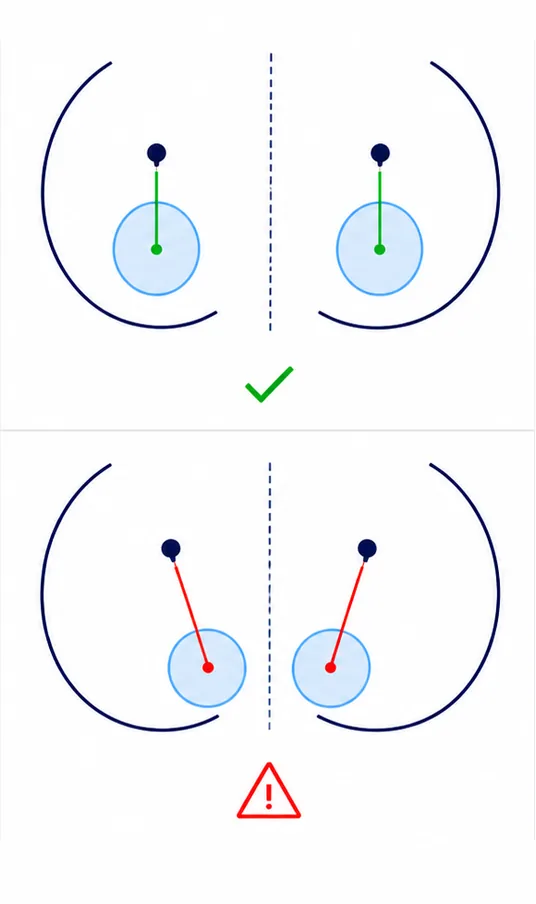
The implant's width, height, and projection are selected to fill the available base while staying aligned with the nipple.
Wide-set nipples
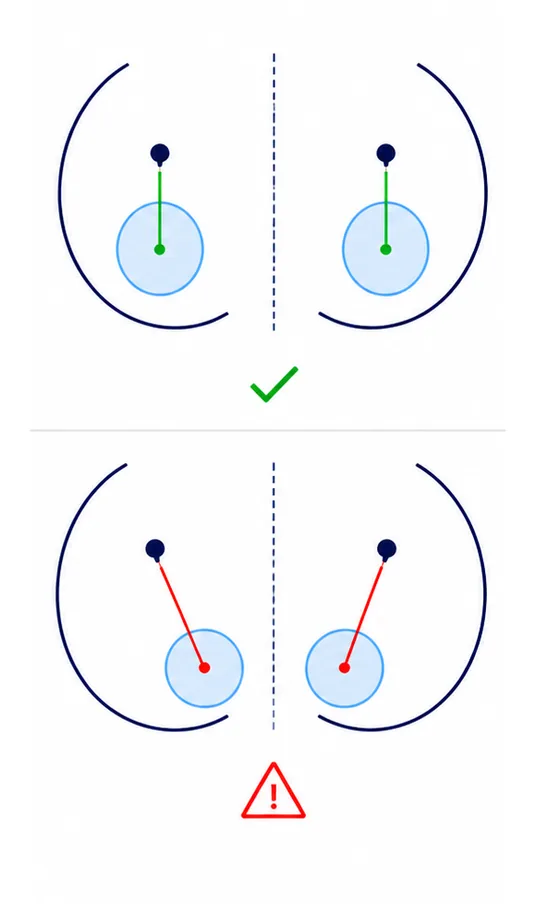
Forcing the implants toward the sternum creates more medial volume, but leaves the nipples lateral to the center of each breast.
What changes when the nipples start closer together or farther apart
These 3D planning images are not photographs of surgical results and do not precisely predict an operation. They illustrate why the original nipple spacing determines where the implant centers should sit.


Width, size, and profile: how an implant can fill more of the medial pole
To bring the inner edge closer without moving the implant off-center, we primarily need an implant base that adds width and fits safely within the breast base. That width does not extend only inward: it also extends laterally.
That is why we do not choose an implant by cubic centimeters alone. Two implants of the same volume may have different widths and projections. Dimensional selection needs to consider the base, coverage, elasticity, nipple position, and gel distribution. Tissue-based planning systems were developed specifically to prevent size preferences from overriding anatomical limits.3
Determines how much area it occupies
A wider base can extend farther medially, but also laterally. It must respect the available footprint and tissue coverage.
Determines how far it projects
A higher profile may add projection without adding the same width. It does not replace an appropriate base when medial fullness is the priority.
The result of several dimensions
Cc help compare size, but alone do not explain width, height, projection, or gel behavior.
Set the safe limit
Coverage, elasticity, and the chest determine how much the base can be widened without visibility, palpability, displacement, or deformity.

What medial fat grafting can add
Fat can add coverage or soften the transition beside the sternum in selected patients. Published series show a reduction in apparent breast spacing through grafting into the medial quadrants, but control depends greatly on anatomy, and the evidence does not make it a universal solution.4
The geometric limit is the same as with an overly medial pocket: the nipple does not move. Adding volume toward the sternum creates volume centered medial to the nipple. It may improve a contour, but, if overdone, can also leave the nipple lateral to the new point of maximum projection.
What should not be done to force cleavage
Crossing the medial pocket boundary, separating tissues over the sternum, or excessively altering the pectoral muscle's medial attachments can cause symmastia: an abnormal connection between the two pockets and loss of the central groove. It is uncommon, but difficult to correct.
The literature links acquired symmastia to medial overdissection, disruption of sternal structures, and inappropriate implant dimensions.56 The opposite can also happen: placing an implant too medially relative to a laterally positioned nipple creates a visually off-center breast. A study specifically addressing laterally positioned nipples supports adapting the pocket to that position instead of pushing the implant inward.7
An excessively wide implant
It may extend beyond the base, become visible or palpable, shift laterally, and place a load on tissues that cannot support it.
An overly medial pocket
This moves the implant off-center relative to the nipple and weakens the sternal barrier separating the breasts.
Promising a specific photograph
Another patient's cleavage may depend on completely different nipples, chest, and breast bases.
Are the results permanent?
Releasing constriction, redistributing the gland, or constructing the pocket well can produce lasting structural improvement. However, it is not appropriate to promise a permanent result that remains identical throughout life.
Skin, gland, and implants change with aging, gravity, weight changes, pregnancy, breastfeeding, and tissue quality. How close the breasts look when wearing a bra or changing posture may also vary.
Swelling and firmness
The area over the sternum may be swollen, and implants relatively immobile. Early cleavage does not allow the final result to be judged.
Gradual adaptation
Swelling decreases and tissues relax. This process can be particularly slow in young patients with tight tissues.
A stable aesthetic assessment
Shape, scars, and the relationship between implant and tissues can be assessed more reliably after they mature.
Follow-up, the postoperative bra, and restrictions depend on the specific technique. General advice about creams or massage does not replace individualized instructions.
What if the breasts look widely spaced after surgery?
During the first few weeks, this may reflect swelling over the sternum, tissue tension, and limited implant mobility. The first month usually brings substantial improvement, but cleavage cannot be assessed as final until 6–12 months, particularly in young patients with firm tissues.
Persistent spacing may reflect the original anatomy, a narrow implant base, or true lateral malposition. That diagnosis and the options involving bras, bands, fat grafting, or capsulorrhaphy are covered in a separate guide.
Read "Do Breasts Move Closer Together After Augmentation?" →
Breast augmentation results and 3D planning
A single photograph cannot tell you which technique would suit another patient. The interactive gallery helps compare cases by volume, height, weight, implant shape, and technique. In consultations, we also use measurements, mirror-based trials, and 3D simulation when useful, without presenting it as an exact prediction.

Meet Dr. Aso
Dr. Jorge Aso is a specialist in Plastic, Aesthetic and Reconstructive Surgery through Spain's MIR training system, completing his training at Hospital Universitario 12 de Octubre in Madrid, and holds a doctorate in Medicine cum laude from Universidad Complutense de Madrid. His surgical practice focuses particularly on aesthetic breast surgery.
He currently performs over 500 aesthetic breast operations a year and has performed more than 4,000 breast augmentations, according to the clinic's internal records.
For a patient concerned about wide-set breasts, he assesses nipple position, each breast's base, the sternum, chest, coverage, elasticity, and any asymmetries. These measurements show how much medial volume can be added without moving the result off-center, and whether there is also tuberous anatomy or sagging.
His priority is to explain what an implant can improve and which limits must be respected. A natural result depends on an appropriate indication and on recognizing when cleavage cannot be safely created within the available anatomy. He also teaches and lectures internationally on aesthetic breast surgery.
* Experience and surgical volume figures come from the clinic's internal records, updated in June 2026.
Frequently asked questions about wide-set breasts
Why are my breasts so widely spaced?
Does having wide-set breasts mean they are tuberous?
Can implants bring breasts closer together?
Can the nipple be moved inward during augmentation?
Does a larger implant always create more cleavage?
Can fat grafting close the gap between the breasts?
Does surgery produce a permanent result?
When can cleavage be assessed after surgery?
Selected medical sources
- The Surgical Treatment of Tuberous Breast Deformity: A Review Article. 2023. PMID: 37566822.
- The Different Surgical Strategies for Treating Tuberous Breast Deformity: A Scoping Review. 2024. PMID: 39555168.
- Tebbetts JB. A system for breast implant selection based on patient tissue characteristics and implant-soft tissue dynamics. Plast Reconstr Surg. 2002. PMID: 11964998.
- Serra-Mestre JM et al. Breast Cleavage Remodeling with Fat Grafting: A Safe Way to Optimize Symmetry and to Reduce Intermammary Distance. Plast Reconstr Surg. 2017. PMID: 29068922.
- Selvaggi G et al. Synmastia: prevention and correction. Ann Plast Surg. 2010. PMID: 20948424.
- Kalaria SS et al. Iatrogenic Symmastia: Causes and Suggested Repair Technique. Aesthet Surg J. 2019. PMID: 30137185.
- Khan UD. Breast augmentation in asymmetrically placed nipple-areola complex in the horizontal axis: lateralisation of implant pocket to offset lateralised nipples. Aesthetic Plast Surg. 2009. PMID: 19296149.
The best cleavage respects each breast's axis
Surgery can add medial volume, release constriction, lift a sagging breast, or improve asymmetry. It should not use off-center implants to create the illusion that the nipple or sternum is in a different position.
A useful assessment identifies whether your spacing is a normal variation, tuberous anatomy, a result of sagging, or a combination, and compares what can be achieved without compromising a natural appearance or safety.