
MIA Femtech® and Preservé™ share a minimally invasive approach, but suit different anatomies. The important question is not which is “better” in general, but how much volume you want, the position of your breast folds, your tissue coverage and whether any additional correction is needed.
Is MIA Femtech or Preservé better?
If you want less than 200 cc and do not need changes to the breast fold or glandular tissue, both techniques may give a very similar result. In this situation, we tend to favor MIA slightly. Its incision is in the armpit. The Diamond implant has a relatively narrow diameter and slightly greater projection; its biconvex shape avoids the shape change associated with front-to-back implant flipping.
Preservé is usually our preferred option when the desired volume is between 200 and 320 cc or more anatomical adjustment is needed. Its wider implant range and inframammary access allow us to release or lower a high breast fold and address some asymmetries, short lower poles and mild tuberous breasts.
In our protocol, both use local anesthesia with intravenous sedation, without general anesthesia or intubation. Our early experience has not shown a clinically meaningful difference in pain or speed of recovery; this does not establish equivalent long-term safety.
Preservé extends our practical range to 320 cc.
Average incision: 2.3 cm in the armpit for MIA; 2.5 cm beneath the breast for Preservé.
More scope to address high folds, asymmetry and mild tuberous anatomy.
Diamond offers slightly more projection at the same nominal volume.
In this article
MIA Femtech vs. Preservé: comparison table
This table summarizes our clinical approach. It does not replace an examination, but shows which factors can change the recommendation.
| Feature | MIA Femtech | Preservé |
|---|---|---|
| Access | Armpit incision with a dedicated implant delivery system. | Inframammary fold beneath the breast. |
| Average incision | 2.3 cm, away from the breast. | 2.5 cm, within the breast fold. |
| Implant | Biconvex Diamond. | Ergonomic Ergonomix2. |
| Our practical range | 165–195 cc. | 200–320 cc. |
| Projection | Slightly greater at the same nominal volume because of the biconvex shape. | Measured volume closer to the nominal implant volume. |
| Flipping | A change in front-to-back orientation does not alter its shape because both surfaces are convex. | Front-to-back flipping of Ergonomix2 can change breast shape and may require revision. |
| Changing the fold | Not indicated when the fold needs to be lowered. | Can release or lower a high fold and adjust a short lower pole. |
| Asymmetry | May suit very minor asymmetry. | A wider range of volumes and better access to uneven folds. |
| Mild tuberous anatomy | Usually unsuitable because the fold often needs lowering. | An option in selected cases, with glandular correction. |
| Breast drooping | May be an option if the nipple remains at or above the fold. | The same criterion for augmentation alone; Preservé mastopexy may suit selected grade II drooping. |
| Anesthesia | Local anesthesia plus sedation, without intubation in our protocol. | Local anesthesia plus sedation, without intubation in our protocol. |
| Recovery | Similar in our early clinical experience. | Similar in our early clinical experience. |
What MIA and Preservé have in common
Prepectoral placement
The implant sits above the muscle in patients with adequate tissue coverage. The pectoral muscle is not divided or manipulated as it may be in submuscular augmentation.
Controlled expansion
A balloon and dedicated instruments create the implant pocket, reducing dissection compared with conventional surgery.
Local anesthesia and sedation
In our protocol, an anesthesiologist monitors the patient during intravenous sedation. She breathes independently without intubation; the anesthesia plan is confirmed individually.
Early recovery
In the clinical series reported in our Spanish guide, the median return to office work was day three, with no meaningful difference between the techniques. This is not a guarantee or clearance to fly.
Our protocol uses approximately 200 cc of a solution containing local anesthetic—not 200 cc of the active anesthetic drug. This provides local pain relief during the early hours. Moderate implant sizes, muscle preservation and reduced dissection also contribute to recovery.
In fewer than 5% of procedures in our experience, a small blood vessel has required direct coagulation or a ligament has needed division to allow expansion. We have not observed a difference between the techniques in this respect. Minimally invasive does not mean that no surgical intervention is needed: tissue disruption is limited where possible.
How the breast moves matters as well as photographs
A breast should not be assessed only in a still, front-facing photograph. Placement above the pectoral muscle avoids the implant animation associated with some submuscular augmentations. Assessment includes standing, walking, moving the arms and contracting the chest, as well as still images.
How we choose between MIA and Preservé
Less than 200 cc and no need for anatomical correction
- Well-positioned, symmetrical breast folds.
- A preference for a modest, proportionate change.
- A priority to place the scar in the armpit.
- A slim patient for whom a narrow implant diameter is useful.
- A preference for slightly greater projection at a smaller volume.
- Interest in the dedicated delivery system and manufacturer coverage, subject to its terms.
When either option is suitable below 200 cc, we tend to favor MIA slightly. It is positioned as a more premiumoption, but that only becomes relevant after confirming that it suits the anatomy.
More volume or a need to adjust the anatomy
- A target volume between 200 and 320 cc.
- A naturally high fold that needs releasing or lowering.
- A short or less stretchable lower breast pole.
- Uneven folds or more noticeable asymmetry.
- Mild tuberous anatomy requiring glandular correction.
- Selected grade II drooping in a breast that is not too heavy, where Preservé mastopexy may be appropriate.
In our practice, Preservé is not used to raise a naturally low fold. Its advantage is the ability to release or lower a high fold and, when indicated, work on glandular tissue through the same incision.
Nominal volume and apparent size are not always the same
We use MIA implants from 165 to 195 cc. In the series described in our Spanish guide, the median was 190 cc and the most common size was 195 cc. Preservé implants ranged from 200 to 320 cc, most commonly 250–285 cc.
We describe 320 cc as our practical Preservé limit. Although a 330 cc size is referenced, insertion can be difficult in many patients with the current balloon technology. A theoretical maximum should not become a general expectation.
Preliminary research from our team
Understanding volume efficiency
Our Spanish guide describes a retrospective study submitted for scientific review: 28 patients with Diamond implants placed using MIA and 15 with Ergonomix2 implants placed by conventional prepectoral augmentation. Crisalix 3D measurements were obtained before surgery and at three months, with analysis by a blinded researcher.
This preliminary observation may help explain why a 190 cc MIA implant can appear similar in volume to a conventional ergonomic implant of around 210 cc. The biconvex geometry may concentrate more volume in the front-to-back axis and increase projection. It is not a predictable size conversion for every patient.
Important limitation: this was a small retrospective cohort, and the Ergonomix2 group did not undergo Preservé. The study primarily compares implant geometries; it does not establish that MIA is superior to Preservé. Larger prospective studies are needed.
BMI alone does not determine suitability
In our practice, a BMI above 27 is not an automatic exclusion. Proportions matter: 195 cc can create a very small change on a larger frame. Preservé may provide up to 320 cc for someone seeking a subtle increase, although the same volume looks different on different bodies. Individual assessment remains essential.
Where are the scars?
MIA: an armpit scar
The incision is near the border of the pectoral muscle and is usually concealed when the arms are resting normally. It is generally smaller than the incision used for conventional transaxillary augmentation. Scar visibility varies with healing and arm position; it is not scar-free surgery.
Preservé: a scar in the breast fold
The scar can be well concealed when the breast forms a small fold over the chest. If there is little or no fold, it may remain visible when viewed from below or when the breast is lifted.
Both scars are generally well tolerated in our experience. If scar location is the deciding factor, MIA places it away from the breast; neither technique guarantees an invisible scar.
Anatomy matters more than the technique name
Tissue coverage and the pinch test
We apply the same coverage assessment to both techniques in every breast quadrant. In our practice, less than 1 cm usually excludes prepectoral placement; between 1 and 2 cm requires individual assessment. Around 1.5 cm is our usual practical minimum, while 2 cm generally provides better coverage—not a guarantee of safety.
MIA may meet this criterion more readily in some slim patients because the implant is usually around 9 cm in diameter or smaller and extends less into peripheral areas with thinner tissue.
Mild tuberous breasts
Preservé may be an option because it allows implant placement, glandular correction and lowering of a high fold. MIA is usually unsuitable when the inframammary fold needs lowering, as it does in many tuberous breasts.
Asymmetry
Either technique may address very minor asymmetry. For more noticeable differences, Preservé offers a wider choice of implant volumes. Uneven folds and a shorter lower pole on the smaller side are also more accessible through an inframammary incision.
Neither technique can guarantee perfect symmetry.
Existing drooping (ptosis)
If the nipple remains at or above the fold, MIA or Preservé augmentation alone may be options. Where drooping is already present, augmentation may act as a temporary compromise for someone wishing to postpone breast-lift scars; it does not lift the nipple and a future mastopexy may still be needed.
For selected grade II drooping in breasts that are not too heavy, Preservé mastopexy may be considered. For grade III drooping or very heavy breasts, our usual recommendation is a conventional mastopexy, often with submuscular implant placement when an implant is indicated.
Previous surgery
Previous breast surgery does not always rule it out
We have used MIA or Preservé in selected patients after a lift without implants, an earlier reduction followed by weight loss, implant removal followed by a wish to restore a small amount of volume, or fat grafting that produced insufficient volume. Current anatomy and tissue quality need careful assessment.
A contraindication in our practice
We do not offer these techniques for an irradiated breast
In our practice, previous breast radiotherapy is an absolute contraindication to MIA or Preservé because of concerns about expansion, outcomes and capsular contracture. Previous breast-conserving cancer surgery without radiotherapy would require highly individualized assessment; adequate anatomy and coverage alone do not establish oncological suitability.
Our choice is not based on a proven difference in pain or early safety
The series reported in our Spanish guide includes 160 consecutive patients: 51 MIA and 109 Preservé. We began using these techniques in October 2024. Mean follow-up in that report was approximately eight months, so the findings describe early experience, not established long-term outcomes. We did not observe a clinically meaningful difference in pain.
We therefore do not present one as the safe option and the other as unsafe. The decision depends on anatomy, volume, access and implant characteristics. When both suit a target below 200 cc, we tend to favor MIA slightly for its scar location, smaller diameter, biconvex shape, delivery system and manufacturer coverage—not because our series has proved fewer complications.
Three examples to illustrate the options
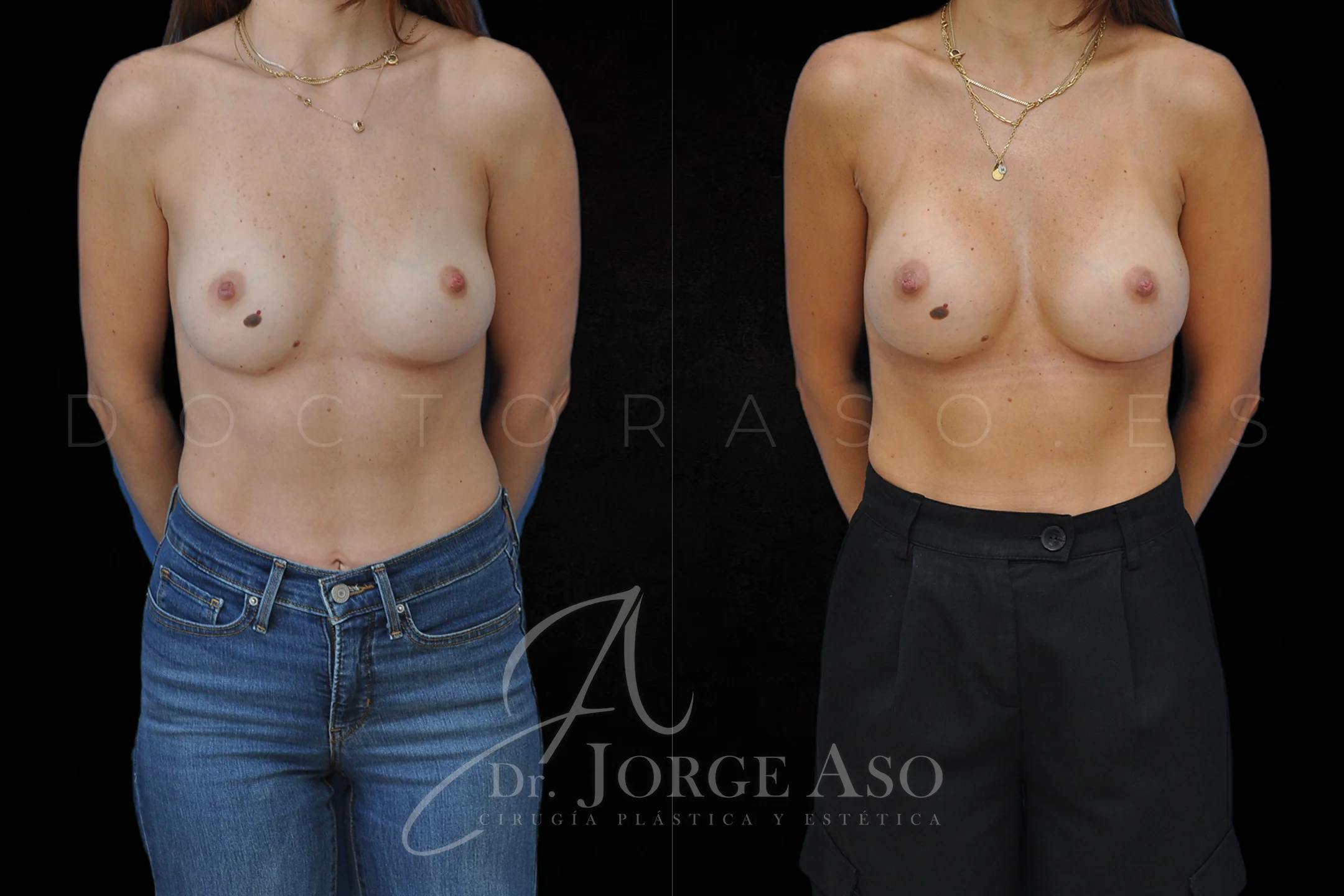
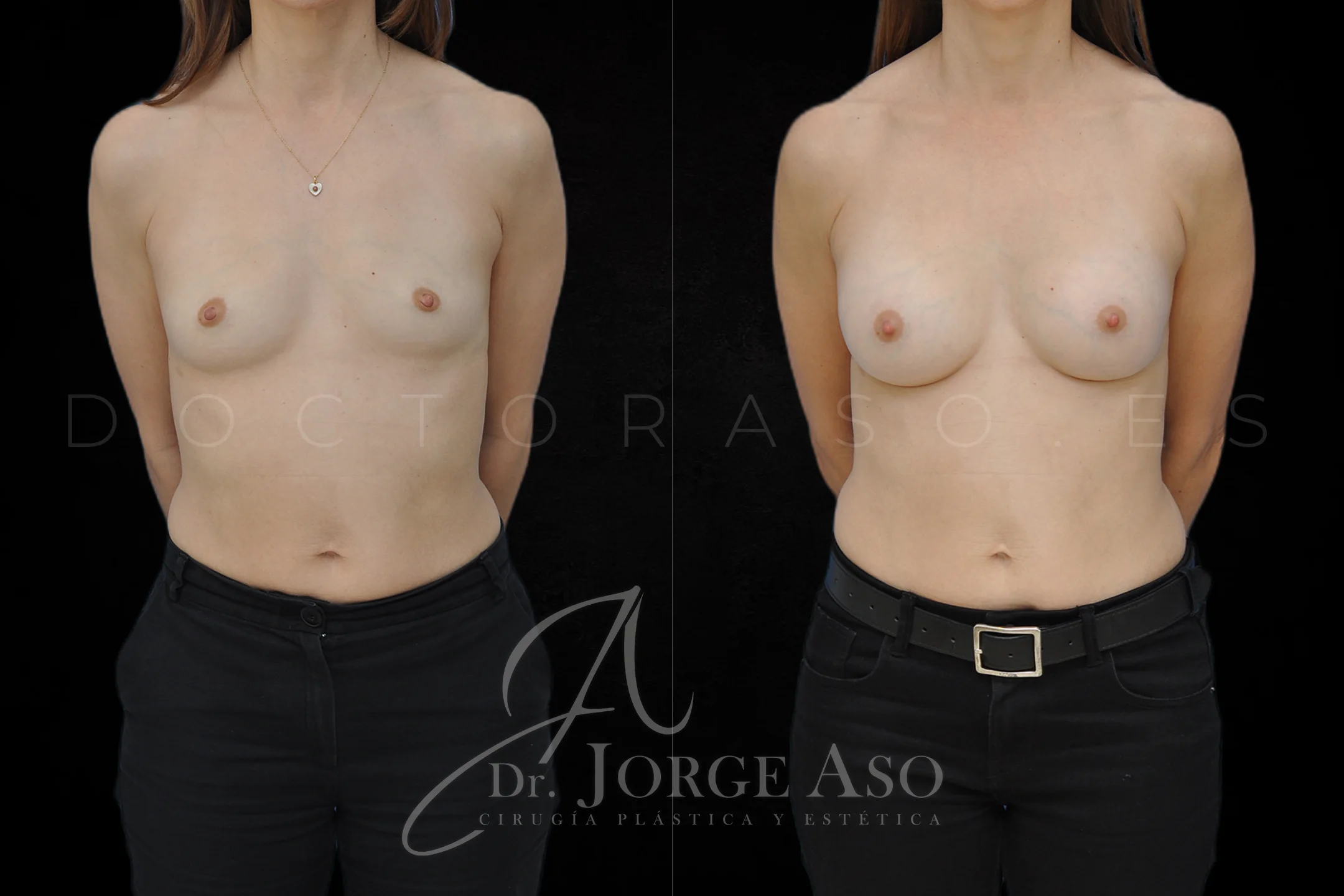
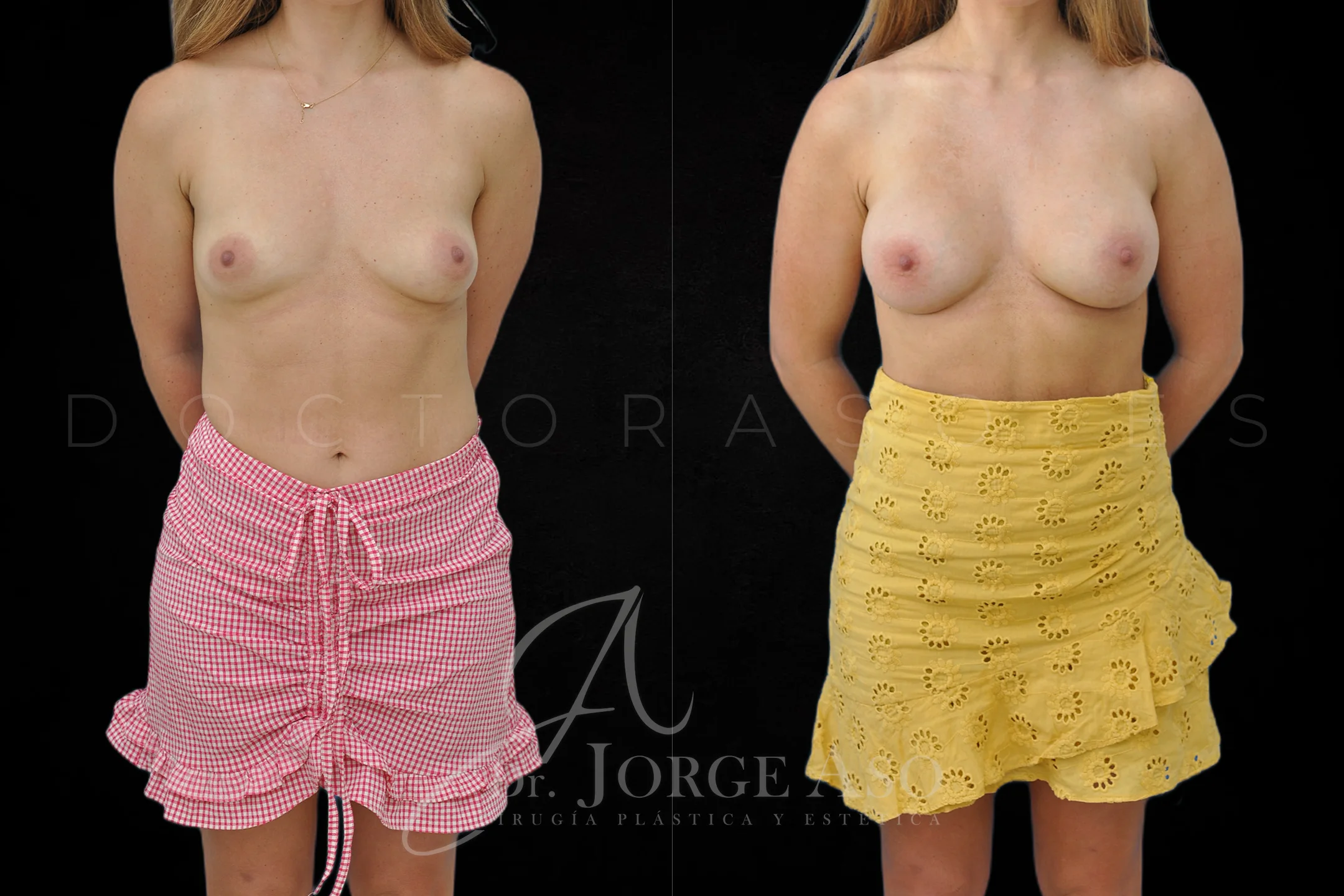
These photographs show individual outcomes, not a promise of your result. They help compare patients with similar proportions and goals. A consultation—not choosing a photograph—determines which technique and size may suit you.
MIA Femtech
190 cc: a modest volume change
Biconvex Diamond implants and an armpit incision.
Preservé
225 and 270 cc: a wider choice of volume
Ergonomix2 implants through the breast fold.
MIA vs. Preservé: frequently asked questions
Which technique has the less visible scar?
MIA often has an advantage because its average 2.3 cm incision is in the armpit, away from the breast. The Preservé incision averages 2.5 cm and may be well concealed in an existing breast fold. Scar visibility varies with anatomy and healing; neither option is scar-free.
Which allows a larger increase?
Preservé. Our practical range is 200–320 cc, compared with 165–195 cc for MIA. The choice depends on chest width, tissue coverage and the change you want—not just the number of cubic centimeters.
Can a 190 cc MIA implant look larger than its nominal size?
In our preliminary retrospective 3D study, described in the Spanish guide as under scientific review, the MIA group showed approximately 20 cc more measured volume than nominal implant volume. This may help explain an appearance comparable to roughly 210 cc with a conventional ergonomic implant. It is not a reliable conversion for every patient, needs confirmation in larger studies and was not a direct comparison of MIA against Preservé.
Which looks more natural?
For a patient suitable for both, with similar volumes, the appearance can be very similar. Tissue coverage, size selection, skin quality and pocket planning matter more than the technique name. Diamond tends to offer slightly more projection at the same nominal volume.
Which is better for a very slim patient?
Both require adequate tissue coverage. MIA may meet the criteria more readily in some slim patients because the implant diameter is generally around 9 cm or smaller, extending less into peripheral areas with thin tissue. We still measure the pinch test in every quadrant and do not recommend prepectoral placement when coverage is inadequate.
Can MIA or Preservé be used with a BMI above 27?
A BMI above 27 alone is not an automatic exclusion in our practice. On a larger frame, the maximum 195 cc MIA implant may produce too small a change. Preservé may offer up to 320 cc for a subtle increase, subject to individual suitability.
Which is better for tuberous breasts?
For mild tuberous anatomy, Preservé may allow glandular correction and lowering of the fold. MIA is usually unsuitable when a high fold needs to be changed. More pronounced tuberous anatomy may need a different approach.
Do MIA or Preservé lift a drooping breast?
Augmentation alone does not truly lift the nipple. If it remains at or above the fold, adding volume may be an option or a temporary compromise. Selected grade II drooping may suit Preservé mastopexy. For grade III drooping or very heavy breasts, we generally recommend a conventional lift.
Which is less painful or has a faster recovery?
We have not observed a clinically meaningful difference in our early series. Median return to office work was day three. In our protocol both use local anesthesia and sedation without intubation; discharge is often possible after 2–3 hours if clinical criteria are met. These figures are not guarantees and do not determine when it is safe to fly.
Is MIA more expensive than Preservé?
MIA is positioned as a more premium option because of its dedicated implant, armpit delivery system and manufacturer coverage. Cost should not determine the technique before anatomy is assessed. Current figures and what each estimate includes are explained in our MIA and Preservé pricing guide.
Which is safer?
Our early experience in carefully selected patients has been favorable with both, but it does not establish that either causes fewer complications. Safety depends on appropriate selection, tissue coverage, implant volume, surgical technique and follow-up. Read our detailed MIA and Preservé safety analysis.
There is no universal winner—only an option that fits your anatomy
MIA is often our first choice below 200 cc when the fold is well positioned and no glandular correction is needed. Preservé offers more flexibility for larger volumes, fold adjustment, asymmetry or mild tuberous anatomy. If both are suitable, examination, ultrasound, measurements and 3D simulation help guide the decision.
Good planning means explaining what each option can and cannot achieve—not forcing a technique to fit. If you are traveling to Madrid, we can discuss your goals in English by video before arranging an in-person examination. Initial consultations are 100 EUR. Travel and follow-up timing must be agreed individually.
Clinical guidance from Dr. Jorge Aso
Adapted from Dr. Aso’s Spanish comparison guide. Clinical series and preliminary research are described with their original limitations; individual outcomes vary. Dr. Aso speaks native-level English and has trained in the United States.
Medical transparency

Medical authorship

Jorge Aso, MD, PhD
Specialist in Plastic, Aesthetic and Reconstructive Surgery (Spanish MIR training)
Medical registration no. 2828/61062 · Madrid
Original Spanish article updated
About MIA Femtech vs. Preservé: Which Is Right for You?: clinical information, safety and expectations. Based on the original Spanish content.
Translation does not constitute a new medical review. This information does not replace an individual medical assessment.
View profile, training and credentialsMedical sources and editorial standards Selected references for this article 4 references
References support the general medical information. Suitability, alternatives, and risks are discussed individually during consultation.
- Patient information on breast implants Spanish Agency of Medicines and Medical Devices (AEMPS)
- 3-Year Results of a 100-Patient Prospective Study of the Safety and Effectiveness of Mia Femtech Aesthetic Surgery Journal / PubMed
- The Study of the Safety and Effectiveness of Motiva SmoothSilk Silicone Gel-filled Breast Implants: 5-Year Clinical Data Aesthetic Surgery Journal / PubMed
- A Systematic Review and Meta-Analysis of 11,686 Breasts Undergoing Transaxillary Augmentation Plastic and Reconstructive Surgery / PubMed
Latest articles
MIA Femtech and Preservé consultation checklist
Dr Jorge AsoDr. Jorge Aso is a plastic surgeon with extensive academic and clinical training. He leads Dr. Aso Clinic, with a particular focus on breast surgery alongside other aesthetic…
B-Lite Lightweight Breast Implants: Benefits, Drawbacks, and When We Recommend Them
Explore B-Lite lightweight breast implants: weight reduction, feel, benefits, limitations, extra cost, and when Dr. Aso recommends MESMO or MICROTHANE.

Fat Transfer: What It Is, How Long It Lasts, and What to Expect
Dr Jorge AsoDr. Jorge Aso is a plastic surgeon with extensive academic and clinical training. He leads Dr. Aso Clinic, with a particular focus on breast surgery alongside other aesthetic…
Uneven Breasts: Causes, Warning Signs, and Treatment Options
Dr Jorge AsoDr. Jorge Aso is a plastic surgeon with extensive academic and clinical training. He leads Dr. Aso Clinic, with a particular focus on breast surgery alongside other aesthetic…