
What a drain can do
- Remove and measure fluid in selected cases.
- Allow the team to assess whether the fluid is serous or bloodstained.
- Reduce a fluid collection when there is a specific indication.

A drain can be useful in specific situations, but it is not a prerequisite for safe breast surgery. At our clinic, we do not use drains routinely in primary breast surgery: the decision depends on the procedure, the tissues, and what happens during the operation.
In most primary breast procedures, no. Our usual practice is to perform breast augmentation, breast lifts, reductions, and tuberous breast correction without drains. Careful control of bleeding, an atraumatic technique, and appropriate follow-up are more important than placing a tube as a precaution.
We reserve drains for selected secondary procedures, for example after a seroma or an infection, or in some capsulectomies. Even replacing a ruptured implant does not necessarily require a drain.
To assess our actual outcomes, we reviewed primary breast procedures performed without drains over an eight-year period. We defined a clinically significant event as a hematoma requiring reoperation, evacuation, or subsequent drain placement. We did not count minor bruising, normal postoperative swelling, or a fluid collection that only required observation as an event.
| Procedure | Cases | Hematomas | Rate |
|---|---|---|---|
| mia® / Preservé™ | 160 | 0 | 0.00% |
| Conventional breast augmentation | 1,343 | 3 | 0.22% |
| Breast lift with implants | 989 | 3 | 0.30% |
| Breast reduction or lift without implants | 679 | 2 | 0.29% |
| Tuberous breast correction | 216 | 1 | 0.46% |
| Total | 3,387 | 9 | 0.27% |
A surgical drain is a thin tube that runs from the surgical space to a small suction reservoir. It removes blood or fluid during the first few days and allows the amount and appearance of the fluid to be monitored.
It can be useful when a surgical space has a particular risk of fluid accumulation, when tissues are inflamed or contaminated, or in complex secondary surgery. However, it does not stop a bleeding vessel, replace meticulous control of bleeding, or guarantee that a hematoma, seroma, or infection will not develop.
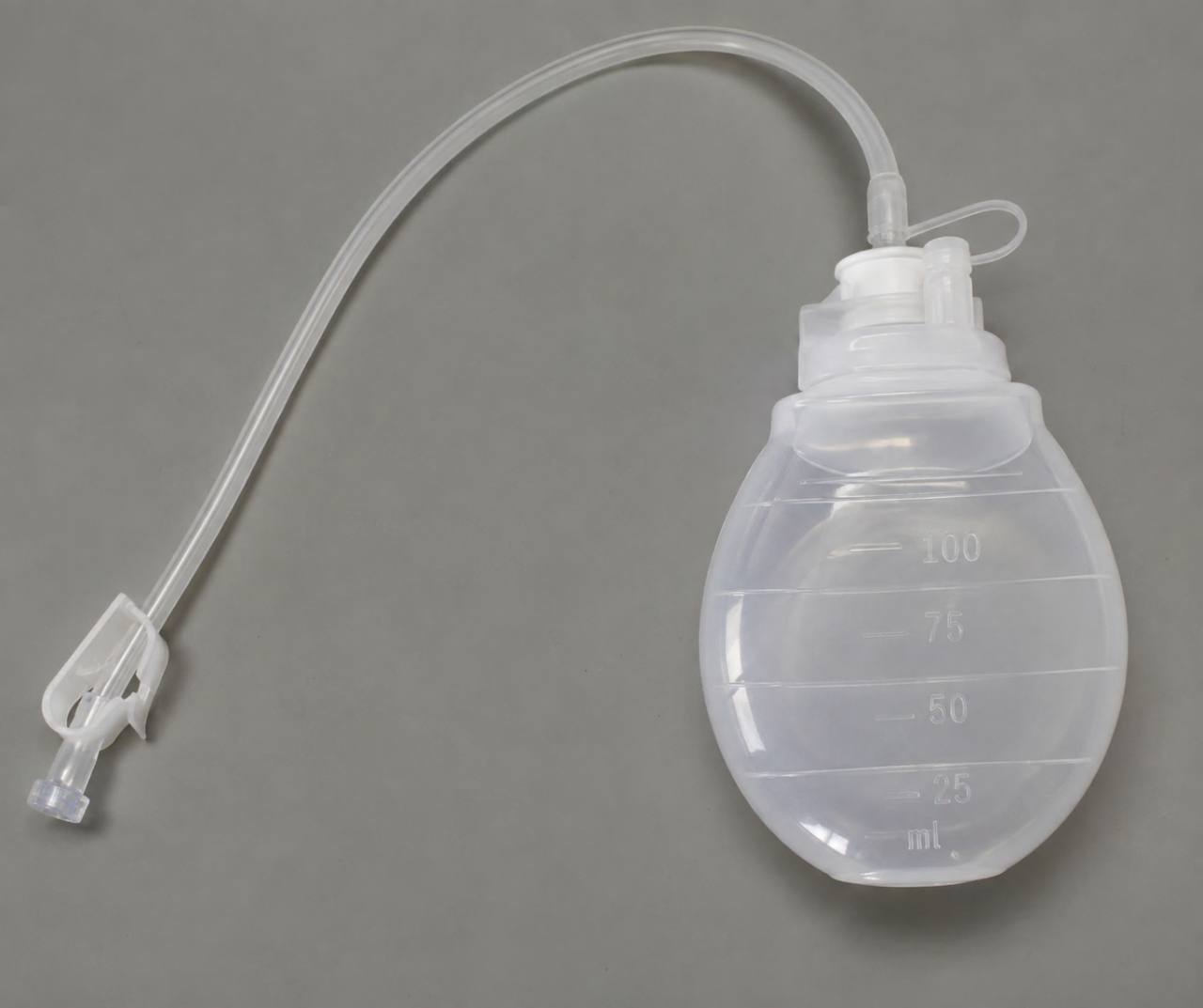
The available literature does not justify automatically using drains in every primary breast augmentation. A randomized trial involving 150 patients found no clinical benefit from drains in primary subglandular augmentation. A systematic review specifically examining breast augmentation found similar complication rates, while highlighting the heterogeneity and limited number of comparative studies.
A series of 1,617 primary augmentations without drains has also reported low rates of hematoma, seroma, and infection. This was an observational experience from a single surgeon, with patients lost to follow-up, so it should not be considered definitive proof. It is nevertheless consistent with the view that routine drains are not essential in a well-performed primary augmentation.
Because the tube passes through the skin and temporarily connects the surgical space to the outside, there is a biologically plausible possibility of bacterial contamination. This makes it important to keep the system closed, handle it correctly, and not leave a drain in place without a clinical indication. Bacterial biofilm has been associated with capsular contracture, but the available evidence does not establish that a routine drain causes contracture by itself or that avoiding one eliminates the risk. Capsular contracture has multiple contributing factors.
We do not place drains routinely in conventional augmentation, mia® and Preservé™, breast lifts with or without implants, breast reduction, or primary tuberous breast correction.
A drain may be appropriate after cleaning and treating the surgical space, depending on the condition of the tissues and the fluid found.
Extensive capsule removal can create surfaces that release fluid. We assess this individually; not every capsulectomy requires a drain.
An implant rupture does not automatically require a drain. After thorough cleaning, and when the remaining capsule is healthy, we usually avoid one, with excellent results in our experience.
Reconstruction involves different risks and surgical spaces. Its protocol should not be inferred from the one used for primary cosmetic surgery.
Avoiding a drain does not mean less monitoring. It requires meticulous surgery and a consistent protocol, from the operating room through follow-up.
We systematically inspect the pocket and control every bleeding point before closing.
Reducing tissue injury and creating a precise pocket limit dead space and unnecessary inflammation.
We irrigate when indicated and use a stable closure that protects the tissues during early recovery.
Follow-up examinations and ultrasound help identify small collections early and determine whether observation or treatment is needed.
A significant hematoma is not “solved” by placing a preventive drain. A rapid increase in volume, pain, or asymmetry suggesting bleeding requires assessment and, when appropriate, evacuation and control of the bleeding source.

Most of our patients who have had drains after secondary surgery describe them as uncomfortable or painful. The exit site can pull during movement, the tube requires constant attention, and the reservoir can make dressing, washing, and resting more difficult.
Drains can also affect quality of life while they are in place: patients may worry about catching the tube or about the amount or color of the fluid, and may need help emptying the reservoir. Avoiding an unnecessary drain makes a tangible difference to postoperative recovery.
The team should explain how to maintain suction, secure the reservoir without tension, and record the output. The exit site and dressing should remain clean and dry, following the care instructions provided. Patients should not cut the tube, insert anything into it, or attempt to remove it. They should not apply products or change the prescribed care on their own.
The reservoir should sit below the exit site, without pulling, kinking, or pressing against the skin.
Record the amount and observe whether the fluid becomes clearer and more serous.
Handle it only as instructed, and contact the team if it loses suction, opens, or moves out of position.
In our protocol, we remove a drain when both of the following conditions are met:
Some patients meet these criteria quickly; others need more time. Keeping a drain solely according to the calendar, or removing it just because “three days have passed,” oversimplifies a decision that should consider the amount and appearance of the fluid, the examination, and the procedure.
Our current protocol is to continue oral antibiotics until the drain is removed. This is our own approach, not a universal rule: the available evidence does not establish that continuing antibiotics for the entire time a drain remains in place is always appropriate.
The World Health Organization's global guidelines on surgical site infection advise against automatically extending prophylaxis solely because a drain is present. However, this recommendation is based on low-quality evidence and covers very different operations. The decision should be individualized according to contamination, previous infection, implants, the procedure, and the treating team's judgment.
An isolated low-grade fever immediately after surgery can be a physiological response to the operation and is not, on its own, a warning sign. It should be assessed alongside the recovery course, temperature, wound, and other symptoms.
In our internal series of 3,387 primary procedures without drains, nine patients—0.27%—needed reoperation, evacuation, or subsequent drainage for a hematoma. The risk is never zero, but these results do not justify routine drain use in our practice.
It can remove fluid while it is working, but does not eliminate the cause or guarantee that a seroma will not develop after removal. With a seroma after breast surgery, diagnosis and treatment depend on when it develops and its characteristics.
No. When replacing a ruptured implant, thorough cleaning and a healthy remaining capsule often allow us to avoid a drain. We are more likely to consider one after an infection or seroma, or in selected capsulectomies.
Removal usually takes a few seconds. It may cause a pulling sensation or brief discomfort, but usually does not require anesthesia. Discomfort while the drain is in place often concerns patients more than removal itself.
There is no strong evidence that a routine drain prevents capsular contracture. It has multiple contributing factors and should not be attributed to a single measure.
A drain is not inherently good or bad. It is a useful tool when there is a specific clinical reason for it. In our experience, routine placement in primary breast surgery adds pain, discomfort, and limitations without enough benefit to outweigh them.
That is why we do not use drains in primary surgery, reserving them for selected secondary procedures. To learn how we organize the rest of recovery, see our breast augmentation aftercare protocol.
Medical authorship

Specialist in Plastic, Aesthetic and Reconstructive Surgery (Spanish MIR training)
Medical registration no. 2828/61062 · Madrid
About Drains After Breast Surgery: When They Are Needed and When They Can Be Avoided: clinical information, safety and expectations. Based on the original Spanish content.
Translation does not constitute a new medical review. This information does not replace an individual medical assessment.
View profile, training and credentialsReferences support the general medical information. Suitability, alternatives, and risks are discussed individually during consultation.
Dr Jorge AsoDr. Jorge Aso is a plastic surgeon with extensive academic and clinical training. He leads Dr. Aso Clinic, with a particular focus on breast surgery alongside other aesthetic…

Explore B-Lite lightweight breast implants: weight reduction, feel, benefits, limitations, extra cost, and when Dr. Aso recommends MESMO or MICROTHANE.

Dr Jorge AsoDr. Jorge Aso is a plastic surgeon with extensive academic and clinical training. He leads Dr. Aso Clinic, with a particular focus on breast surgery alongside other aesthetic…

Dr Jorge AsoDr. Jorge Aso is a plastic surgeon with extensive academic and clinical training. He leads Dr. Aso Clinic, with a particular focus on breast surgery alongside other aesthetic…