
Reduced sensation
Also called hypoesthesia. The nipple feels numb or responds less to touch.

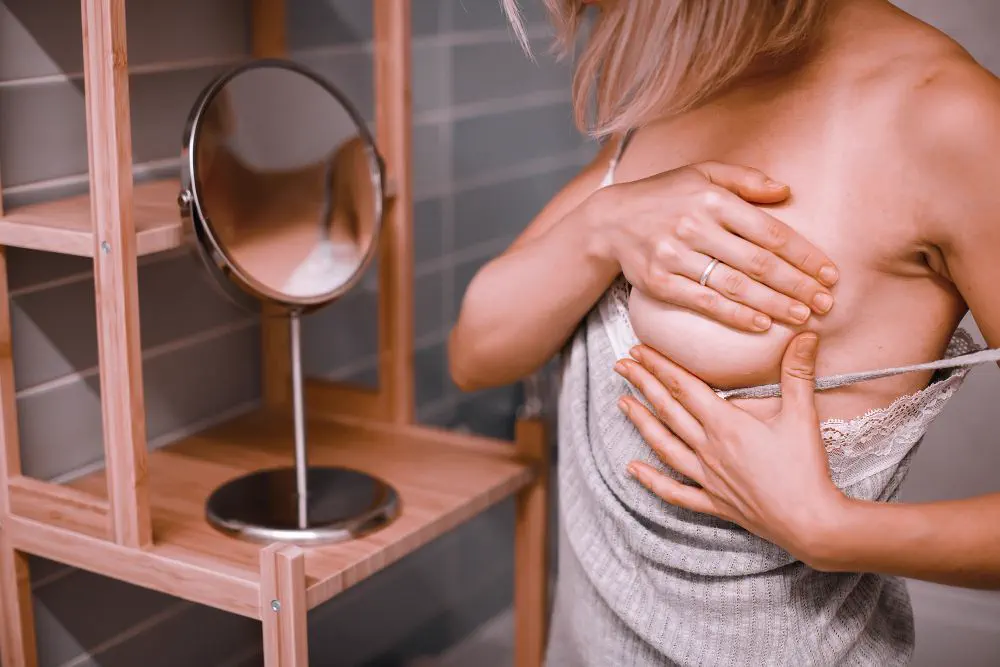
After breast augmentation, you may experience reduced sensation, increased sensitivity, tingling, or a different feeling in the nipple and areola. These changes are usually temporary, although recovery and risk differ between augmentation, a breast lift, and breast reduction.
Sensation can change, but permanent loss is not the usual outcome of a well-planned primary augmentation. Numbness, increased sensitivity, and tingling are relatively common in the first few weeks. Improvement may continue for many months and, in some patients, for up to 24 months.
The risk depends on your anatomy, the operation, the extent of dissection, the size of the implant relative to your tissues, and your individual nerve recovery.
Sensation is not an on–off switch. The nipple–areola complex responds to pressure, touch, temperature, pain, and sexual stimulation. After surgery, these different types of sensation may recover at different rates.
Also called hypoesthesia. The nipple feels numb or responds less to touch.
Clothing brushing against the skin or a light touch feels more intense than usual.
Also called paresthesia. Pins and needles, brief shooting sensations, or electric-like feelings may occur during nerve recovery.
Also called dysesthesia. A normal stimulus feels unusual or uncomfortable. This does not necessarily mean permanent injury.
Swelling, tissue tension, and adjustment to the new breast volume also affect sensation in the early weeks. An early examination alone therefore cannot predict your final sensory outcome.
The skin of the breast receives branches from several intercostal nerves. The nipple–areola complex is supplied mainly by anterior and lateral branches of the third, fourth, and fifth intercostal nerves. The fourth intercostal nerve is the most consistent contributor and usually provides the main supply, although anatomy varies between patients.

Anterior and lateral branches run from the intercostal spaces toward the breast skin and nipple–areola complex.
The exact distribution varies between patients; this illustration summarizes the most common anatomical pattern.
In conventional augmentation, implant-pocket dissection often proceeds from the breast crease toward the lower and outer breast. Nerve branches may become irritated, stretched, or lie within the surgical field. This helps explain why changes may affect not only the nipple but also the skin between the areola and the breast crease.
This anatomical overview draws on dissection studies and a systematic review and meta-analysis of breast innervation.
“Breast surgery” covers very different procedures. The amount of tissue moved and the way the nipple–areola complex remains attached to the breast affect the risk.
| Procedure | What happens to the tissues | What this means for sensation |
|---|---|---|
| Conventional augmentation | A pocket for the implant is created by dissecting the breast tissue planes. | Temporary changes can occur. Persistent changes are uncommon, but possible. |
| mia Femtech and Preservé | Small incisions, tissue expansion, no routine internal coagulation, and usually modest or moderate implant volumes. | In selected patients, these approaches may be considered when minimizing trauma to sensory nerve branches is a priority. |
| Breast lift (mastopexy) | The breast is lifted and reshaped, and the nipple–areola complex is moved while remaining attached to a tissue pedicle. | Changes are more likely than with a straightforward augmentation and depend on the pedicle, movement, and tissue removal. |
| Breast reduction | Skin and glandular tissue are removed, and the remaining tissue is reshaped. | Changes are more frequent and variable. Some patients have reduced sensation beforehand and may even notice improvement. |
| Free nipple graft | The nipple–areola complex is detached and repositioned as a graft in exceptional reduction cases. | The risk of substantial or permanent loss is much higher and requires a specific discussion. |
In our internal clinical series of 150 consecutive patients treated with mia Femtech or Preservé, clinically significant loss of sensation has been virtually absent during the available follow-up.
We believe several factors may contribute: small incisions—slightly more lateral in Preservé than in conventional augmentation—tissue expansion rather than cutting, no routine internal coagulation, relatively small implants, and less need for extensive lateral dissection. Subglandular placement may also play a role.
This is an internal clinical observation, not a published comparative trial. It does not establish a zero risk or prove superiority over another technique. It informs our discussion of minimally invasive options with patients who particularly value preserving sensation.
A breast lift or reduction moves more tissue than a straightforward augmentation. We frequently use superomedial pedicles in our practice and explain that the sensory risk is higher than with augmentation.
The visible scar is not the only consideration. Its exact location, internal dissection, and anatomical variations in the nerve branches also matter.
Volume in cc alone does not predict the outcome. An implant that is large for the available breast envelope may increase tension and nerve stretching; the same volume may be proportionate for another patient.
A wide implant or an excessively dissected pocket may require work closer to the lateral intercostal nerve branches.
Tissue coverage, elasticity, preoperative sensation, and the degree of stretching affect how the nerves adapt.
Significant inflammation, a hematoma, healing problems, or another operation can alter sensory recovery.
Some cohorts report more sensory changes after periareolar incisions, while prospective studies do not always find a difference. A review of 37 studies concludes that incision choice influences sensation, but its effect also depends on the technique, implant plane, and how sensation is measured.
Nerve recovery is slow and does not follow the same timeline for everyone. One area may improve before another, and sensation may pass through a phase of tingling or increased sensitivity before settling.
First few weeks
You may experience numbness, tension, increased sensitivity, or uneven sensation in different areas.
3–6 months
Swelling decreases and many patients notice clear changes. Tingling or brief shooting sensations may accompany this stage.
6–12 months
Sensation may become closer to its preoperative state, although further change is still possible.
12–24 months
We do not necessarily consider a stable sensory deficit permanent at one year. In some patients, we observe improvement for up to two years.
Studies use different tests, follow-up periods, and definitions. Persistent changes after primary augmentation are generally uncommon, but reported rates are not directly comparable. For breast reduction, a systematic review found variable outcomes and low or very low overall evidence quality.
No cream, vitamin, or home treatment can guarantee nerve regeneration. The first steps are to allow time for healing and avoid injury to an area that may not detect heat, cold, or pressure properly.
Our sensory retraining protocol

Start this protocol only when your surgical team authorizes it and explains how to do it safely. Do not apply it to an open wound, a recent scar with healing problems, or an inflamed area that has not been assessed.
Persistent reduced sensation without these warning signs is not usually an emergency, but it should be documented and reviewed. An examination helps assess progress and adjust rehabilitation.
No single maneuver eliminates the risk. We consider sensory preservation throughout surgical planning.
We consider width, volume, tissue coverage, and elasticity together to avoid unnecessary tension or lateral dissection.
The incision is adapted to the technique and anatomy. With Preservé, we use a small incision positioned slightly more laterally.
We limit excessive dissection and respect nerve branches identified during surgery.
We record changes, provide reassurance without guarantees, and recommend sensory retraining when appropriate.
Changes in sensation need time, follow-up, and an explanation tailored to your operation. If you are considering augmentation or have noticed changes after breast surgery, we can review your case and recommend an individual plan.
Medical authorship

Specialist in Plastic, Aesthetic and Reconstructive Surgery (Spanish MIR training)
Medical registration no. 2828/61062 · Madrid
About Nipple Sensation After Breast Augmentation: Changes and Recovery: clinical information, safety and expectations. Based on the original Spanish content.
Translation does not constitute a new medical review. This information does not replace an individual medical assessment.
View profile, training and credentialsReferences support the general medical information. Suitability, alternatives, and risks are discussed individually during consultation.
Dr Jorge AsoDr. Jorge Aso is a plastic surgeon with extensive academic and clinical training. He leads Dr. Aso Clinic, with a particular focus on breast surgery alongside other aesthetic…
Explore B-Lite lightweight breast implants: weight reduction, feel, benefits, limitations, extra cost, and when Dr. Aso recommends MESMO or MICROTHANE.

Dr Jorge AsoDr. Jorge Aso is a plastic surgeon with extensive academic and clinical training. He leads Dr. Aso Clinic, with a particular focus on breast surgery alongside other aesthetic…
Dr Jorge AsoDr. Jorge Aso is a plastic surgeon with extensive academic and clinical training. He leads Dr. Aso Clinic, with a particular focus on breast surgery alongside other aesthetic…