
Sedation without general anesthesia
Local anesthetic infiltration and intravenous sedation under anesthesiologist monitoring, without intubation in our protocol.

Many women considering MIA Femtech® or Preservé™ have postponed breast augmentation because of concerns about anesthesia, pain or complications. These approaches aim to limit tissue disruption. Our initial 160-patient series has been encouraging, but it is early clinical experience—not proof of zero risk or established long-term superiority.
Both can be appropriate options for carefully selected patients. Our early results compare favorably with our historical experience of conventional augmentation, but the groups were not randomized and follow-up is too short to establish that either technique is safer across all outcomes. In the 160-patient series reported in our August 2026 Spanish guide, no infections, hematomas requiring treatment, seromas requiring drainage or surgery, Baker II–IV capsular contractures, or permanent nipple-sensation loss had been diagnosed. One patient (0.6%) required implant replacement for an early rupture detected by ultrasound and recovered well.
These are observed results in a specific series, not a prediction of your individual risk. A complication can be uncommon and still important. We explain both its possible consequences and the limits of the available evidence. A small series with short follow-up cannot reliably estimate rare or late complications; an event not yet observed may still occur.
Local anesthetic infiltration and intravenous sedation under anesthesiologist monitoring, without intubation in our protocol.
This is the median in our reported series, with an estimated reduction in pain-medication use compared with our historical submuscular experience—not a guaranteed recovery time.
No seromas required treatment and no Baker II or higher contracture was observed during the reported follow-up. This does not mean zero future risk.
We infiltrate approximately 200 cc of a solution containing local anesthetic—not 200 cc of the active anesthetic drug. This provides local pain relief during the first hours and can make early recovery more comfortable.
An anesthesiologist also administers and monitors intravenous sedation. In our protocol, the patient breathes independently without intubation. Sedation still carries risks and requires appropriate monitoring; the individual anesthesia plan is confirmed by the team.
For some patients, this approach addresses concerns about general anesthesia. Discharge is often possible after 2–3 hours if all clinical criteria are met. Day-case discharge does not mean that postoperative support or follow-up is unnecessary.
Questions about anesthesia, recovery, scars and complications are reasonable. So are questions about how new a technique is, what might happen in ten years, and whether a short procedure can be safe.
Our aim is to explain what is new, what can be learned from previous implant experience and what we have actually observed in our own patients—without dismissing concerns or implying that reassuring early results remove uncertainty.
The main innovation is how the pocket is created and the implant inserted. The patient still has a silicone implant above the muscle and needs ongoing monitoring. Previous experience with related implants provides useful context, but it does not replace long-term follow-up of the specific technique and device.
A shorter operation, local anesthesia with sedation and less tissue manipulation may make the experience more manageable. Safety still depends on patient selection, planning, anesthesia care and follow-up.
MIA uses a small armpit incision; Preservé uses the inframammary fold. Both use dedicated instruments and controlled expansion to reduce dissection and avoid dividing the pectoral muscle.
A silicone implant still requires ongoing checks. Many patients return to normal activities, but implants are not lifetime devices and future treatment may be needed.
In most procedures in our experience, tissue expansion creates the pocket without internal cutting or electrocautery. In fewer than 5% of cases, a vessel has required direct coagulation or a ligament has needed division to allow expansion. We have not observed a meaningful difference between MIA and Preservé in this respect.
Several factors may contribute to recovery: muscle preservation, controlled expansion, smaller incisions, moderate implant volumes and local pain relief. Patient selection and expectations also affect observed outcomes. These factors cannot be separated by our uncontrolled clinical series.
In our practice, both techniques use prepectoral or subglandular placement. We measure the pinch test in every quadrant. Less than 1 cm usually excludes these techniques; 1–2 cm requires individual assessment. Around 1.5 cm is our usual practical minimum and 2 cm generally provides better coverage. These are clinic-specific criteria, not universal safety thresholds or guarantees.
It is therefore inaccurate to describe this as simply the same operation in the long term. Final implant position may resemble conventional subglandular augmentation, but access, instruments, implant design, dissection and the evidence for each procedure differ.
For more on how implant position affects coverage, movement and rippling, see our guide to implants above or below the muscle (Spanish).
The MIA incision lies near the pectoral border and the tunnel is subcutaneous. It is not intended to involve deep axillary dissection or the main nerves and vessels. Correct technique reduces risk, but no surgical approach is free of possible tissue or nerve injury.
| Feature | MIA Femtech | Preservé |
|---|---|---|
| Access | Armpit, with the scar away from the breast. | Inframammary fold, allowing direct access from beneath the breast. |
| Implant | Biconvex Diamond, designed for MIA. Front-to-back orientation does not change its shape. | Ergonomix2 implants with a SmoothSilk surface, which can potentially undergo flipping like other ergonomic implants. |
| Volume | 165–195 cc; median 190 cc and most commonly 195 cc in our reported series. | 200–320 cc in our reported series, most commonly 250–285 cc. |
| Additional correction | Less scope to change the fold or correct asymmetry. | Allows selected additional adjustments in mild cases. |
| Shared limitations | Requires adequate tissue coverage and expectations of a modest increase. | Does not replace a full breast lift or correct marked anatomical changes by itself. |
For a patient seeking less than 200 cc, both may sometimes be suitable. The biconvex Diamond design offers a specific shape-related advantage if front-to-back flippingoccurs: orientation does not change the implant’s shape. This does not establish lower overall complication risk. Preservé offers more scope to alter the inframammary fold when indicated.
Front-to-back flipping of an ergonomic implant can deform the breast. In our experience with conventional augmentation, manual repositioning has often been difficult and revision surgery may be needed. None was observed among the 109 Preservé patients in the reported series, but cases may emerge with longer follow-up. Manufacturer warranty terms are a separate issue from biological safety.
Suitability and the exact implant model must be confirmed at consultation. Read more about MIA Femtech and Preservé breast augmentation.
All implant-based augmentation has potential complications. Both AEMPS and the FDA recommend discussing these risks. Our early clinical observations are encouraging, but observed frequencies in a small, selected group should not be treated as definitive complication rates or proof of superiority over conventional augmentation.
A hematoma is a blood collection; a seroma is a fluid collection. Infection can cause pain, redness or fever. In the reported 160-patient series, no infections, postoperative hematomas needing treatment or seromas requiring drainage or surgery were diagnosed. Small fluid layers seen on ultrasound were common and usually resolved without intervention; new symptoms still require assessment.
Swelling and discomfort can occur. Our team estimates about 50% less pain-medication use, over fewer days, than in its historical submuscular practice. This is an uncontrolled observation, not a guaranteed reduction for an individual patient. Four patients (2.5%) required one to three reinforcing stitches in clinic for a superficial wound opening. None had implant exposure, infection or a keloid scar in the reported follow-up.
The tissue capsule around an implant can tighten, making the breast firmer, changing its shape or causing pain. No Baker II, III or IV contracture was observed among the 160 patients during the reported follow-up. Short follow-up limits this finding. Contracture can occur later; zero observed cases does not mean zero risk.
Implant rippling means folds or wrinkles that may become visible or palpable under thin tissue. Mild rippling was observed in 5 of 160 patients (3.1%): three only when bending forward and two slightly when standing. None requested correction. No displacement, bottoming out or flipping was observed in the reported series. These remain possible complications.
An implant can rupture without obvious symptoms. Ultrasound detected an early unilateral rupture in 1 of 160 patients (0.6%). It was confirmed on removal and replaced through the same armpit incision, with a good recovery. This was the only reoperation reported in the series at that point.
Up to approximately 30% reported mild temporary increased sensitivity, especially centrally and around the nipple–areola complex. In our experience, this generally settled over around six months. Reduced sensation was reported very rarely, and no permanent nipple numbness was observed in the 160-patient series. Permanent changes remain a possible implant-surgery risk.
Breast implant-associated anaplastic large cell lymphoma is rare and is reported more often with textured implants. A smooth surface does not remove the need to investigate symptoms. The 2026 AEMPS surveillance report describes 111 confirmed cases reported in Spain from 2012 through 2025 and a stronger association with textured implants. These national reports are not a risk estimate for MIA or Preservé.
New, persistent breast swelling months or years after surgery needs clinical assessment. Depending on findings, ultrasound and testing of fluid or tissue may be appropriate.
Some patients report systemic symptoms described as breast implant illness (BII). The FDA acknowledges these reports and continuing uncertainty about their causes. Symptoms should be taken seriously and assessed without assuming either that an implant must be responsible or that the symptoms are unimportant.
It is important to distinguish evidence about breast implants generally, evidence about incision and implant position, and studies of the specific MIA system or implant family. These do not answer exactly the same questions.
Previous experience informs discussion of contracture, rupture and further surgery. It does not establish that implants last forever or that a new technique has identical outcomes.
A meta-analysis of 22 studies involving 5,843 patients found no statistically significant differences from other incisions in contracture, reoperation or infection. The evidence was heterogeneous; it is not a direct trial of MIA against Preservé.
A prospective study of 100 patients with three-year resultsprovides relevant evidence for MIA. Its sample size and duration still limit conclusions about rare or late events and suitability across different anatomies.
The Motiva SmoothSilk implant literature includes published five-year clinical data. This device-family evidence is not a five-year study of the Preservé surgical protocol and does not establish its superiority. The exact implant model also matters.
Existing evidence can reduce some uncertainty while technique-specific follow-up develops. It cannot remove the need for longer studies: rare complications and late outcomes require larger samples and more time.
The report covers 160 consecutive patients operated on from October 2024: 51 MIA and 109 Preservé. All had a one-month ultrasound; some did not attend subsequent reviews because they felt well. These are practice-based observations, not a comparative trial, and later events may be underestimated.
51 MIA and 109 Preservé.
No contracture of these grades observed during the reported follow-up.
Maximum follow-up: 22 months for MIA and 18 for Preservé.
No clinically meaningful pain difference observed between MIA and Preservé. Not a fitness-to-fly timeline.
| Observed outcome | Reported series | Interpretation |
|---|---|---|
| Infection | 0/160 | None diagnosed during the reported follow-up. |
| Postoperative hematoma | 0/160 | None required evacuation, drainage or further surgery. |
| Seroma requiring treatment | 0/160 | No fluid collection required ultrasound-guided drainage or surgery. Small self-resolving fluid layers were common. |
| Drains | 0/160 | None placed during or after surgery in this series. |
| Implant replacement | 1/160 (0.6%) | One confirmed early unilateral rupture in a MIA patient. |
| Displacement or bottoming out | 0/160 | No flipping was detected in the 109 Preservé patients; cases may emerge with longer follow-up. |
| Rippling visible | 5/160 (3.1%) | All mild: three visible only when bending and two slightly when standing. None requested correction. |
| Permanent sensory deficit | 0/160 | Up to approximately 30% reported mild temporary increased sensitivity; reduced sensitivity was reported very rarely. |
| Minor wound separation | 4/160 (2.5%) | Superficial openings treated in clinic; none exposed the implant or became infected. |
A routine one-month ultrasound suggested a unilateral rupture in an asymptomatic MIA patient. It was confirmed when the implant was removed and replaced through the same armpit incision, with a good recovery. The cause could not be established; possibilities considered included delivery-related damage or a pre-existing device defect.
One MIA patient developed unilateral radial neurapraxia, thought to be related to excessive arm abduction and a history of similar position-related episodes. She recovered fully within one week with conservative care. We subsequently limited arm abduction during MIA to 30 degrees; no further cases were reported in the series.
Moderate bleeding prompted direct inspection through the same inframammary incision in two procedures, without conversion to another approach. In one, the incision was extended by 5 mm. When indicated, the balloon can also be repositioned briefly to apply pressure for hemostasis.
Three MIA armpit incisions required one to three simple stitches. One superficial 0.5 cm opening at the side of a Preservé incision was reinforced with a stitch for cosmetic reasons. No keloid scars were reported. The source describes increased use of barbed sutures to help reduce extrusion or wound separation.
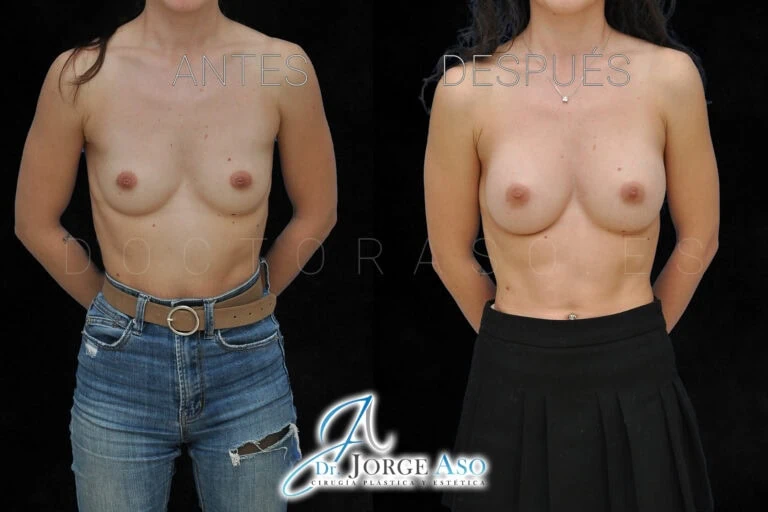
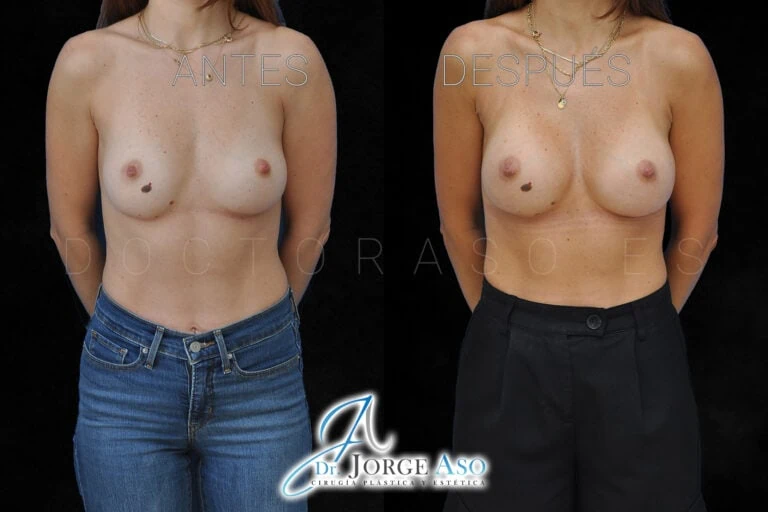
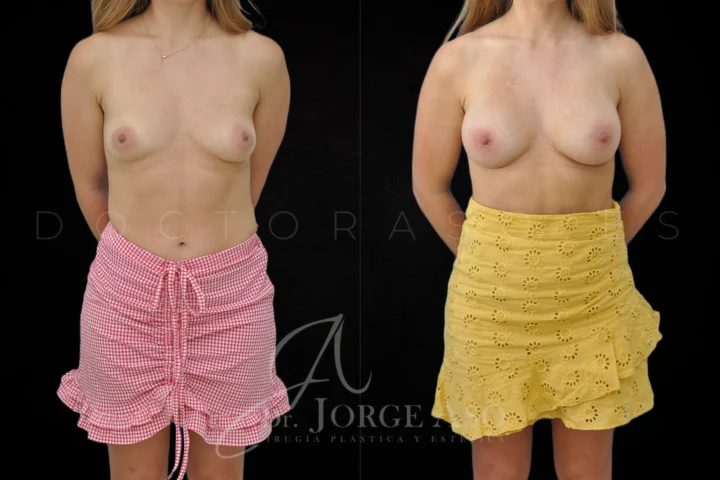
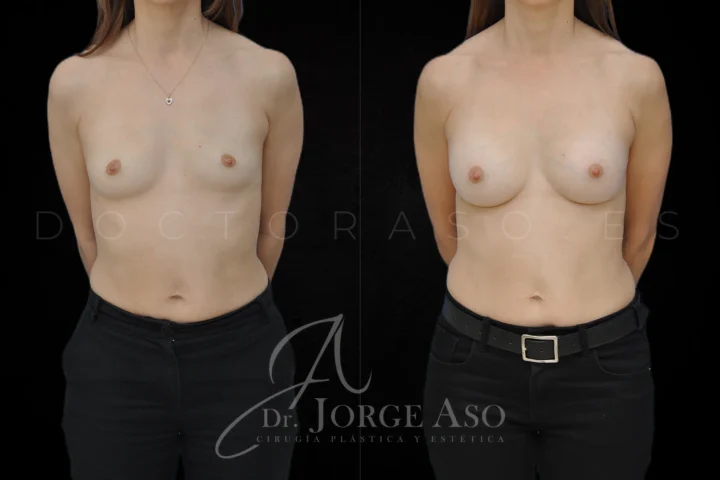
Safety includes selecting an implant volume that the tissues can cover and that fits the patient’s goals. These four existing cases illustrate outcomes within the usual ranges. Photographs are educational examples, not evidence that another patient will obtain the same result.
Modest increases with low-profile Diamond implants.
Moderate increases with moderate-profile ergonomic implants.
A wish for a quick recovery does not establish suitability for a prepectoral implant or a limited-volume technique. Patient selection is central to safety.
A pinch test below 1 cm usually excludes these techniques in our practice. Between 1 and 2 cm is assessed individually, with around 1.5 cm our usual practical minimum. Muscle coverage or another approach may be more appropriate.
An implant alone does not truly lift the nipple. A breast lift may be needed, although selected anatomies may suit Preservé mastopexy.
MIA is intended for modest increases and Preservé for moderate augmentation. Pushing volume beyond what the tissues can support may affect coverage, stability and appearance.
Large differences in shape, volume, folds or nipple position often require an approach with greater corrective scope.
This may be a relative, rather than absolute, contraindication. Selected patients may be suitable after assessment of the capsule, pocket, existing implant and tissue quality.
We do not offer these techniques for an irradiated breast after cancer treatment. Radiation-related tissue changes require a different, individualized reconstructive plan.
Surgery may also be unsuitable or need postponement because of infection, an unresolved breast finding, uncontrolled anesthesia or healing risks, or incompatible expectations. No technique guarantees perfect symmetry, an exact cup size or freedom from future surgery.
Selected mild drooping or tuberous anatomy may allow additional correction, particularly with Preservé. Where a lift is required, trying to avoid it may leave drooping or lead to further surgery.
The source also describes an assessment of a patient operated on elsewhere with high-positioned MIA implants and a volume she considered excessive. Proposed correction had not been performed. This external case is not part of the clinic’s complication rates and cannot establish that the technique itself caused the outcome.
Early discharge does not mean no follow-up. Our clinic’s minimum protocol includes checks at one week, one month, three months and one year, with ultrasound at each visit, followed by annual ultrasound even without symptoms. This is the clinic’s protocol, not a universal schedule. International patients must agree how these reviews will be completed after returning home.
Our MIA and Preservé patients use a chest band for the first two weeks. Implants may initially sit higher and gradually settle toward the preserved natural fold. Persistent position concerns need assessment. In uncomplicated cases with no improvement by three months, our source describes observation until around six months before considering revision; warning symptoms should never be left waiting on that timeline.
For one-sided pain or increasing asymmetry, our team usually arranges ultrasound. An obvious urgent complication may require treatment without delaying it for imaging. Seek urgent local medical care if symptoms are severe or you cannot reach the surgical team.
Small localized fluid layers can occur during recovery, but a tense collection, clear clinical asymmetry or infection signs require assessment. Patients should not try to decide at home whether a collection is harmless.
A late seroma needs specific investigation. Our protocol may include ultrasound, guided fluid sampling, cytology and immunohistochemistry when indicated.
Routine one-month ultrasound detected the only early rupture reported in our series before symptoms developed. Imaging should be individualized to the implant, elapsed time, symptoms and applicable regulator/manufacturer recommendations. A normal examination does not make future monitoring unnecessary.
MIA and Preservé offer tissue-preserving options for selected patients. Our early series is encouraging, but reassurance should come from clear information, appropriate surgical planning, anesthesia care and follow-up—not a promise of zero risk. If you travel to Madrid, agree your stay, postoperative support, review schedule and fitness to fly before booking your return journey.
This guide is an English adaptation of Dr. Aso’s Spanish article. The internal clinical figures refer to its August 2026 report and are not a new audit or a substitute for an individual medical assessment. Dr. Aso speaks native-level English and has trained in the United States.
Initial consultations are 100 EUR. A video consultation can help start the discussion before traveling, but an in-person examination is needed to confirm surgical suitability.
Medical authorship
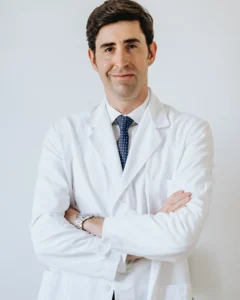
Specialist in Plastic, Aesthetic and Reconstructive Surgery (Spanish MIR training)
Medical registration no. 2828/61062 · Madrid
About MIA Femtech and Preservé: Safety, Risks and Suitability: clinical information, safety and expectations. Based on the original Spanish content.
Translation does not constitute a new medical review. This information does not replace an individual medical assessment.
View profile, training and credentialsReferences support the general medical information. Suitability, alternatives, and risks are discussed individually during consultation.
Dr Jorge AsoDr. Jorge Aso is a plastic surgeon with extensive academic and clinical training. He leads Dr. Aso Clinic, with a particular focus on breast surgery alongside other aesthetic…
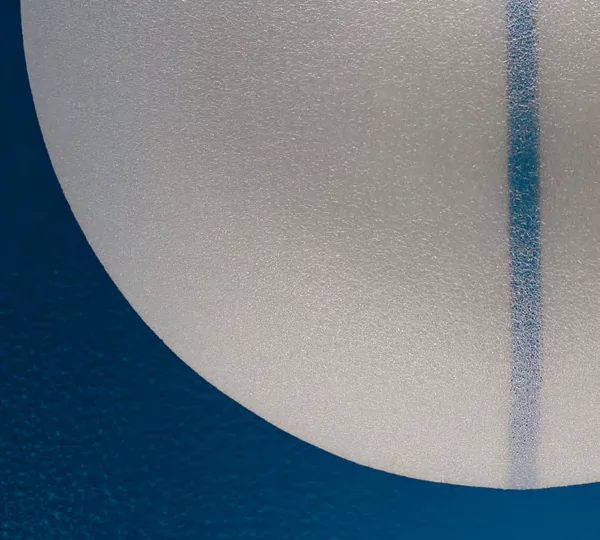
Explore B-Lite lightweight breast implants: weight reduction, feel, benefits, limitations, extra cost, and when Dr. Aso recommends MESMO or MICROTHANE.

Dr Jorge AsoDr. Jorge Aso is a plastic surgeon with extensive academic and clinical training. He leads Dr. Aso Clinic, with a particular focus on breast surgery alongside other aesthetic…
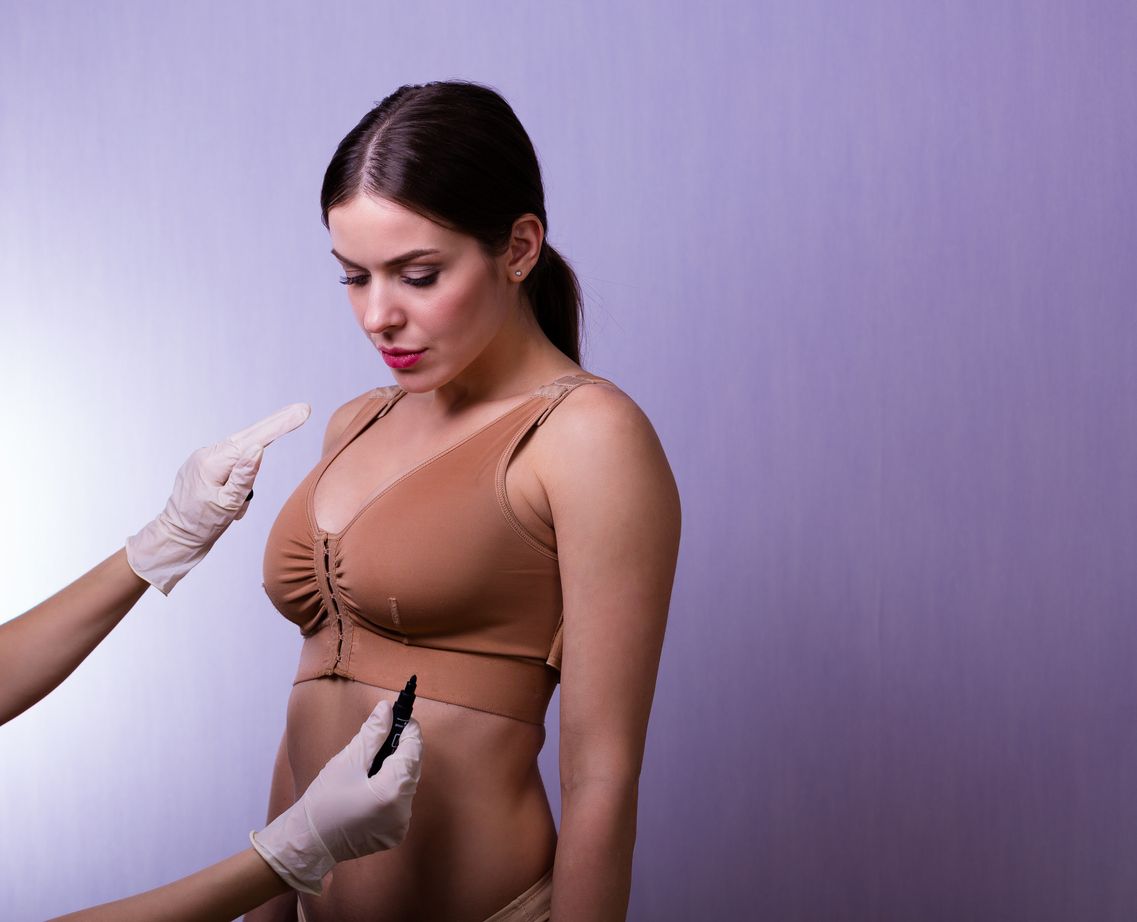
Dr Jorge AsoDr. Jorge Aso is a plastic surgeon with extensive academic and clinical training. He leads Dr. Aso Clinic, with a particular focus on breast surgery alongside other aesthetic…