

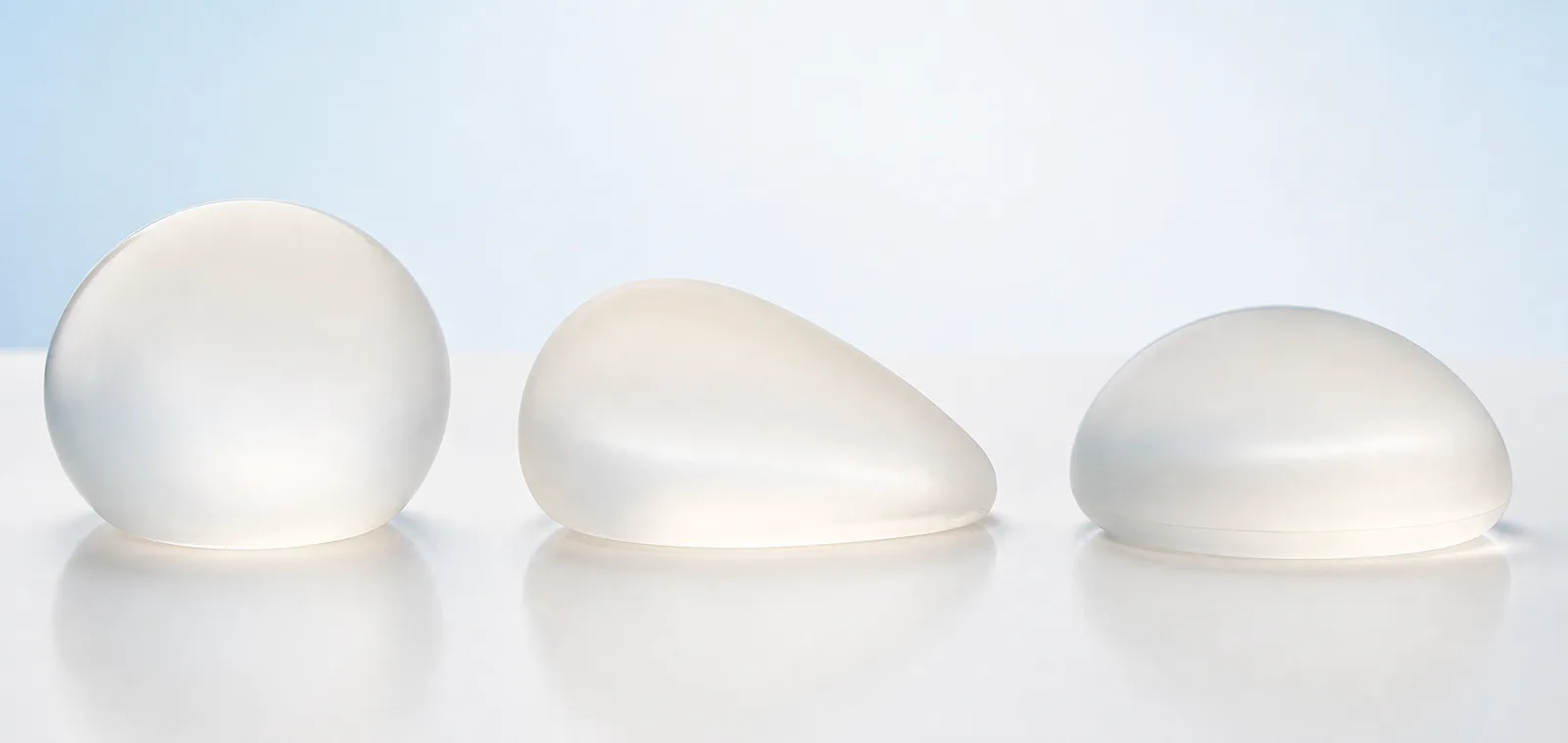
Round, anatomical, and ergonomic implants can all be good options, but they do not produce exactly the same breast shape. Your anatomy, nipple position, and desired result determine which option is most suitable.
Can you see the difference between round and anatomical implants?
Yes. The difference is usually noticeable or very noticeable in most cases when we compare implants with equivalent dimensions and assess the breasts without clothing. Anatomical implants distribute more volume toward the lower pole and, in our experience, provide a more natural result in the vast majority of patients.
This does not make round implants a worse option. They provide more upper-pole fullness and somewhat more pronounced cleavage, which many patients want. With clothing, the differences may be small; with suitable anatomy, a round implant can look proportionate and attractive.
An anatomical implant is usually our first option, particularly with limited tissue coverage or when we need to guide the shape.
A round implant can be an excellent choice if the nipple is well centered and the upper pole can accommodate that fullness.
For us, Ergonomix occupies a clinical category between a conventional round implant and an anatomical implant.
Choosing a shape alone is not enough: we assess anatomical implants and dual plane placement or, if necessary, a breast lift to center the nipple.
Contents of this guide
Round, anatomical, and ergonomic implants: comparison table
| Feature | Round | Anatomical | Ergonomix |
|---|---|---|---|
| Volume distribution | More even distribution with greater upper-pole fullness | More volume in the lower pole and greater control of shape | Changes with position because of the gel's behavior |
| Typical natural appearance | Can look natural, but usually produces a more pronounced upper pole | The most natural appearance in most of our patients | Intermediate appearance, with a very natural feel and movement |
| Cleavage | Fuller and more visible without a bra | A more gradual, subtle contour | Natural at rest, with dynamic movement |
| Specific positional risk | Rotation does not change shape; flipping is rare | Rotation can alter the contour | Rotation does not usually alter shape; flipping is rare |
| When we particularly consider them | Loss of upper-pole fullness, a long lower pole, or a preference for fuller cleavage | Limited breast tissue, a short lower pole, asymmetry, or a need to guide shape | Patients who prioritize feel, movement, and a dynamic natural appearance |
Implant shape does not act alone
The result depends on the interaction between the implant and your tissues. This is why two patients with the same implant can look very different.
Breast and subcutaneous tissue
The less tissue coverage there is, the more directly the implant's shape is reflected in the external contour. In very thin patients or those with absent breast development, differences between shapes are often particularly apparent, and an anatomical implant allows better control of the contour.
Base, height, volume, and projection
Comparing cc alone is not enough. A tall anatomical implant and a wide round implant distribute the same volume differently. As volume increases, a round implant's upper-pole fullness may become more visible, but there are no universal figures that separate a natural result from an artificial one.
Skin tone and elasticity
A very tight skin envelope reflects the implant's shape more closely. In breasts with looser skin after pregnancy, breastfeeding, or weight loss, a round implant can restore upper-pole fullness very effectively; the decision also depends on the breast fold and nipple position.
Position and direction
The implant should fill the breast around the nipple, rather than force the nipple to fit an unsuitable shape. Nipple height and direction may matter more than volume.
Placement and technique
Subglandular, subfascial, dual plane, and tissue-preserving techniques have different indications. No placement is always superior, and the same shape can behave differently depending on the pocket.
Sports and lifestyle
Intense pectoral activity and impact sports are part of planning and follow-up. They do not automatically make one shape "safe" and another "unsafe," but they may influence the pocket, stability, and postoperative instructions.
Round implants: when they are a good choice
Round implants retain more volume in the upper half. This can produce fuller cleavage and a somewhat more visibly "augmented" appearance without necessarily being excessive. Many patients love this result, especially with clothing or dresses worn without a bra.
They can also provide very natural results when there is enough tissue coverage, the nipple is well centered, and base width and projection are chosen appropriately. In our practice, they are a particularly useful option for restoring upper-pole fullness and in many breast lifts with implants.
Loss of upper-pole fullness
After pregnancy or weight loss, restoring upper-pole fullness may be desirable, provided that the skin envelope and nipple position are carefully planned.
A long lower pole
A round implant can balance breasts with a relatively long lower pole and limited upper-pole fullness, particularly when combined with a breast lift.
Aesthetic preference
When a patient wants visible cleavage and accepts a less gradual upper contour, this is a consistent choice.
Round implants and breast lifts
In our hands, round implants are an excellent option for many breast lifts because they restore the upper pole after the nipple has been correctly centered. They are not mandatory: if a patient wants a more gradual contour or we need to guide the shape, an anatomical implant may also be used.
Take care with slightly low nipples
A round implant can fill the upper breast substantially and make a low nipple appear to point farther downward. In these cases, we usually consider an anatomical implant with dual plane placement or a breast lift to raise the nipple to the center of the breast; once centered, a round implant can be used if the remaining anatomy and goals allow it.
Anatomical implants: natural appearance and shape control
Anatomical implants are not simply "teardrop-shaped implants." We can choose their width, height, and projection to place volume where the patient needs it. In the vast majority of our augmentations, they provide the most natural result, particularly without clothing, in very thin patients, and when existing tissue is limited or breast development is absent.
They are particularly useful for short lower poles, asymmetry, reconstruction, and situations where we want to direct maximum projection toward nipple height. They may also help with certain cases of mild sagging or slightly low nipples that do not require a breast lift, always with appropriate planning of the fold and implant placement.
Patients with tuberous breasts often have an underdeveloped lower pole, a constricted base, a more conical shape, and, in some cases, marked spacing. An anatomical implant can add volume more proportionately to the lower pole, although correction usually also requires specific adjustments to the gland and breast fold.
Feel and cohesivity
To maintain a stable shape, many anatomical implants use more cohesive gels and may feel slightly firmer than a conventional round implant or Ergonomix. The difference is usually small and is most noticeable in very thin patients or those with very limited coverage; with enough tissue, it may be almost imperceptible.
Natural does not mean sagging
A gradual upper contour does not mean breast sagging. Nipple position, the breast fold, and volume distribution determine whether the breast looks lifted and proportionate. An implant does not replace a breast lift when true sagging is present.
Ergonomix: a clinical category of its own
Geometrically, Ergonomix has a round base. However, its gel changes distribution with body position: when standing, more volume tends to settle lower down, while lying down it flattens and moves more like breast tissue.
Because of its appearance, feel, and movement, we consider it a distinct clinical category, between a conventional round implant and an anatomical implant. It does not exactly reproduce an anatomical implant's ability to select height and guide shape, but neither does it behave like a conventional round implant.
What we value about Motiva Ergonomix
In our practice, it has become increasingly important because of its very natural feel, typically thin capsule, and good clinical behavior. It usually feels softer than many cohesive anatomical implants. Like any implant with a very smooth surface, it requires precise pocket planning and does not eliminate the possibility of displacement or flipping.
You can read more about its features, indications, and limitations in our guide to Motiva Ergonomix ergonomic implants.
Rotation, malposition, and flipping
An anatomical implant that rotates may change the breast contour because its volume is not symmetrical in every direction. With round implants and Ergonomix, rotation around the implant's axis usually has little effect on shape, but front-to-back flipping can occur: it is much less frequent, but not impossible.
What this figure means
We perform imaging follow-up for all of our surgical patients. In our clinical series, imaging-detected rotation of MESMO anatomical implants is around 15–20 %. This includes findings that may be subtle and does not mean that 15–20 % have an obvious deformity or need another operation.
Rotation usually occurs early, with a peak in the first two or three weeks, while the pocket has not yet stabilized. It can also develop later after trauma, pocket changes, or tissue changes.
Clinically apparent rotation does not automatically mean another operation. Many rotated anatomical implants reposition themselves spontaneously over time, partly because their lower pole contains more gel and tends to turn downward again. If the shape is acceptable and there are no other problems, our protocol may include observation and imaging follow-up; we consider another operation when rotation persists, causes a significant deformity or discomfort, or the pocket is unstable.
Published rates vary widely because not all studies use systematic imaging and some record only clinically visible rotation. Figures obtained with different follow-up methods should therefore not be compared directly.
A published study compares POLYTECH MESMO and Motiva Ergonomix focusing on displacement problems. You can explore this further in our article on anatomical implant rotation.
Photographs of round and anatomical implants
These cases illustrate trends, not a guaranteed result. Starting anatomy, technique, size, and follow-up also play a role.
Case with 400 cc round implants
Front, oblique, and side views. Upper-pole fullness is more pronounced, within the proportions chosen for this patient.


Case with 395 cc anatomical implants
Front, oblique, and side views. Volume is distributed more gradually toward the lower pole.


Compare similar patients in our interactive gallery
An isolated photograph can be misleading. Our new interactive breast augmentation gallery lets you filter real cases by implant shape and find patients with similar height, weight, and implant volume. To our knowledge, no other public clinical gallery allows these variables to be combined with this level of precision.
It is one of the website's best tools for understanding how results differ between anatomical, round, and ergonomic implants without comparing completely different bodies.
Open all gallery filtersCan 3D simulation help you choose?
3D simulation helps compare trends in shape and volume on your own body. It is particularly useful for visualizing the difference in upper-pole fullness between a round and an anatomical implant.
Comparing both options on the same body is far more informative than comparing photographs of different patients, because chest dimensions, existing tissue, height, and nipple position remain constant.
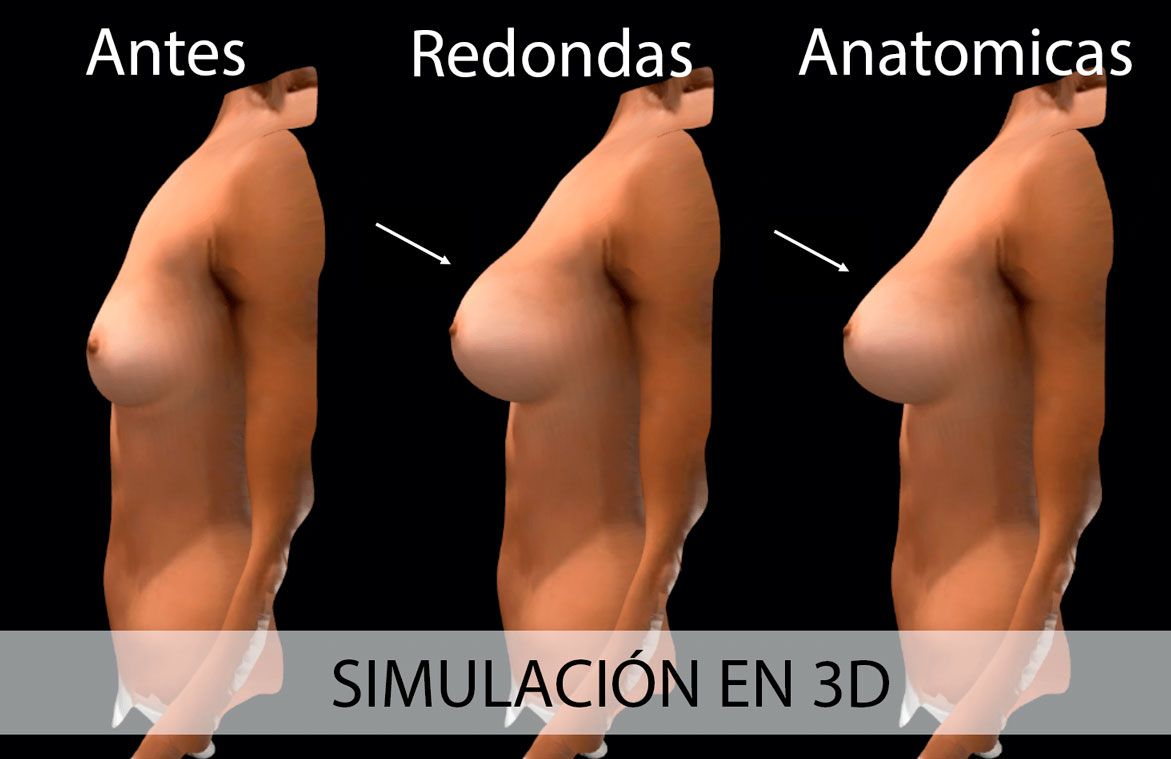
It is not a photographic guarantee of the result: healing, tissue behavior, technique, and implant settling cannot be predicted precisely. We combine it with measurements, external sizers, and comparable real cases.
The follow-up we recommend
Follow-up should not be limited to "contact us if you notice something." In our clinic, we perform routine ultrasound for all surgical patients and document implant position, the capsule, integrity, and the presence of fluid.
The first weeks
We assess healing and implant position during the period of greatest risk of early rotation. Bra and activity instructions are individualized.
Imaging follow-up
Ultrasound can identify malposition, fluid, or changes even when they are not visible. It complements rather than replaces a clinical examination.
Long term
Implants have no exact expiration date and do not automatically need replacement at ten years, but they should not be considered lifetime devices either. Many remain in good condition for 10–20 years or longer; we increase monitoring after the first decade and consider replacement based on imaging, symptoms, tissue changes, and the patient's preferences.
Frequently asked questions
Do anatomical implants always look more natural?
In our experience, they look more natural in the vast majority of cases, but not all. With substantial breast tissue coverage or a preference for a full upper pole, a round implant can integrate very well.
Do round implants always look artificial?
No. They can look proportionate and natural in selected patients. They usually provide somewhat greater upper-pole fullness; whether this is an advantage depends on the patient's goals.
Can an anatomical implant rotate even after well-performed surgery?
Yes. A precise pocket reduces the risk, but does not eliminate it. The surface, dimensions, tissues, postoperative period, and activity also matter.
What is flipping?
It is front-to-back turning of the implant, so that its back surface faces forward. It is rare, but can also occur with round and ergonomic implants.
Which shape is suitable if the nipple sits low?
It depends on the degree. An anatomical implant and dual plane placement may help in mild cases. If the nipple genuinely needs to be raised, a breast lift is the solution; a round or anatomical implant can then be used depending on the goal.
Is Ergonomix a round implant?
Its base is round, but its gel, feel, and dynamic behavior mean that we treat it clinically as a category of its own, between a conventional round and an anatomical implant.
Which is more expensive?
Price can vary by manufacturer and model, but we do not recommend choosing shape based on a price difference. The correct clinical indication matters much more.
Can you feel whether an implant is anatomical?
It may feel slightly firmer because many anatomical implants use more cohesive gels to maintain their shape. The difference is most noticeable with very limited coverage; with enough tissue, it is usually subtle or imperceptible.
Do size and projection affect how natural the result looks?
Very much. A large or high-projection implant makes its shape more apparent in the external contour, particularly with limited tissue. No number of cc is natural or artificial in itself: it must be considered alongside chest width, tissue coverage, and goals.
What should we consider if I do a lot of sports?
The type of sport, intensity, pectoral muscle use, and risk of impact. These factors may influence pocket selection, postoperative instructions, and follow-up, but do not make one implant shape the right choice for every athlete.
Can I change shape or size years later?
Yes. Aesthetic preferences and tissues change over time. If there is an indication, a secondary operation can replace implants with a different volume or shape. Careful initial planning, 3D simulation, and comparable cases help reduce decisions based on unrealistic expectations.
How long do breast implants last?
There is no exact expiration date. Many remain in good condition for 10–20 years or longer, but need monitoring throughout their useful life, with particularly careful surveillance after ten years. Replacement is decided based on implant condition, tissues, symptoms, and patient preferences, not the calendar alone.
The choice should be based on your anatomy
Tables and photographs help explain the differences, but do not replace an examination. During consultation, we measure your chest and tissues, assess nipple position, compare similar cases, and perform a 3D simulation on your own body.
The goal is not to choose a "winning" implant, but to find the combination of shape, dimensions, gel, surface, placement, and technique that best fits your desired result.
Request a personalized assessment



Editorial note on comments in the original article: the original Spanish article has accumulated replies since 2015. Clinical practice, available implants, and evidence have evolved. Older replies should be read in their original context; those containing overly absolute recommendations or outdated safety information have been updated in the original article.