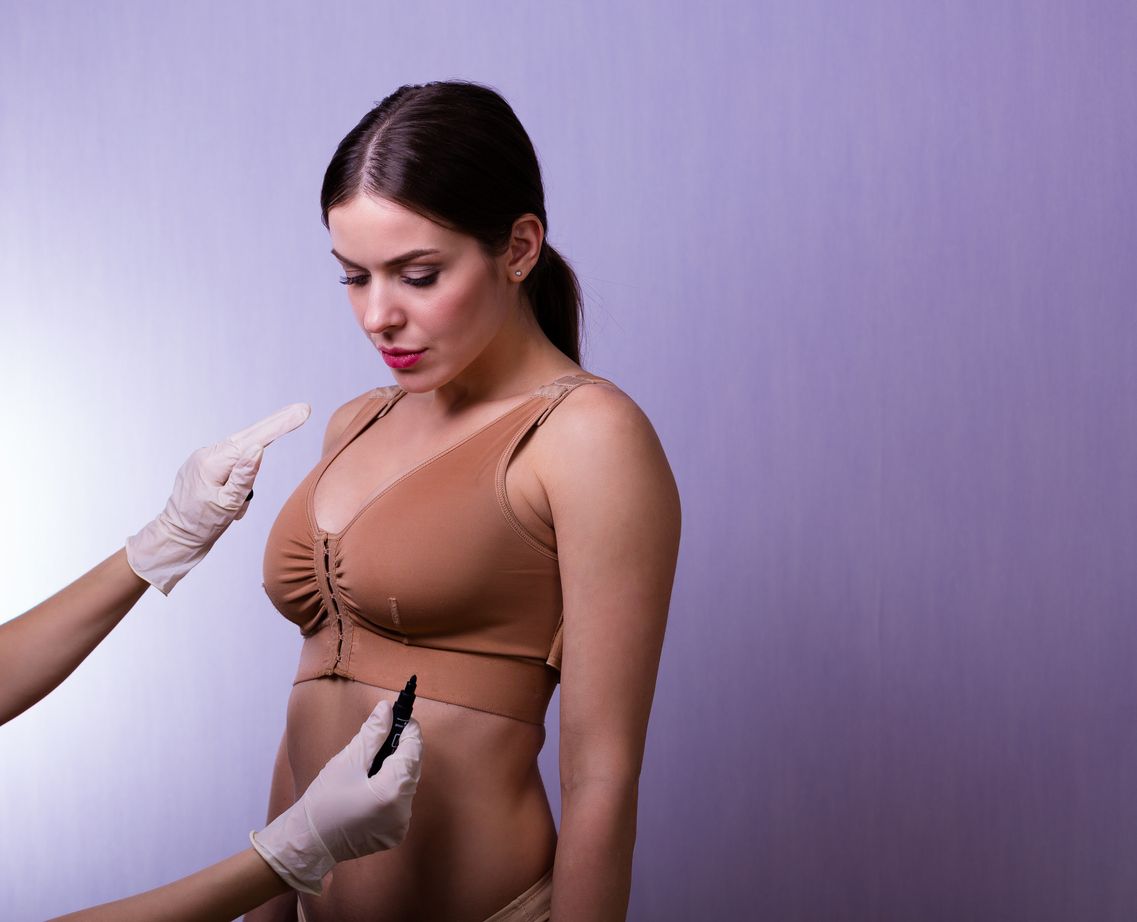
Anatomical implants can rotate, but rotation detected by ultrasound does not necessarily mean a visible deformity or another operation. In our imaging series, we observe approximately 15–20% rotation, while only 5–8% is clinically visible and around 4% leads to surgery.
This article addresses two different concerns: what to do if one breast has already changed shape, and whether an anatomical implant is worthwhile when you like its effect but worry about rotation. Alternatives now include round implants, Ergonomix2 —with dynamic behavior—and, in selected cases, polyurethane-covered anatomical implants.
Do anatomical implants rotate often?
They rotate more often than we can see externally, but many rotations are small, appear only on ultrasound, and do not need treatment. Figures vary greatly depending on whether studies look for any rotation on imaging or only a clinical deformity. A single percentage therefore cannot describe the “true risk” for every patient and implant.
When rotation changes the shape, we generally observe before operating if the situation allows. We wait at least six months because approximately half partly or fully return to position. If surgery is ultimately needed, we strongly recommend switching to an ergonomic, round, or polyurethane-covered anatomical implant rather than simply rotating the same implant back.
Article contents
What it means when an anatomical implant rotates
A breast implant sits in a space surgeons call the pocket. It is not screwed into place or attached to a rigid structure, so it retains some mobility. This can allow it to rotate around its axis.

Anatomical: orientation matters
An anatomical implant—also called “teardrop-shaped”—distributes volume in a specific way. If it rotates, the portion designed for the lower pole may move upward or sideways and change the breast contour.
Round or ergonomic: axial rotation does not change the silhouette
A round implant is symmetrical around its axis. Ergonomix2 also has round geometry, although its gel behaves dynamically. If either rotates sideways, its external orientation remains the same.
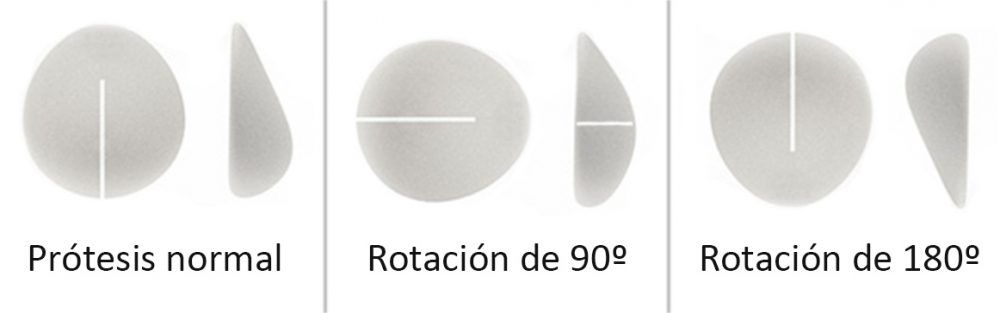
May appear only on ultrasound
Neither the patient nor the surgeon may notice any external difference.
Asymmetry or a different contour
It can reduce fullness in one area and create abnormal fullness elsewhere.
The shape is reversed
With a 180° rotation, the implant's lower pole points upward.

Rotation, displacement, flipping, and rupture are not the same
Patients often say their implant has “moved,” “turned,” or “flipped.” This is understandable, but can describe different situations that require different approaches.
Axial rotation
The implant rotates sideways within the pocket. This changes the shape of an anatomical implant, but not a round or ergonomic one.
Displacement
The implant sits too high, low, inward, or outward. This can occur without the device rotating.
Flipping
The implant turns front to back. This can affect cohesive round or ergonomic implants and change the shape.
Rupture
The shell's integrity has been compromised. A shape change alone cannot diagnose or rule out rupture.
How can I tell if an implant has rotated?
Significant rotation usually presents as a new change in a breast that previously had a stable shape. Many patients notice it while dressing or getting up in the morning; this does not necessarily mean the rotation happened overnight.
Sudden shape change
One breast looks higher, wider, or different from previous days.
New asymmetry
Breasts that previously looked similar develop clearly different contours.
Different cleavage
One side of the cleavage loses fullness or changes direction.
A straighter lower pole
The area between the nipple and fold loses some of its curve and looks less full.
Fullness in an unusual area
Volume appears higher up or sideways where it was not present before.
Movement or discomfort
A feeling of mobility, pain, or swelling may occur, but is not always present.
Isolated rotation is usually a shape problem rather than an emergency. Pregnancy, breastfeeding, weight loss, capsular contracture, seroma, hematoma, rupture, downward implant movement, or natural tissue changes can also cause asymmetry. We therefore advise against drawing conclusions from photographs at home alone.
How we determine whether an implant has rotated
Diagnosis starts with your history and an examination. We compare the current shape with earlier photographs, examine the pocket, and assess whether the change fits rotation, displacement, or another complication.
Understand what changed
When it started, whether suddenly or gradually, and whether there is pain, swelling, trauma, or a recent bodily change.
Examine in different positions
Shape can behave differently when standing, lying down, or moving the arms.
Perform an ultrasound
We locate the implant's orientation markers and assess the capsule, fluid, integrity, and position.
Investigate further if needed
MRI or another test may be indicated if ultrasound does not resolve the question or another complication is suspected.
In a prospective series of 308 women, shape changes were more often associated with other implant complications than confirmed rotation. Ultrasound identified additional cases when examination was inconclusive, but decisions should consider the whole patient, not just an angle measured on an image.
What is the actual risk of anatomical implant rotation?
No single percentage applies to every patient. A series using systematic ultrasound finds more rotations than one counting only visible deformities or revision surgery. Model, surface, pocket, technique, and follow-up duration also vary.
| Source | Population and method | Result | Interpretation |
|---|---|---|---|
| Sieber et al., 2017 | 69 patients, 138 implants; high-resolution ultrasound | 27% of implants rotated more than 30° | Imaging finds rotations that often cannot be recognized in photographs. |
| Montemurro et al., 2017 | 531 primary augmentations; clinical rotation | 1.88% of implants; 3.58% of patients | Counting only clinical deformities produces a much lower figure. |
| Randquist et al., 2023 | 308 women; examination and ultrasound | 3.6% on examination, plus 10 additional ultrasound cases | Ultrasound increases detection, and a shape change is not always rotation. |
| Montemurro et al., 2025 | 1,126 patients, 2,252 anatomical implants; mean follow-up 18.8 months | 1.8% of implants with clinical rotation | A short- to medium-term clinical rate, not a lifetime risk. |
Three figures that should not be confused
In our own imaging series, an imaging finding is much more common than a deformity that ultimately requires surgery.
Includes small rotations detected during imaging checks.
The shape change can be seen externally.
The approximate proportion ultimately requiring surgery.
These are approximate internal data. They do not come from a comparative trial or guarantee any individual patient's risk. They help explain why rotation on ultrasound does not automatically represent a significant complication.
When rotation occurs and why
In our experience, there is a peak during the first two or three weeks, before the implant has stabilized. Rotation can also occur months or years later as the pocket, tissues, or the film surrounding the implant change.
Size and design
An excessively large pocket allows more movement. One that is too tight or poorly adapted can distort the implant and hinder stable settling.
Friction and adherence
A surface with little tissue interaction may move more. Greater friction reduces mobility but makes an imperfect initial position less forgiving.
Coverage and laxity
A loose tissue envelope, lax tissues, or secondary surgery may provide less stability than a well-fitted primary pocket.
Shape and dimensions
The more the result depends on precise orientation, the greater the aesthetic effect rotation may have.
Pregnancy and weight changes
The gland, skin, and pocket can change over time and alter the relationship between the breast and implant.
Trauma or strenuous activity
A significant impact or repeated exertion may coincide with some episodes, although many rotations have no identifiable trigger.
Is an anatomical implant worthwhile if it can rotate?
It can be worthwhile when its shape provides a real advantage for your anatomy or desired result. There is no best implant for every patient. In breast augmentation, the decision involves weighing what each design offers against the specific risk you are willing to accept.
60% → 20%
Approximate anatomical implant use in primary augmentation from the macrotextured era to the present.
When macrotextured implants played a major role, approximately 60% of our primary augmentations used anatomical implants and 40% round implants. Their high friction provided substantial stability, and we observed few rotations. However, their association with BIA-ALCL and other complications such as double capsules and late seromas led us to gradually stop using those surfaces.
Switching to microtextured anatomical implants—for example, POLYTECH MESMO®—improved these macrotexture-related problems in our practice, but also reduced implant adherence and stability within the pocket. We reduced those complications while accepting a greater rotation risk. Anatomical implants now account for around 20% of our primary augmentations; the shift has been split approximately equally between greater use of round and ergonomic implants.
Anatomical MESMO®
- What it offers
- Specific control of the poles and a defined teardrop shape.
- If it rotates
- It can change the contour and cause a deformity.
- When it suits the patient
- When anatomy requires a very specific volume distribution.
Ergonomix2
- What it offers
- Round geometry with gel that behaves dynamically, giving an intermediate effect.
- If it rotates
- Axial rotation does not change the silhouette.
- What it does not eliminate
- Malposition or front-to-back flipping .
Conventional round
- What it offers
- Multiple profiles and axial rotation without an aesthetic effect.
- Result
- It need not look artificial; anatomy, volume, gel, and placement determine the result.
- What it does not eliminate
- Displacement or flipping.
Polyurethane-covered anatomical
- What it offers
- An exceptionally low rotation rate in our own series.
- Trade-off
- Firmer or more visible edges and less tolerance of imperfect positioning.
- When it suits the patient
- Mainly in secondary surgery or selected anatomical indications.
For more on shape and natural appearance, see our guide with photographs and differences between round, anatomical, and ergonomic implants. This page focuses on rotation risk and our approach when it occurs.
Why many patients are switching to Ergonomix2
In our practice, many women who like the effect of an anatomical implant but do not want rotation to change the shape are choosing Ergonomix2. It is geometrically round, but its gel redistributes dynamically: retaining a rounder profile when lying down and behaving more like a teardrop when standing.
A rounder distribution
The gel follows the position, and the breast may spread out more naturally.
More weight in the lower pole
Its dynamic behavior approaches the effect of an anatomical implant.
The external shape does not change
Its round geometry avoids the sideways distortion caused by anatomical implant rotation.
The manufacturer's official information describes this dynamic behavior of Ergonomix2, and an early prospective cohort reported greater softness, adaptability, and favorable early outcomes. Specific follow-up remains limited, so it should not be presented as an implant without complications.
Flipping observed at the latest snapshot of our Preservé series
Mean follow-up was approximately eight months. This is an early internal finding: we expect cases to appear as patient numbers and years of follow-up increase.
Does polyurethane prevent anatomical implant rotation?
The polyurethane covering creates very high friction and subsequent adherence. Rotation becomes exceptionally uncommon, but we do not routinely use polyurethane for straightforward primary augmentation. Its greatest value is when repeated rotation or malposition requires a more stable solution.
Our own clinical observation with incomplete follow-up, not a published comparative cohort or a zero-risk guarantee.
Recurrent rotation or a large pocket
Particularly in secondary surgery, replacement with a smaller anatomical implant, or cases requiring the shape to remain precisely oriented.
Edges, palpability, and position
Edges can be firmer, palpable, or visible; a small malposition becomes fixed and is difficult to correct without surgery.
See our complete guide to the benefits, risks, and indications of polyurethane implants. Here, it is important to distinguish a MICROTHANE® anatomical implant from a B-Lite® MESMO® implant, which is lightweight but does not have polyurethane coverage.
What we do to reduce rotation risk
Prevention starts before surgery: we choose a shape that offers a real advantage, measure the implant, and design a well-fitted pocket. We then protect the initial healing phase. No measure guarantees that an anatomical implant will not rotate.
Implant selection
Shape, height, width, projection, and surface should suit the anatomy, not an isolated preference.
A precise pocket
An oversized space allows movement; a poorly adapted one may prevent stable positioning.
Bra and band 24 hours a day
Our protocol supports early stabilization, tailored to the procedure and each patient.
Avoid heavy lifting
We do not recommend significant arm exertion while the initial capsule forms.
On your back, not on your stomach
We advise sleeping on your back for the first month and avoiding stomach sleeping until three months.
A gradual return
Sports and strenuous movement are reintroduced according to technique, placement, and clinical recovery.
What we do if an anatomical implant has already rotated
Management depends on the extent of rotation, aesthetic impact, symptoms, timing, and pocket stability. Not every rotation needs immediate surgery.
Confirm what happened
Examination and ultrasound to distinguish rotation, displacement, flipping, contracture, fluid, or rupture.
Observe for at least six months if safe
In our experience, up to approximately 50% partly or fully return to position on their own. A small or tolerable rotation can be monitored with follow-up.
One manual attempt on hands and knees
We may offer one manual derotation maneuver in the clinic. Its success rate does not exceed approximately 30%, so we explain its limitations beforehand.
Surgery if deformity persists
We recommend it when the change remains significant, there is recurrence or symptoms, or the pocket does not provide sufficient stability.
This estimate comes from our clinical experience. It supports observation when appropriate, but does not mean living indefinitely with a significant deformity or replacing follow-up.
If surgery is needed, we prefer a different strategy
We strongly recommend changing to an ergonomic, round, or polyurethane-covered anatomical implant. Recurrence may remain high even after pocket adjustment because lack of adherence is not always just a problem of space.
Compare anatomical, round, and ergonomic implants
Our interactive gallery lets you filter cases by volume, height, weight, implant shape, and technique. Comparing patients of similar build is more useful than deciding solely on an implant's name.
Frequently asked questions about rotated or flipped implants
What does a rotated anatomical implant look like?
Is a rotated implant ruptured?
Is implant rotation urgent?
Can a rotated implant return to position on its own?
Can it be repositioned manually?
Does every rotation lead to another operation?
Can a round implant rotate?
Is Ergonomix2 round or anatomical?
Can Ergonomix2 flip?
Is an anatomical implant worthwhile if I prefer its result?
Does polyurethane completely prevent rotation?
Can sleeping on my stomach or exercising rotate an implant?
Can pregnancy make an implant look rotated?
What solution do we recommend if another operation is needed?
Selected medical sources
Published figures are not interchangeable: some series look for any rotation with ultrasound, while others record only clinical rotation. Our practice data are explicitly identified as internal experience.
- Sieber et al. — rotation assessed using high-resolution ultrasound.
- Montemurro et al. — clinical incidence in primary augmentation with anatomical implants.
- Randquist et al. — shape change, examination, and ultrasound.
- Montemurro et al. — 2,252 anatomical implants and clinical rotation.
- Montemurro — comparison of MESMO® and Motiva Ergonomix® focusing on displacement.
- Szychta — early Ergonomix2 results.
- Vázquez — observational series of polyurethane-covered anatomical implants.
- AEMPS — information and monitoring of breast implant-associated BIA-ALCL.
- Motiva — official description of Ergonomix2 dynamic behavior.
- FDA — breast implant risks and complications.
The most natural shape is the one whose benefits suit your case
Anatomical implants remain useful when a specific volume distribution is needed, but rotation risk should be explained at three levels: imaging findings, visible deformity, and the need for surgery. Most rotations detected on imaging do not lead to another operation.
If you like the anatomical effect but worry about rotation, Ergonomix2 offers a dynamic alternative whose axial rotation does not change the shape. A round implant can also produce a very natural result, while polyurethane retains a selective role when particularly strong fixation is needed.