Yes, a breast lift without implants is possible when you have enough of your own tissue and are comfortable keeping a similar size or even making it slightly smaller. A breast lift, or mastopexy, removes excess skin, raises the areola, and reshapes the breast. It can achieve an attractive, natural-looking result, but it does not create the same upper-pole fullness, volume, or stability of shape as an implant.
Lifting, reshaping, and increasing size are not the same
Raise the areola and breast
Excess skin is removed and the nipple–areola complex is repositioned in proportion to the reshaped breast.
Redistribute your own tissue
The glandular tissue is brought together and secured to improve shape, firmness, and projection without adding a foreign body.
Add new volume
A breast lift alone does not do this. In our approach, a clear increase in size requires an implant; fat transfer offers more subtle changes.
The key distinction: tissue can be positioned better, but its amount does not increase. The breast may look fuller after reshaping while still containing the same volume, or slightly less, than before.
Article contents
How are sagging breasts lifted without implants?
Breast sagging, or ptosis, develops when the skin, ligaments, and breast tissue no longer maintain their previous shape. Pregnancy, breastfeeding, weight changes, aging, skin quality, breast volume, and gravity can all contribute. Not every patient has the same type of sagging or needs the same operation.
During a breast lift without implants, we remove excess skin, raise the nipple–areola complex, and reconstruct the breast mound using the tissue available. The areola is not simply moved upward: it needs to form part of a proportionate breast, with a well-defined lower pole and a balanced distribution of volume.
We assess the sagging
We assess the positions of the areola and breast fold, the lower-pole distance, asymmetry, skin quality, and the amount of glandular tissue.
We plan the new shape
We decide how much tissue to preserve, which skin to remove, and whether using lower-pole tissue to create an autoaugmentation flap would be appropriate.
We reposition and secure the tissue
The tissue is redistributed and secured to deeper structures to improve support, projection, and contour.
We close without unnecessary tension
The scar pattern reflects the amount of skin that actually needs to be removed. Trying to minimize the scar at any cost can compromise the shape.
Who may be a good candidate for a breast lift without implants?
The degree of sagging matters, but it is not enough on its own. Two breasts with nipples at the same height may need different approaches if one has ample tissue and resilient skin while the other is deflated, lightweight, and very stretched.
Enough tissue is available
- You want to lift your breasts and improve their shape.
- You are comfortable keeping a similar size or making it slightly smaller.
- You prefer subtle cleavage and natural movement.
- You want to avoid implant-specific risks and monitoring.
Volume is lacking or you want more fullness
- The breast is very deflated, particularly in the upper pole.
- You want a noticeable increase in size.
- You want very high, round breasts or a deliberately augmented appearance.
- Greater stability of the breast shape is a priority.
We also assess breast weight, lower-pole length, skin elasticity, stretch marks, smoking, previous scars, and plans for pregnancy. Absolute symmetry does not exist: if the breasts differ before surgery, we can reduce that difference, but we cannot promise two identical breasts.
What is an autoaugmentation flap in a breast lift without implants?
“Autoimplant” or “autoaugmentation” describes using your own breast tissue to build and support the new shape. No implant is inserted: we mobilize part of the lower pole—the area that has often descended—and reposition it to restore projection or fullness.
The literature describes many variations of breast lift without implants, including glandular flaps, dermal supports, and different fixation methods. No single technique has been shown to be best for every anatomy.1 In our practice, we use two approaches, always selected according to the tissues:
Prepectoral autoaugmentation
Lower-pole tissue is lifted and secured in front of the muscle. This brings the breast tissue together and reinforces projection using only your own tissue.
Subpectoral autoaugmentation
Some of the tissue is positioned beneath the muscle. In our experience, it behaves more like a submuscular implant and is less prone to descending.
This should not be confused with PEF. In our surgical approach, PEF is an autologous extension of pectoral support used in selected conventional breast lifts with implants; the autoaugmentation discussed in this article involves redistributing breast tissue to create shape without inserting an implant.
Can fat transfer fill the upper pole?
Yes. Fat transfer, or lipofilling, can complement a breast lift to soften small asymmetries, subtly improve cleavage, or add some upper-pole volume. It can be particularly relevant if you are certain you do not want implants and are comfortable with a subtle improvement.
Fat does not remove skin, does not lift a low nipple on its own, and cannot create the same volume or shape as an implant. Some of the fat may also be reabsorbed, and more than one session may be needed. Published case series describe favorable outcomes in selected patients, but use varied techniques and volumes. They do not establish fat transfer as a “natural” equivalent of an implant.4
Refine
Subtly improve cleavage, the transition into the upper pole, or small differences in volume.
Replace
Reproduce the fullness, projection, and stability of shape of a breast implant.
A lift without implants, with implants, or Preservé mastopexy: what changes?
The decision is not simply about having an implant or not. Each option addresses a different goal. A good consultation translates the result you have in mind into volume, shape, position, scars, and the changes you can reasonably expect over time.
Without implants
For a natural feel and a similar size
- Lifts and reshapes the existing volume.
- The feel and movement remain entirely those of your own tissue.
- More subtle upper-pole fullness.
- In our experience, more prone to descending because more glandular tissue is retained.
- Avoids implant-specific risks and monitoring.
With implants
For more fullness and a higher breast shape
- Allows an increase in size and greater upper-pole fullness.
- Can create a rounder or deliberately augmented appearance.
- In our approach, some of your own tissue is replaced with a more stable volume.
- Still settles and may descend or become malpositioned over time.
- Adds the risks and follow-up associated with an implant.
Preservé mastopexy
For mild to moderate sagging and modest volume
- We consider it for grade I–II ptosis.
- Requires a breast that is not heavy and adequate tissue coverage.
- Combines an implant with a tissue-preserving approach.
- Does not replace a conventional breast lift when there is substantial excess skin.
If your main question is not just about lifting but also about increasing size, our breast augmentation guide explains how we choose volume, shape, and implant placement.
What scars does a breast lift without implants leave?
A surgical lift of sagging breasts cannot be achieved without scars. The pattern depends on how far the areola needs to move, how much excess skin is present, and the shape we need to create. Choosing a scar pattern that is insufficient for the anatomy can increase tension, widen the areola, or leave the breast with poor projection.
Vertical or “lollipop” lift
Combines a scar around the areola with a vertical line down to the breast fold.
Mini-T
Adds a short horizontal section to better control the lower pole without extending the scar unnecessarily.
Inverted-T or “anchor” lift
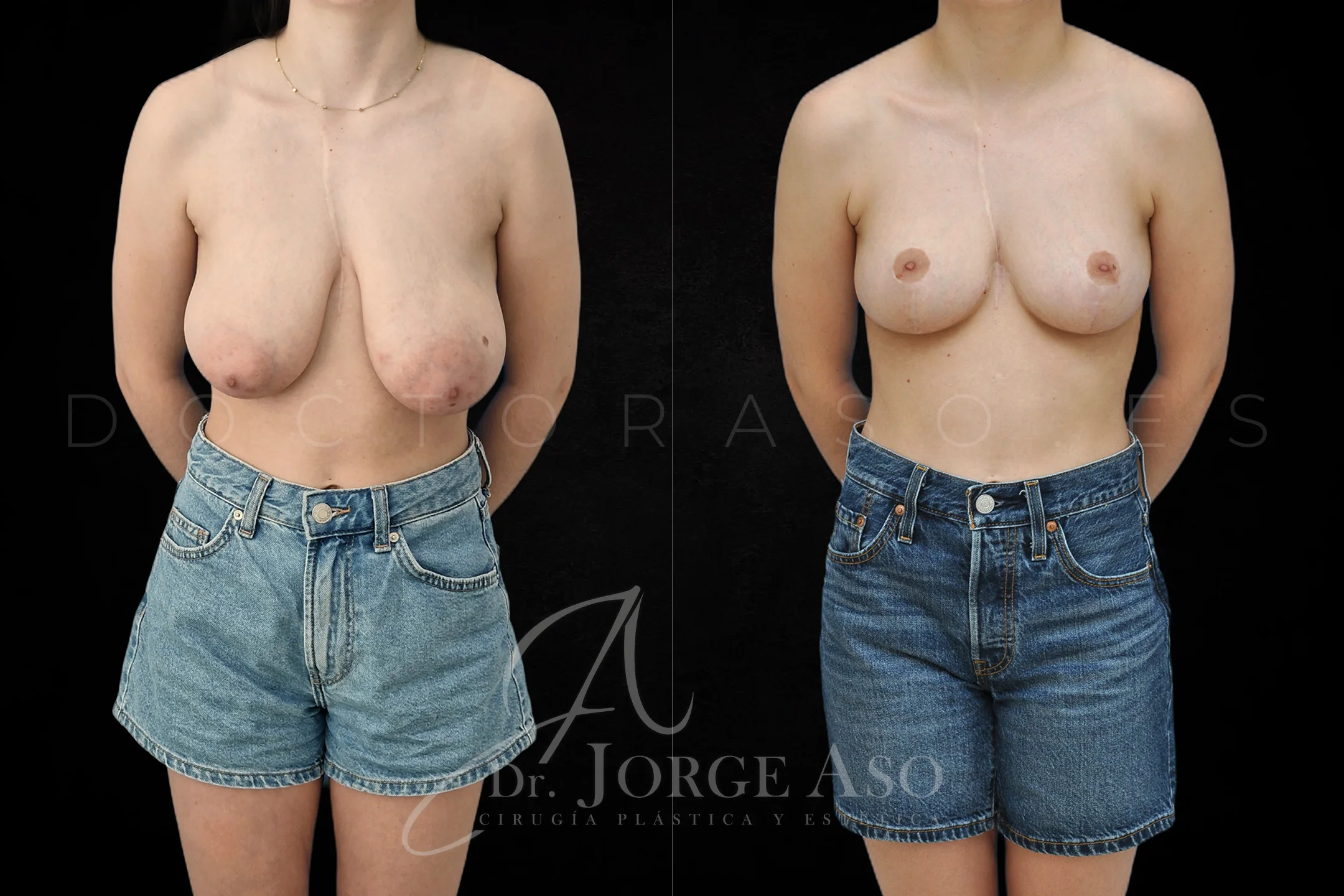
Allows more skin to be removed and greater control over the shape. This is the technique used in the real patient case below.
Scars are permanent, although they usually lighten and flatten over 12–18 months. Their quality depends on genetics, tension, smoking, sun exposure, and aftercare. Our breast lift in Madrid page explains in more detail how we choose the scar pattern and care for the scars.
What will the breasts look like, and how long can the lift last?
A reasonable outcome is a higher, firmer, more proportionate breast, with the areola better positioned and the tissue brought together. Projection may look greater without increasing the amount of breast tissue. The feel and movement remain those of your own tissue.
A breast lift without implants does not produce the same result as a lift with implants. An implant can add volume where it did not previously exist, increase upper-pole fullness, and define a more stable shape. Without implants, we depend entirely on your existing glandular tissue, fat, and skin.
In our experience, breasts without implants tend to descend more over time because they retain a greater proportion of their own glandular tissue. In a lift with implants, we usually remove more tissue and replace some of that volume with an implant, which tends to hold its position better than glandular tissue. Even so, no operation stops gravity: a breast with an implant also settles and can descend, move outward, or change with weight gain, pregnancy, or declining skin quality.
Swelling and a changing shape
The breast may look high, firm, or asymmetric. This is not the time to judge the final result.
A more representative result
The tissues soften, the scars mature, and the breasts settle into a more natural position.
Your body continues to change
Age, gravity, weight, pregnancy, and skin quality continue to have an effect. Results do not last the same length of time for everyone.
Autoaugmentation techniques can improve fullness and have shown high satisfaction in clinical case series. However, the available evidence is varied and comes largely from small or single-center studies.23 That is why we distinguish a technical possibility from a guarantee that the literature does not support.
Anesthesia, procedure time, and recovery after a lift without implants
A breast lift is surgery even when no implants are used. In our practice, it is performed under general anesthesia in a hospital and usually involves an overnight stay. Timings are individualized according to the extent of surgery, the technique, and your recovery.
Usual procedure time
This may vary with significant asymmetry, a complex autoaugmentation flap, or additional procedures.
Hospital stay
Allows pain, bleeding, and your general condition to be monitored during the first hours.
Office work
Many patients can return if recovery is progressing normally and their job does not require physical exertion.
Postoperative bra
We recommend it to support the tissues as swelling subsides and the initial wound closure heals.
Gradual return to exercise
Exercise resumes in stages with your surgeon’s approval. Arm work, impact activities, and lifting require particular care.
3D simulation and volume trials can help compare a lift without implants with one that includes an implant. They cannot predict exactly how a real breast will heal or settle.
What are the risks of a breast lift without implants?
Without implants, there is no risk of implant capsular contracture, rupture, or implant malposition, and no need for implant-integrity monitoring. You also avoid future surgery required solely because of the device. However, a breast lift still carries the risks associated with breast surgery.
Scarring and asymmetry
Scars may widen or become pigmented. Residual differences, changes in sensation, or changes in areola shape can also occur.
Bleeding and swelling
Hematoma, seroma, infection, partial wound opening, and delayed healing require follow-up and sometimes additional treatment.
Fat necrosis or skin loss
Some of the repositioned tissue may be damaged, particularly with smoking, previous scars, or vascular problems.
Nipple–areola complex
Its blood supply may be partially or completely compromised. Patient selection and surgical planning aim to reduce this risk, but cannot eliminate it.
A breast lift without implants with an inverted-T scar
This case shows a substantial lift achieved using only the patient’s own tissue. The aim was not to create an artificially high breast, but to remove excess skin, reposition the areola, and build a more proportionate, natural shape.
- No breast implants.
- Inverted-T scar.
- A real result, not presented as equivalent to implant volume.
Enlarge image
Compare more real breast lift cases
The gallery shows different degrees of sagging, volumes, scars, and results with or without implants. No photograph replaces an individual assessment.
Common questions about a breast lift without implants
Can very sagging breasts be lifted without implants?
Yes, provided there is enough tissue to create a proportionate shape and you accept the limitations in volume and upper-pole fullness. Significant sagging may require an inverted-T scar. The lift raises the breast; an implant adds volume and support for the shape.
Does a breast lift without implants increase size?
No. It redistributes tissue and may make the breast look more projected, but does not create new tissue. Size usually stays similar or decreases slightly as skin and, when needed, a small amount of glandular tissue are removed.
Can the upper pole be filled without implants?
Autoaugmentation with your own tissue can concentrate volume, while fat transfer may add a subtle improvement. Neither option reproduces the volume, shape, or effect of an implant.
Do breasts look more natural without implants?
The feel and movement remain entirely those of your own tissue, and the breasts eventually rest naturally against the chest. This can be an advantage or a limitation: if you want a very high, round, deliberately augmented appearance, a lift with implants is often a better fit.
What scars will I have?
This depends on the excess skin and how far the areola needs to move. The pattern may be vertical, mini-T, or inverted-T. We do not consider it responsible to promise minimal scarring before assessing your anatomy.
How long do the results last?
There is no fixed duration. The breasts continue to age and may change with gravity, pregnancy, weight, and skin quality. In our experience, your own tissue tends to descend more than a shape partly supported by an implant.
When can I return to work and exercise?
As a guide, office work may be possible after around one week, and exercise can resume gradually from 4–6 weeks. Clearance always depends on healing, the technique, and your individual recovery.
When is a lift with implants or Preservé mastopexy appropriate?
An implant makes more sense when you want to increase size, noticeably fill the upper pole, or create higher, rounder breasts. Preservé mastopexy may be considered for grade I–II ptosis, breasts that are not heavy, good tissue coverage, and a modest volume increase. It does not replace a conventional lift when there is substantial excess skin.
Would you like to know what your own tissue can achieve?
An examination helps estimate how much volume can be preserved, which scars would be needed, and whether a lift without implants could meet your expectations. If it would not, we will explain just as clearly what would change with an implant.
Medical sources
- Di Summa PG et al. Systematic review of outcomes and complications in nonimplant-based mastopexy surgery. J Plast Reconstr Aesthet Surg. 2019. PubMed PMID 30527707.
- Grünherz L et al. Long-term results measured by BREAST-Q reveal higher patient satisfaction after autoimplant-mastopexy than augmentation-mastopexy. Gland Surg. 2019. PubMed PMID 31741882.
- Gupta R et al. Refining Aesthetics and Volume: A Retrospective Analysis of Our Experience With Autoaugmentation Mastopexy. Ann Plast Surg. 2025. PubMed PMID 42359739.
- Bruno A, Foti R. Intramuscular and Subcutaneous Lipofilling in Mastopexy: Technical Considerations and Clinical Outcomes. Aesthetic Plast Surg. 2026. PubMed PMID 41944876.
- American Society of Plastic Surgeons. Breast lift procedure steps.
- American Society of Plastic Surgeons. Breast lift results.