Wrinkled or sagging upper-arm skin does not have a single cause. Before discussing devices or surgery, we need to distinguish how much relates to muscle, fat, and genuinely excess skin.
What is the best treatment for sagging arms?
Brachioplasty is the most effective treatment for substantial excess skin, because it is the only option that can remove it. However, it is not always the best individual choice: if fat is the main concern and skin quality is good, liposuction may be enough; if laxity is mild, BodyTite, alone or with liposuction, may achieve contraction and help some patients avoid a skin-excision scar or limit its length.
Exercise improves muscle but does not remove excess skin. No cream, external treatment, or device can deliver the same change as surgically removing a significant amount of excess skin.
Strength training and consistent habits.
Liposuction if the skin can adapt well.
BodyTite, with or without liposuction, in selected cases.
Surgery with a limited, longitudinal, or extended scar.
Article contents
Is the sagging due to muscle, fat, or skin?
Two arms that look saggy at first glance may need very different treatments. An examination should assess skin thickness and elasticity, how much fatty tissue can be pinched, whether the excess is confined to the armpit or extends down the arm, and whether it continues onto the side of the chest.
The muscle component
Underdeveloped triceps can reduce definition. Strength training improves muscle tone and the arm's contour, but does not tighten skin that already forms an excess fold.
The fat component
When there is localized fat and the skin can contract, reducing volume may be enough. If the skin is lax, removing fat without addressing it can accentuate sagging.
The skin component
Thin, wrinkled, or excess skin needs a specific strategy. Energy-based treatments offer limited changes; when there is substantial excess, removal needs to be considered.
Why does sagging or wrinkled skin develop on the arms?
Skin elasticity and its ability to adapt decrease with age. Genetics, sun damage, and weight changes influence when laxity appears and how much the skin can contract after volume loss. After significant weight loss, a hanging fold may remain even when weight and muscle development are appropriate.
A lack of exercise can make the arm look less defined, but does not explain the entire problem on its own. Similarly, a healthy diet, skin moisturization, and sun protection help care for tissues, but do not eliminate established excess skin.
Which treatment usually suits each type of arm?
| Main concern | Option considered | What it can achieve | Main limitation |
|---|---|---|---|
| Reduced muscle tone without excess skin | Strength training | More muscle and better definition | Does not remove skin or localized fat |
| Localized fat and good skin quality | Liposuction alone | Reduces volume and reshapes | Requires anticipating how the skin will adapt |
| Fat with mild laxity | BodyTite with or without liposuction | Volume reduction and controlled thermal contraction | Does not replace excision when there is a lot of excess skin |
| Excess confined to the armpit | Axillary brachioplasty with horizontal excision, sometimes combined with BodyTite | Removes localized excess with a short armpit scar | Offers limited correction of excess extending toward the elbow |
| Excess along the arm | Longitudinal brachioplasty | Removes skin from the armpit toward the elbow | Leaves a permanent scar on the inner arm |
| Excess continuing onto the chest | Excision extended onto the lateral chest wall | Treats the arm and chest as a continuous area | A longer scar and more extensive recovery |
This guide does not replace an examination. The amount and distribution of fat, skin quality, major weight loss, weight stability, and expectations about scarring may change the indication.
Can sagging arms be corrected without surgery?
Mild laxity may improve, but substantial excess skin cannot be eliminated without removing it. It is also important to distinguish genuinely noninvasive treatments from minimally invasive techniques such as BodyTite, which place a cannula beneath the skin and are performed in a medical setting.
Exercise and strength training
These are the foundation when muscle tone is lacking and help maintain the overall result. They do not “reattach” excess skin or replace surgery to remove it.
External radiofrequency and HIFU
They may produce modest, variable improvements in firmness when laxity is mild. They do not remove tissue, and the extent of change is not comparable to BodyTite or skin excision. A review specifically addressing body skin laxity outside the face includes the arms and emphasizes that surgery may still be indicated after major weight loss.
Cryolipolysis
This is intended to reduce small fat deposits, not treat excess skin. In our practice, we do not use it for upper-arm laxity: losing volume without addressing the skin can make excess more noticeable, and we often find its volume reduction disappointing. The FDA also describes it as a fat-reduction technology, not a skin-removal procedure or treatment for excess skin.
Mesotherapy and skin care
A cream or superficial injection may improve hydration or skin appearance, but does not play a role equivalent to liposuction, BodyTite, or skin excision in our approach to arm contouring.
BodyTite: when it may avoid or shorten a scar
BodyTite delivers controlled bipolar radiofrequency between an internal cannula and an external electrode. It can coagulate fat and encourage tissue contraction; when localized fat is present, it is usually combined with liposuction. Although the incisions are small, it is not an external or entirely noninvasive treatment.
In our practice, we mainly use it for mild laxity. In a well-selected patient, it may make the difference between avoiding skin excision or keeping the scar horizontal within the armpit instead of extending it vertically toward the elbow. This is a clinical possibility, not a guarantee.
The literature includes prospective studies and a favorable randomized comparison of radiofrequency-assisted arm contouring. However, patient selection is crucial, and the evidence itself retains excision as the reference when skin laxity is substantial. A prospective study of 120 patients and a randomized study of contouring without excision help put its possibilities and limitations into context.
When does skin need to be removed?
An arm lift, or brachioplasty, removes excess skin and, where appropriate, also treats localized fat. The American Society of Plastic Surgeons explains that the shape and length of the incision depend on the amount and location of skin that needs removing.
A horizontal armpit scar
This is considered when the excess is concentrated near the armpit. The scar runs across that crease, but its ability to correct the lower part of the upper arm is limited. BodyTite may help us avoid extending it in selected cases.
A scar toward the elbow
This allows treatment of more substantial excess along the inner arm. It offers greater correction in exchange for a visible, permanent scar running from the armpit a variable distance toward the elbow.
Extending the scar onto the chest
This is considered when the hanging fold does not end at the armpit but continues along the side of the chest. The scar is extended so that this anatomical transition is not left untreated.
Scars and risks: the part that should not be hidden
Brachioplasty exchanges excess skin for a scar. It may mature well and become discreet, but it can also widen, become pigmented, or develop hypertrophy. Its position, length, and final quality depend on anatomy, tension, technique, and each patient's healing.
Possible complications include partial wound separation, seroma, infection, hematoma, changes in sensation, contour irregularities, lymphedema, or revision surgery. A meta-analysis of 29 observational studies and 1,578 patients found that abnormal scarring, recurrent sagging, and wound separation were among the more frequently reported events. Pooled figures help inform patients but do not predict individual risk.
BodyTite and liposuction also carry risks, including thermal burns, seroma, fibrosis, sensory changes, asymmetry, and irregularities. This is why treatment selection, energy control, and the care setting matter as much as the technology.
How recovery varies by treatment
Anesthesia depends on the technique and extent. We generally perform these procedures with sedation or general anesthesia in a hospital setting. Only certain very localized mini-liposuction procedures can be performed under local anesthesia. Surgery involving skin excision is usually outpatient; an overnight stay is used when the extent, combined surgery, or recovery warrants it.
We use compression for 1–2 weeks. Other timelines are approximate ranges, adjusted at follow-up according to healing, treatment extent, and activity type.
Walking and gentle movement
Short walks and functional movement, without lifting loads or movements that place tension on the incisions.
Office work after limited treatment
A usual reference for mini-liposuction or limited BodyTite when recovery is going well.
Office work after skin removal
More time may be needed if work involves raising the arms, lifting, or repetitive movement.
Gentle cardio
Earlier after limited procedures and later after excision, always once the wound has closed and clearance has been given at follow-up.
Strength training, swimming, and strenuous exercise
Progress is usually slower after extended surgery or if there is any healing problem.
Driving: as a rough guide, around 5–7 days after a limited procedure and 10–14 days after skin excision. Only once you are no longer taking sedating medication and can turn the steering wheel and perform an emergency maneuver without pain or limitation.
How to care for the result in the long term
Maintaining a stable weight, strength training, eating enough protein, and avoiding smoking support contour and recovery. Sun protection reduces cumulative sun damage and is particularly important for a recent scar once the team permits exposure.
These measures do not completely prevent aging or guarantee that laxity will not return. Surgery removes the excess skin present at that time; tissues will continue to change with age, weight, and their own skin quality.
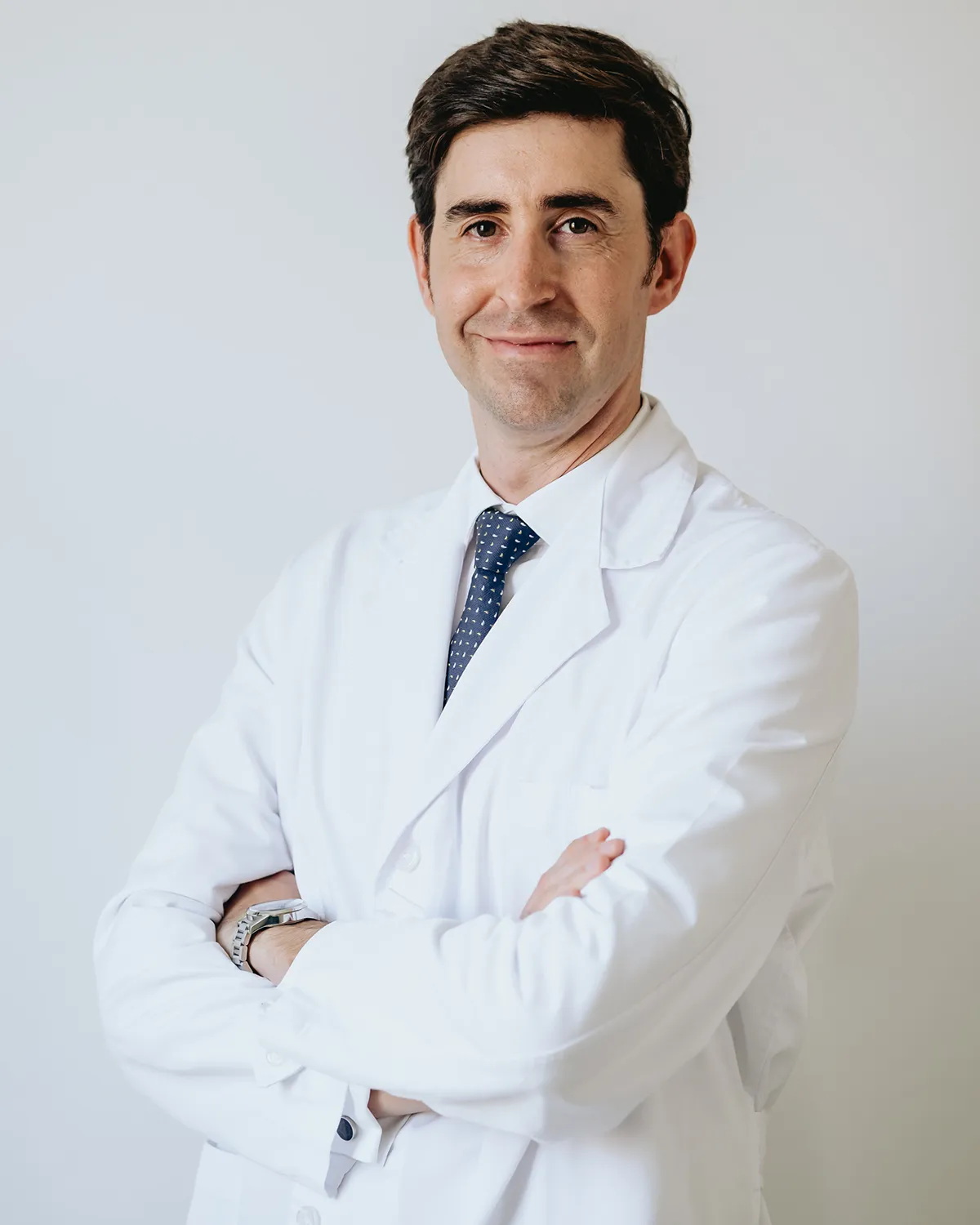
I am Dr. Jorge Aso
I completed specialist training through Spain's MIR system in Plastic, Aesthetic and Reconstructive Surgery and hold a doctorate in Medicine cum laude. For the arm, I do not start with a favorite technique: I assess muscle, fat, skin quality, and the extent of excess separately to determine what change is reasonable and what scar it would require.
My planning approach aims to use the least extensive option that can safely achieve the goal. For mild laxity, we prioritize BodyTite, with or without liposuction; if there is excess skin, we clearly explain the difference between a horizontal armpit scar, a longitudinal scar, and an extension onto the chest.
Questions about sagging arms and wrinkled skin
Do exercises eliminate sagging arms?
They improve muscle volume and definition, so the arm may look firmer. They do not remove genuinely excess skin or a localized fat deposit.
Is there a nonsurgical arm lift?
External treatments may offer modest changes in mild laxity, but do not remove skin. BodyTite may avoid excision in some patients, although it is a minimally invasive technique involving a cannula and should not be confused with an entirely external treatment.
Does BodyTite leave a scar?
It leaves small cannula access marks. In selected cases, it may avoid an excision scar or help limit it to the armpit, but substantial excess skin will still require a longitudinal or extended scar.
Does liposuction alone work for a sagging arm?
It works when fat predominates and the skin has enough capacity to adapt. If the skin is already lax, removing fat without addressing it can worsen the appearance of sagging.
Does cryolipolysis tighten upper-arm skin?
We do not consider it a treatment for laxity. It reduces fat in some indications but does not remove skin; volume loss can make the excess more visible. In our experience, arm volume reduction is also often disappointing.
When can the scar stay within the armpit?
When excess is limited and concentrated in the upper part of the arm. Skin quality and complementary BodyTite may broaden the options, but a short scar does not adequately correct a hanging fold extending toward the elbow.
How long is compression needed?
Our usual protocol is one to two weeks, adjusted to the technique, swelling, and individual recovery.
Does the result of brachioplasty last forever?
The removed skin does not return, but the arm continues to age and may change with significant weight fluctuations. A lasting result does not mean stopping those processes.
First identify the excess; then decide how much to treat
Mild laxity may respond to BodyTite and localized fat to liposuction. With substantial excess skin, the conversation changes: you need to consciously choose between keeping the skin and accepting a scar in exchange for greater correction.
Medical sources
- American Society of Plastic Surgeons. Arm Lift (Brachioplasty).
- American Society of Plastic Surgeons. Arm Lift Recovery.
- U.S. Food and Drug Administration. Non-Invasive Body Contouring Technologies.
- Tettamanzi M et al. Use of Radiofrequency-Assisted Liposuction (BodyTite) for Upper Arms Lifting. Aesthetic Plast Surg. 2023.
- Ibrahiem SMS. Aesthetic Nonexcisional Arm Contouring. Aesthet Surg J. 2022.
- Fabi SG et al. A noninvasive approach to off-face skin laxity and tightening: a review of the literature. Semin Cutan Med Surg. 2015.
- Aljerian A et al. Complications in Brachioplasty: A Systematic Review and Meta-Analysis. Plast Reconstr Surg. 2022.
Medical authorship Specialist in Plastic, Aesthetic and Reconstructive Surgery (Spanish MIR training) Medical registration no. 2828/61062 · Madrid About Sagging Arms: Choosing the Right Treatment: clinical information, safety and expectations. Based on the original Spanish content. Translation does not constitute a new medical review. This information does not replace an individual medical assessment. References support the general medical information. Suitability, alternatives, and risks are discussed individually during consultation.
Medical sources and editorial standards
Selected references for this article
7 references