
Decision guide · Breast surgery · Madrid
Minimally invasive or conventional breast augmentation: mia Femtech®, Preservé® and the classic technique compared
The three techniques we operate with, side by side: anaesthesia, scar, volume, recovery, price and, above all, who each one is for. With the criteria we use in consultation and the real volumes of our cases.
Updated 8 November 2026 · Reviewed by Dr. Jorge Aso, registration no. 2828/61062 · More than 4,000 breast augmentations
Short answer
Volume alone does not decide: below 200 cc all three techniques are options. In practice, most patients seeking less than 200 cc end up choosing mia, and many who come for mia but prefer a little more volume (just over 200 cc) move to Preservé; that is the usual pattern, not a rule. If you want a discreet augmentation and your breast needs no correction of the fold or the gland, mia Femtech® and Preservé® give a very similar result, with sedation, about 25 minutes and back to the office in 24–72 hours; we usually lean slightly towards mia for its armpit scar. Preservé is preferable if a high fold, a mild asymmetry or a mild tuberous breast needs adapting, and it is the minimally invasive option up to about 320 cc. Conventional augmentation works for any volume and is the right technique if you need the implant under the muscle because you have little tissue, have sagging or a marked asymmetry to correct, want to choose among all shapes and profiles, or budget matters; above about 320 cc it is the only option. General anaesthesia, one overnight stay and back to the office in 4–7 days. With mia and Preservé, loss of nipple sensation is also exceptional. All three are performed at HLA Moncloa University Hospital, and the anatomy measured in consultation decides more than the name of the technique.
- mia up to 195 cc · armpit · €8,995
- Preservé up to about 320 cc · fold · from €7,900
- Conventional no volume ceiling · fold · from €6,400
The three techniques, compared
What we do at our clinic with each technique. These are data from our protocol and our cases, not promises: every patient recovers at her own pace and the indication is confirmed at the examination.
| Aspect | Conventional augmentation | Preservé® | mia Femtech® |
|---|---|---|---|
| Type of technique | Classic augmentation: the pocket is created by dissection. The technique with the widest range of shapes, volumes, incision sites and planes. | Minimally invasive (Establishment Labs): prepectoral pocket created by balloon expansion, without wide dissection. | Minimally invasive (Establishment Labs): prepectoral pocket created by expansion, with an insertion system through the armpit. |
| Anaesthesia | General. | Local with sedation, no intubation. | Local with sedation, no intubation. |
| Duration | 30–60 minutes. | 25–30 minutes. | About 25 minutes. |
| Hospital and stay | HLA Moncloa University Hospital; one overnight stay, included in the price. | HLA Moncloa University Hospital; outpatient, discharged about 2 hours later. | HLA Moncloa University Hospital; outpatient, discharged about 2 hours later. |
| Incision | About 3 cm, usually in the inframammary fold (areola or armpit in specific cases). | About 2.5 cm in the inframammary fold. | About 2.3 cm in the armpit crease: no scar on the breast. |
| Implant plane | Dual plane (under the pectoral muscle) in most cases; prepectoral or subfascial when there is enough coverage. | Prepectoral, without touching the muscle. | Prepectoral, without touching the muscle. |
| Implant | Round, anatomical or ergonomic (including Motiva Ergonomix2®), from several brands and profiles (POLYTECH, Motiva, Mentor; polyurethane in selected cases). | Motiva Ergonomix2® (gel that changes shape with posture). | mia® biconvex “diamond” implant with a contained diameter. |
| Usual volume | 185–560 cc in our published cases (median 350 cc); can exceed 600 cc in selected cases. | Up to about 320 cc (current practical limit); also below 200 cc. In our cases, most between 250 and 285 cc. | From about 100 cc up to 195 cc; usually 165–195 cc (the most used is 195 cc). |
| Approximate cup change | One to two cup sizes or more. | From a discreet change up to about one and a half cup sizes. | Around one cup size. |
| Also corrects | Sagging (with a breast lift), marked asymmetries, tuberous breasts, a low or high fold, complex previous surgery. | A high fold or short lower pole, mild or moderate asymmetries, mild tuberous breast; mild sagging with Preservé-pexy. | Does not change the fold or the gland: for anatomies that need no correction, with at most a very mild asymmetry. |
| Pain | Greater, especially under the muscle; manageable with the prescribed medication. | Clearly less in our experience. | Clearly less in our experience. |
| Back to office work | 4–7 days. | 24–72 hours. | 24–72 hours. |
| Arms | Limited at first depending on the plane (sometimes no higher than 90°). | Almost vertical from day one. | Almost vertical from day one. |
| Nipple sensation | Skin changes in the lower pole are not rare; persistent change in the nipple and areola below 5 % in our experience. | Relevant loss virtually non-existent in our series of more than 220 mia or Preservé patients; 0 sensory disturbances in 159 patients in the multicentre series published in Aesthetic Surgery Journal (August 2026). | Relevant loss virtually non-existent in our series of more than 220 mia or Preservé patients. |
| Drains, bra and band | No routine drains; a mould the first night; bra for one month and a chest band for two weeks only with anatomical implants. | No drains; bra for one month and a chest band for two weeks. | No drains; bra for one month and a chest band for two weeks. |
| Guide price 2026 | From €6,400, with hospital, anaesthesia, implants and follow-up visits. | From €7,900, with implants, anaesthetist, operating theatre, pre-op tests and follow-up visits. | €8,995, with implants, anaesthetist, operating theatre, follow-up visits and bra. |
| Dr. Aso’s experience | More than 4,000 breast augmentations. | More than 140 Preservé®; certified trainer (Preservé Trainer). | More than 100 mia® patients; mia®-certified clinic and surgeon. |
Volumes of our published cases: 168 conventional (185–560 cc, median 350 cc), 9 Preservé® (225–285 cc) and 5 mia® (190–195 cc). Guide prices for 2026 as published on Clinic data (in Spanish); surgical insurance is optional in all three (about €120).
How we decide in consultation: six criteria
The technique is not chosen from a catalogue. At the first consultation we examine, measure and simulate in 3D; with that information the decision is usually clear. These are the criteria, in the order in which they weigh.
- How much volume you want. Below 200 cc all three techniques fit and the following criteria decide (in practice, most of these patients choose mia, and many who want a little over 200 cc move to Preservé, but it is not a rule); up to about 320 cc, Preservé or conventional; above that, only conventional. One cup size equals, on average, 150–200 cc; in the implant size guide we explain how we calculate it.
- How much tissue covers you. We measure the pinch test in every quadrant: under 1 cm we rule out the prepectoral plane; around 1.5 cm is our usual minimum and 2 cm gives very safe coverage. If coverage is lacking, the implant goes under the muscle, and that means the conventional technique. mia meets the requirement more easily in slim patients thanks to the contained diameter of its implant.
- Where your fold sits and how the lower pole is. A high fold or a short lower pole can be released or lowered through the Preservé incision; not with mia. If the fold has to come down a lot or the gland needs extensive work, conventional.
- Whether there is sagging. Nipple at the level of the fold or above: any of the three. Mild sagging in a breast that is not heavy: Preservé® mastopexy to consider. Marked sagging: breast lift, with the implant under the muscle where appropriate. No augmentation technique lifts the nipple on its own.
- Symmetry and shape. Very mild asymmetry: any. Mild or moderate, or mild tuberous breast: Preservé, thanks to its range of volumes and access through the fold. Marked asymmetry or moderate to severe tuberosity: conventional.
- Your priorities. Avoiding general anaesthesia and getting back to your life sooner, a scar away from the breast (mia), being able to choose among all shapes and profiles (conventional), or the budget. When two techniques are valid, you decide with this information.

Which technique fits you? Guidance in four questions
Answer with what you know about your breasts today. The result is guidance based on our criteria, not a diagnosis: the examination and measurements can change it.
What really changes between a minimally invasive technique and the classic one
What mia and Preservé share
- Prepectoral plane: the implant sits above the muscle and the pectoral is neither cut nor detached. That is why there is no distortion when it contracts and the postoperative period hurts less.
- Pocket by expansion: created with a distension balloon and specific instruments, with far less dissection than classic surgery. In under 5 % of cases a small vessel needs to be sealed or a ligament divided.
- Sedation, not general anaesthesia: you breathe on your own, with no intubation, monitored by an anaesthetist; as a reference, a sedation similar to a colonoscopy. We infiltrate about 200 cc of solution with local anaesthetic, which acts as a block for the first hours.
- Same recovery: outpatient, no drains, a bra for one month and a chest band for two weeks, arms almost vertical from day one, office in 24–72 hours, static cycling at three weeks and running at six weeks. In our series we have seen no difference in pain between the two.
- Sensation preserved: because the muscle is not cut, there is far less dissection and no electrocautery in the pocket, the breast nerves are better respected. In more than 220 of our mia or Preservé patients, relevant loss of sensation has been virtually non-existent, and the multicentre series by Pittman et al. (Aesthetic Surgery Journal, August 2026; 159 patients) recorded no sensory disturbance at 3 months. After conventional augmentation, skin changes in the lower pole are not rare, although persistent change in the nipple stays below 5 % in our experience. More in nipple sensation after breast augmentation.
- What they do not do: they do not lift the nipple, do not correct marked sagging or asymmetries and are not indicated in irradiated breasts. “Minimally invasive” does not mean “no surgery”.
Between the two, the differences lie in volume, incision site, implant and what each can correct: we detail them in mia Femtech or Preservé: differences and how to choose.
What conventional augmentation brings
- No ceiling on volume or shape: round, anatomical or ergonomic, any profile and brand (POLYTECH, Motiva, Mentor; polyurethane in selected cases). It is the only option above about 320 cc.
- Any plane: under the muscle (dual plane) when tissue is scarce and the implant edges need softening; prepectoral or subfascial when there is coverage. We explain it in above or below the muscle?.
- Corrects while it augments: folds that need lowering or raising, marked asymmetries, moderate or severe tuberous breasts and combinations with a breast lift or with previous surgery.
- In exchange: general anaesthesia, one overnight stay, an incision of about 3 cm in the fold, more discomfort in the first days (especially under the muscle) and office in 4–7 days. No drains or dressings as routine in our protocol.
- The technique with the longest track record: more than 4,000 augmentations by Dr. Aso and 168 published cases with a data sheet, from 185 to 560 cc.
Everything about the technique, the implants and the price in breast augmentation in Madrid.
Our own data · November 2026
What we have observed in 210 patients treated with MIA and Preservé
Consecutive patients operated on since October 2024 with at least 3 months of documented follow-up: 66 MIA and 144 Preservé. Mean follow-up is about 8 months; the longest is 25 months for MIA and 21 for Preservé.
See the full table, including every event- 0infections
- 0hematomas or seromas needing treatment
- 0Baker II, III or IV capsular contractures
- 0malpositions, bottoming out or flipping
- 1(0.5%)implant replacement for an early rupture found on the follow-up ultrasound; replaced through the same incision, with a good recovery
Other events, all mild: 5 cases of mild rippling (2.4%), none wanting correction; 4 superficial wound openings resolved in clinic (1.9%); and 1 wound review under local anaesthesia with no findings.
These are internal data with still-short follow-up: they do not show that the risk is zero and do not replace an assessment of your case.
When we do not recommend a minimally invasive technique
These are the cases in which mia or Preservé would not solve the problem well, even if the patient asks for them because of the anaesthesia or the recovery.
- You want more than 320 cc or a cup size that, with your build, cannot be reached with the volumes of these systems. A larger-framed patient is not excluded by her BMI, but 195 cc may look very small to her.
- Your tissue does not cover: with a pinch test under 1 cm the implant has to go under the muscle.
- There is sagging to correct: no augmentation technique replaces a breast lift. For mild sagging and breasts that are not heavy, Preservé® mastopexy is an intermediate option.
- Marked asymmetry, moderate or severe tuberous breast or a fold that needs lowering a lot: they need the freedom of the conventional technique.
- Irradiated breast: an absolute contraindication in our practice because of the risk of poor expansion and capsular contracture.
- Previous surgery: not an exclusion in itself (we have used mia or Preservé after breast lifts without implants, old reductions or explantations), but it requires studying the current tissues case by case.
Recovery compared, on one timeline
Guide timings from our protocol for an uncomplicated recovery. The instructions from your follow-up visit take priority.
Day by day in breast augmentation recovery, pain by technique and how to sleep.
Price compared and what each one includes
Conventional augmentation
From €6,400
HLA Moncloa Hospital with one overnight stay, general anaesthesia and anaesthetist, implants, pre-op tests and follow-up visits. The final amount depends on the implant chosen and the complexity of the case.
What the quote includesPreservé®
From €7,900
Motiva Ergonomix2® implants, system material, anaesthetist, hospital operating theatre as an outpatient, pre-op tests and follow-up visits until discharge.
Preservé® price and casesmia Femtech®
€8,995
Includes VAT, mia® implants, insertion system, anaesthetist, operating theatre at HLA Moncloa Hospital, follow-up visits and post-operative bra.
mia® price and casesIn all three, surgical insurance is optional (about €120) and the first consultation costs €100 at the clinic or €70 by video, deducted if you go ahead with surgery. These are guide prices: the final quote is given in writing after the assessment and, as with any surgery, does not cover the costs of complications or unforeseen treatment. More detail in how much a breast augmentation costs and how much mia and Preservé cost.
Real cases by technique
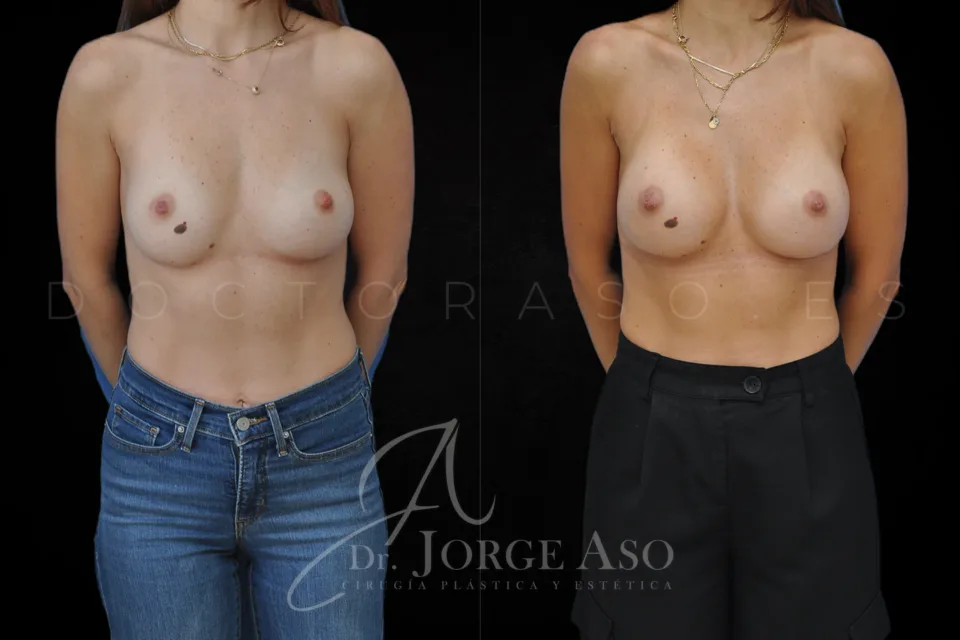
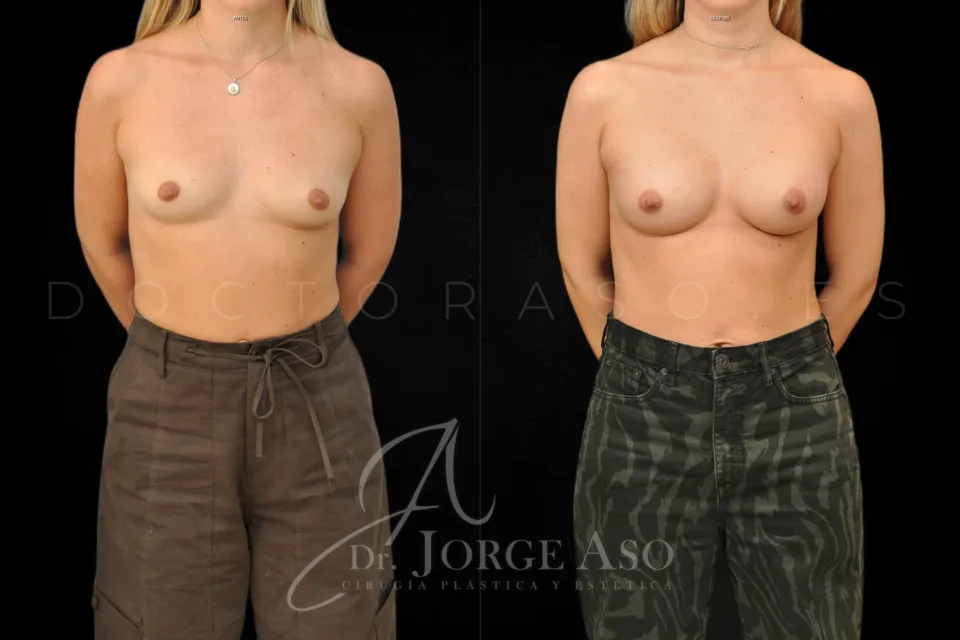
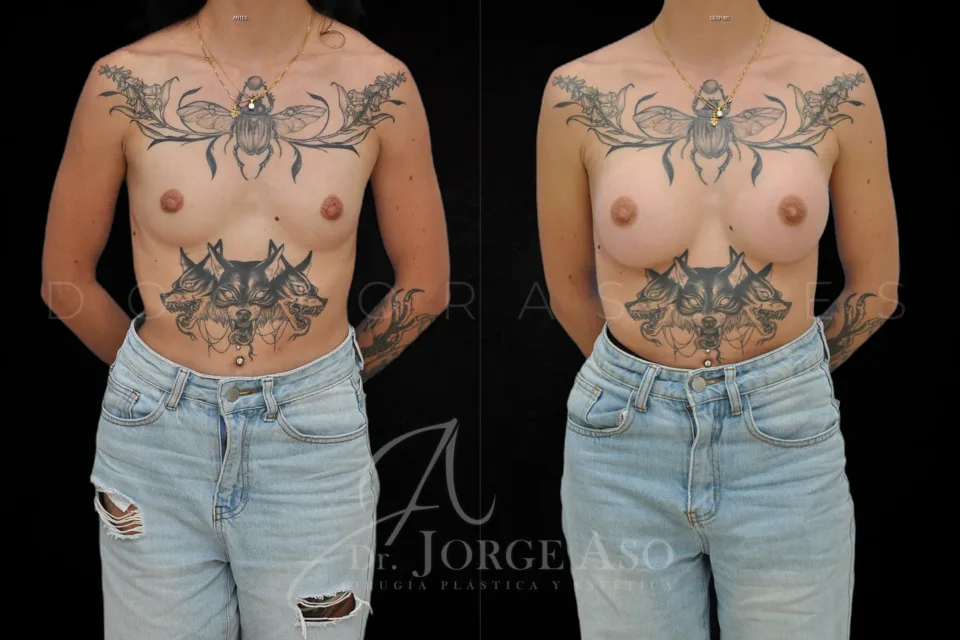
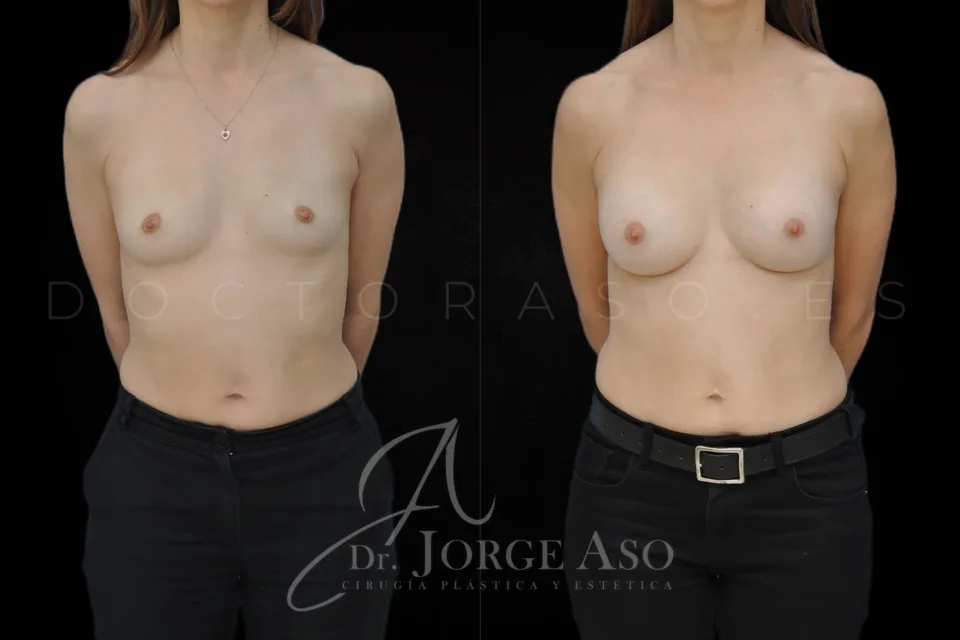
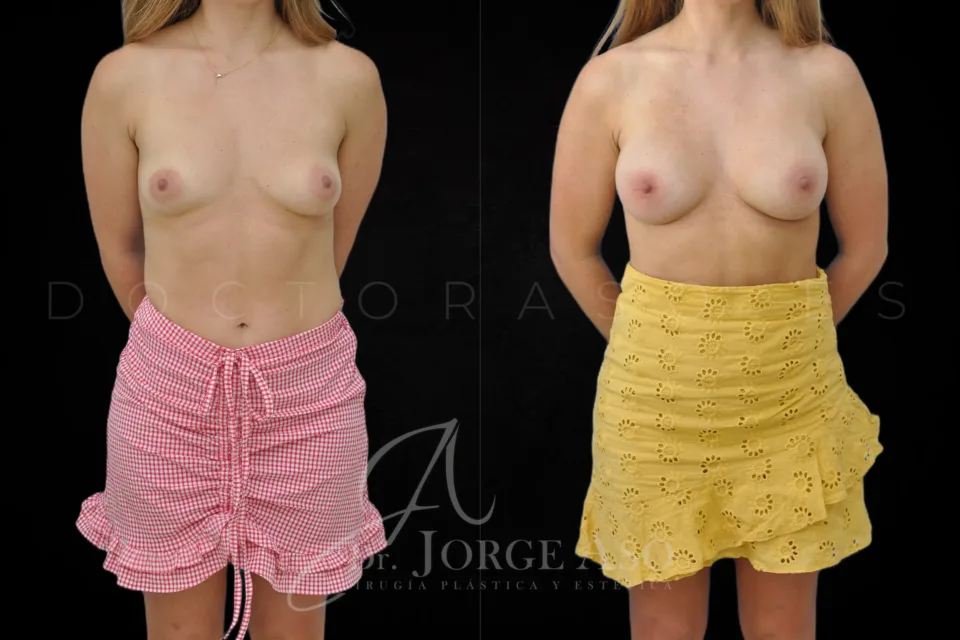
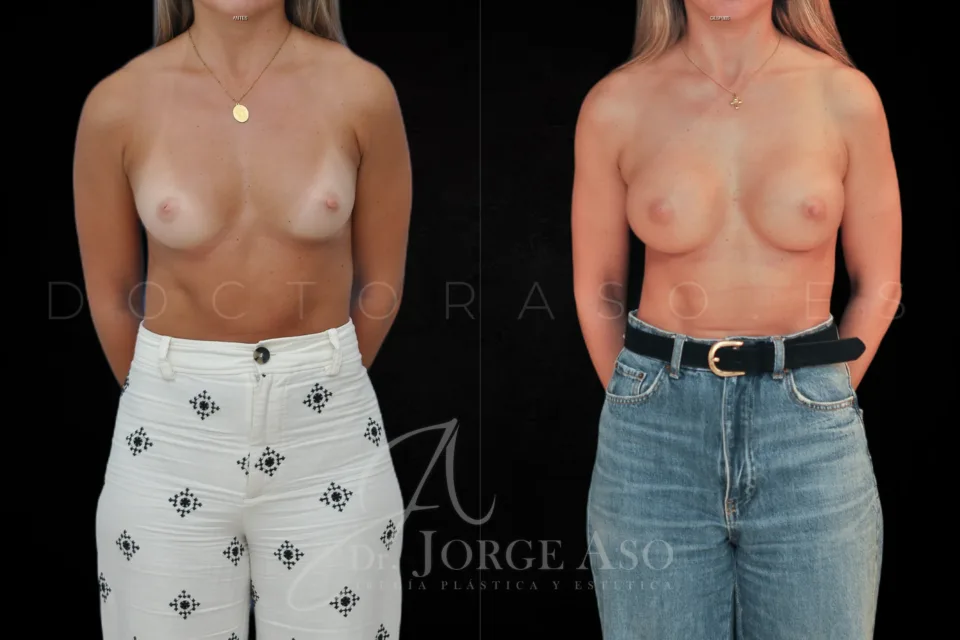
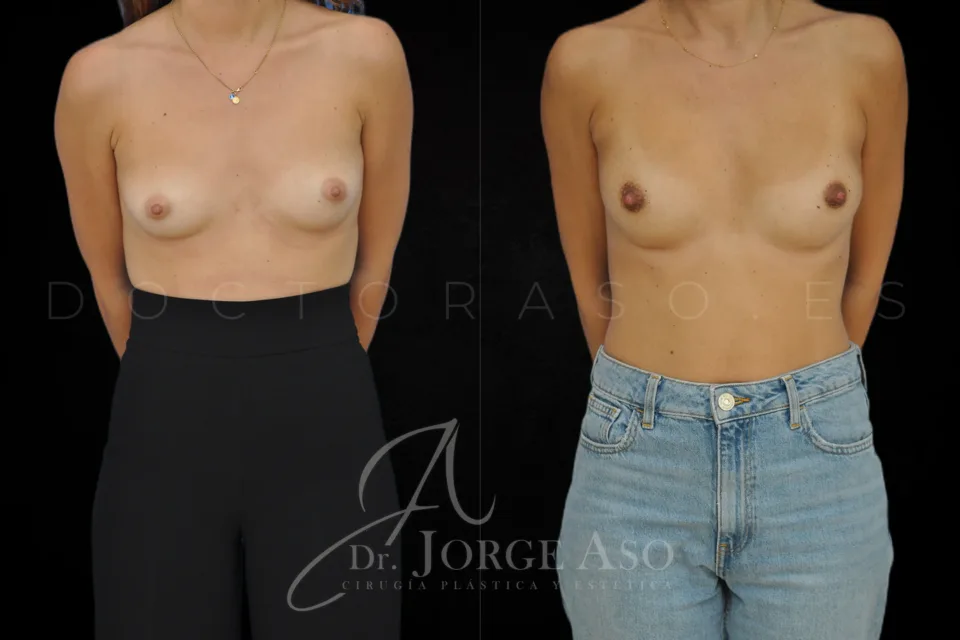
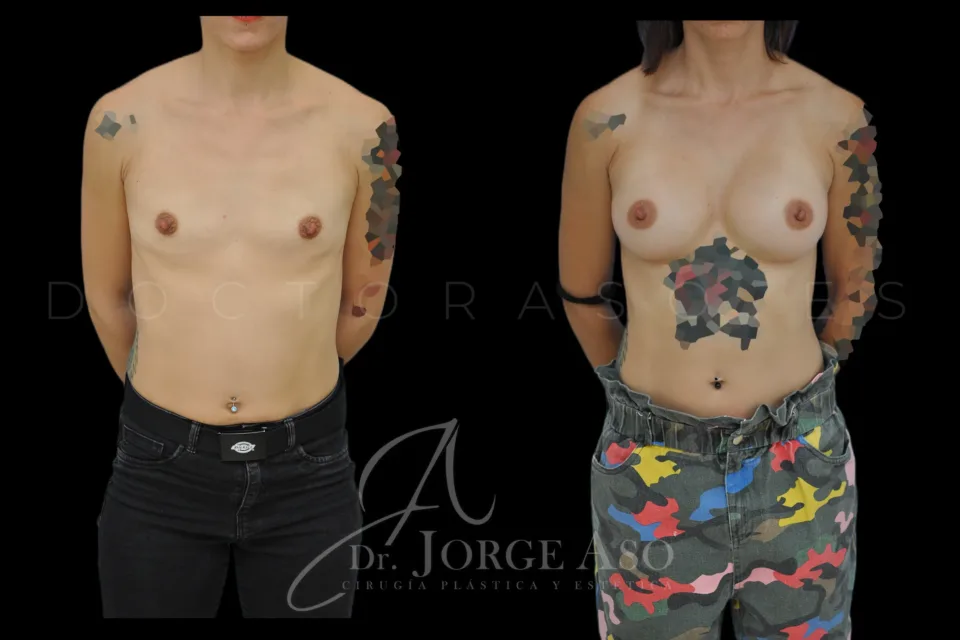
Standardised clinical photos from our gallery, with each case’s data sheet (volume, implant, profile, height and weight). They help you compare patients with proportions similar to yours, not choose a technique by imitation.
mia Femtech® · 190–195 cc
 190 cc, mia Femtech®, low profile170 cm · 53 kg · at 12 months
- 190 cc, mia Femtech®, low profile159 cm · 57 kg · at 12 months
- 195 cc, mia Femtech®, moderate profile152 cm · 41 kg · at 12 months
Preservé® · 225–285 cc
- 225 cc, Preservé® ergonomic, moderate profile165 cm · 55 kg · at 12 months
- 270 cc, Preservé® ergonomic, moderate profile162 cm · 52 kg · at 12 months
- 285 cc, Preservé® ergonomic, moderate profile161 cm · 54 kg · at 12 months
Conventional augmentation · 185–560 cc
- 185 cc, round, low profile167 cm · 50 kg · at 6 years
- 350 cc, anatomical, high profile160 cm · 47 kg · at 6 years
- 560 cc, round, high profile157 cm · 73 kg · at 12 months
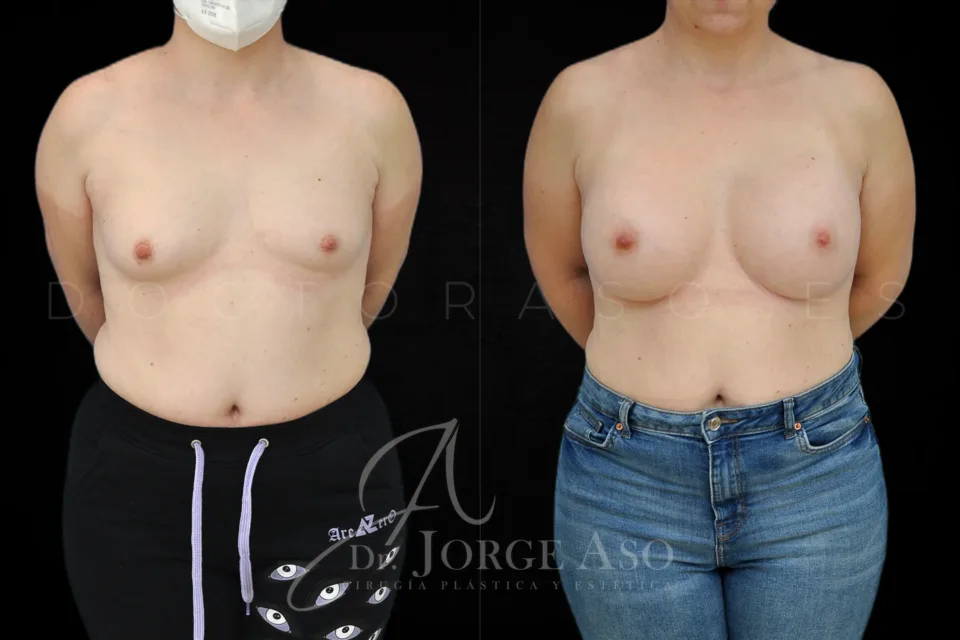
All 182 cases, with filters by volume and technique, in the breast augmentation gallery. Every patient has authorised the publication of her photos.
Let’s talk about your case
At the first consultation we examine you, measure tissue coverage, do the 3D simulation and propose the technique with a written quote. If two options are valid, we explain the difference and you decide. Three SECPRE plastic surgeons; the one who saw you in consultation is always the one who operates.
€100 at the clinic · €70 by video · deducted from the quote
- Breast augmentation in MadridConventional technique, price and cases
- Preservé® in Madridmore than 140 cases, certified trainer
- mia Femtech® in MadridCertified clinic, price and cases
- Before and after galleryReal cases with data sheets
Frequently asked questions about mia, Preservé and conventional augmentation
What is the difference between a minimally invasive and a conventional breast augmentation?
In conventional augmentation the implant pocket is created by dissection, under general anaesthesia with one overnight stay, and it allows any volume, shape, incision site and plane. With mia Femtech® and Preservé® the pocket is created by expansion, above the muscle, under local anaesthesia with sedation, and the patient goes home the same day. In exchange, the volume and the corrections possible are more limited.
Which is better: mia Femtech, Preservé or conventional augmentation?
None is better in the abstract, and volume alone does not decide: below 200 cc all three are options. In practice, most patients seeking less than 200 cc end up choosing mia, and many who come for mia but prefer a little more volume (just over 200 cc) move to Preservé; that is the usual pattern, not a rule. With a discreet volume and an anatomy that needs no correction, mia and Preservé give a very similar result and we usually lean slightly towards mia for its armpit scar; Preservé is preferable if a high fold, a mild asymmetry or a mild tuberous breast needs adapting, and it is the minimally invasive option up to about 320 cc. Conventional augmentation fits any volume when the implant has to go under the muscle, there is sagging or a marked asymmetry to correct, you want to choose among all shapes and profiles, or budget matters; above about 320 cc it is the only option.
How many cc does each technique allow?
mia Femtech® uses implants from about 100 cc up to 195 cc, although 165–195 cc is the usual range. Preservé® reaches about 320 cc as its current practical limit and is also used below 200 cc; in our cases the usual range is 250–285 cc. Conventional augmentation has no such ceiling: our published cases range from 185 to 560 cc, with a median of 350 cc.
Can a breast augmentation be done without general anaesthesia?
Yes, with mia Femtech® and Preservé®: local anaesthesia with intravenous sedation, no intubation, monitored by an anaesthetist, in an operating theatre at HLA Moncloa University Hospital. For conventional augmentation we use general anaesthesia. Exceptionally, any sedation may need to be converted to general anaesthesia.
Does a minimally invasive technique hurt less?
In our experience mia and Preservé hurt clearly less than conventional augmentation, especially compared with the submuscular approach: the pectoral muscle is not touched, there is less dissection and local anaesthetic is infiltrated. They are not “painless” procedures, but returning to office work in 24–72 hours is common, compared with 4–7 days after conventional augmentation.
Is nipple sensation lost with mia or Preservé?
Very rarely. In more than 220 patients operated on at our clinic with mia Femtech® or Preservé®, clinically relevant loss of sensation has been virtually non-existent, and the multicentre series of 159 patients published in Aesthetic Surgery Journal in August 2026 recorded no sensory disturbance at 3 months. The prepectoral plane without cutting the muscle, minimal dissection by expansion and small incisions all contribute. After conventional augmentation, skin changes in the lower part of the breast are not rare, although persistent change in the nipple and areola stays below 5 % in our experience.
What scar does each technique leave?
Conventional: about 3 cm, almost always in the inframammary fold. Preservé®: about 2.5 cm, also in the fold. mia Femtech®: about 2.3 cm in the armpit crease, with no scar on the breast.
Can I choose mia or Preservé if my breasts sag a little?
If the nipple sits at the level of the fold or above, yes. If there is already sagging, they can serve for a few years, but you will probably need a breast lift later. For mild sagging in breasts that are not heavy we consider Preservé® mastopexy; for marked sagging we recommend a breast lift, usually with the implant under the muscle.
Can mia or Preservé correct an asymmetry or a tuberous breast?
Preservé® allows fine-tuning of volumes and working on the fold and the gland through the same incision, so it works for mild or moderate asymmetries and mild tuberous breasts. mia only for very mild asymmetries, because it cannot lower the fold. Marked asymmetries and moderate or severe tuberous breasts are treated with the conventional technique.
Why do mia and Preservé cost more than a conventional augmentation?
Because the implants and the single-use material of these systems (expansion balloon and introducer) have a cost set by the manufacturer, and because they include an anaesthetist and a hospital operating theatre just like the conventional technique. In exchange, there is no overnight stay. Guide prices for 2026: conventional from €6,400, Preservé® from €7,900 and mia® €8,995. These are guide prices: the final quote is given in writing after the assessment and does not include costs arising from complications or unforeseen treatment. Surgical insurance is optional in all three (about €120).
When can I do sport with each technique?
As a guide from our protocol: after conventional augmentation, gentle static cycling at about one month, running at about two months and sports involving the arms or impact at about three; with mia and Preservé, static cycling at three weeks and running or upper-body training at six weeks. Always after checking at a follow-up visit that healing and the implant position are progressing well, and with a supportive sports bra.
Are minimally invasive techniques safe?
They are implant surgeries, with the risks of any breast augmentation. In our series of more than 220 patients operated on with mia or Preservé the postoperative course has been very favourable, with no relevant differences between the two. We do not indicate them in irradiated breasts or when tissue coverage is insufficient.
Which technique gives the most natural result?
All three can give a natural result if the volume, profile and plane are well chosen. mia and Preservé favour it through their contained volume range and by placing the implant above the muscle, which avoids the distortion when the pectoral contracts. Conventional augmentation allows a natural result at any volume and also in slim patients who need muscle coverage.
Can I change technique after the first consultation?
Yes. At the first consultation we examine you, measure tissue coverage (pinch test) and anatomy, and do a 3D simulation. With that we propose a technique and, when two options are valid, we explain the difference so you can decide. The quote is given in writing and the first consultation (€100 at the clinic or €70 by video) is deducted if you go ahead with surgery.
Authorship and medical review

Dr. Jorge Aso Vizán, specialist in Plastic, Aesthetic and Reconstructive Surgery (MIR residency), doctor of Medicine, member of SECPRE and ASPS, certified trainer in Preservé® (Preservé Trainer) and in mia Femtech® by Establishment Labs. Registration no. 2828/61062.








Selected interviews, mentions and third-party articles. Coverage is in Spanish.