No smooth or textured breast implant is the best choice for every patient. Smooth and controlled-smooth surfaces now play a central role. Microtextured implants remain useful when we want more friction or stability, while polyurethane is reserved for very specific indications. The right choice also depends on shape, gel, volume, tissues, placement, and the precision of the pocket.
Potential for more movement
It can provide a very natural feel and movement when the pocket and tissue coverage are appropriate.
SmoothSilk
This is the low-roughness surface we use with mia Femtech and Preservé, and in some conventional augmentations when we want a more natural feel or movement.
Some additional friction
It can provide stability in lax tissues, breast lifts, or with anatomical implants.
Highly selective use
We mainly reserve it for certain revision procedures and complex recurrent problems.
Are smooth or textured implants better?
It depends on the problem we want to address and how we plan to perform the surgery. A smooth surface reduces rough interaction with the capsule, but requires very precise control of the implant pocket. A microtextured surface provides additional friction, which can help when tissues offer limited support. An aggressive texture is not simply “safer” because it holds more firmly: its biological response and complication profile are different.
We therefore no longer recommend one surface for almost every patient, as we did years ago. We choose the complete combination of implant, anatomy, and technique.
Article contents
What is an implant's surface or shell?
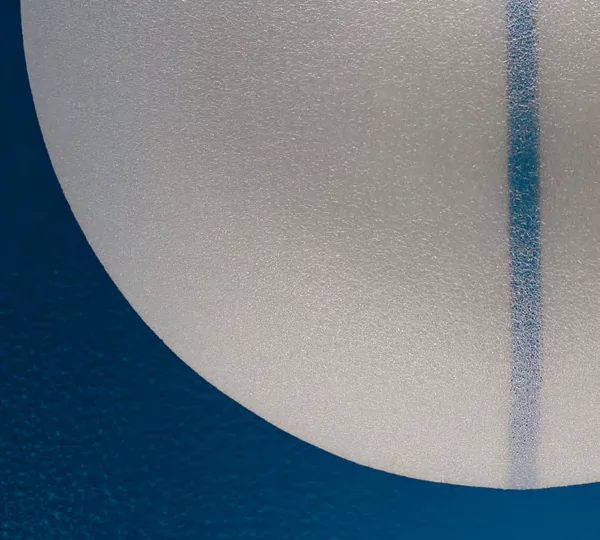
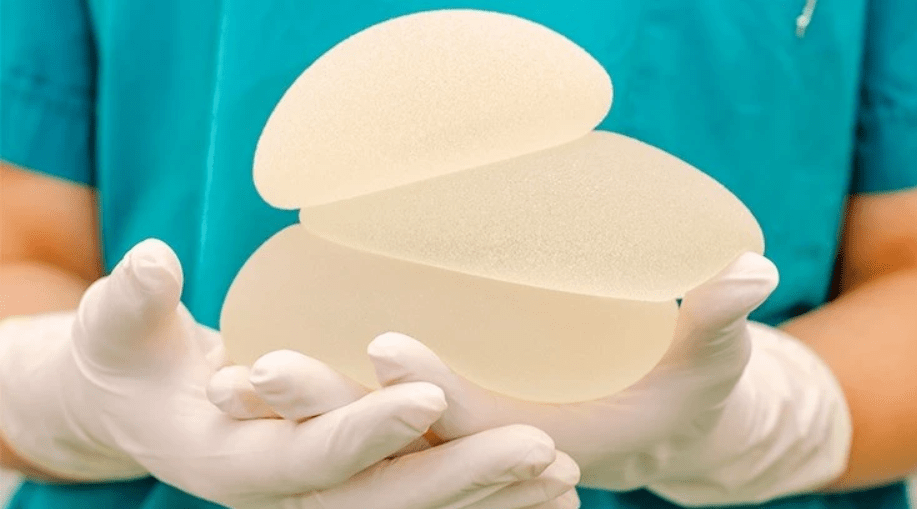
In a silicone breast implant, the shell is the outer layer of silicone elastomer that contains the cohesive gel. Manufacturers usually build it in several layers. The outside of the shell can have different degrees of roughness, from a smooth surface to coatings that interact much more strongly with the tissues.
The surface should not be confused with shape —round, ergonomic, or anatomical—or with gel cohesivity, width, height, or projection. Two implants with similar geometry can have different shells and behave differently.

Differences between smooth, microtextured, and rough implants
“Textured” and “rough” are often used interchangeably, but include very different surfaces. Exact classification depends on the measurement method and standard used. It is therefore more useful to explain how each family interacts with the tissues and why we use it.
Conventional smooth
It has little friction with the capsule and allows more potential movement. It can be an excellent choice, but an overly large pocket increases the chance of displacement.
Controlled smooth with low roughness
This includes surfaces such as SmoothSilk. They are designed with a highly uniform topography and belong to the smooth category under the ISO classification used by the FDA.2
Microtextured
It provides an intermediate level of friction. It can help control the implant when tissues are lax, a breast lift is involved, or we use an anatomical shape.
Macrotextured
It produced strong tissue interaction. Its association with BIA-ALCL, late seroma, and double capsules profoundly changed clinical practice. We do not use macrotextured implants.
Polyurethane
This coating has its own behavior; it is not simply the final step on a roughness scale. We reserve it for highly selected situations.
| Surface | Friction or interaction | Potential benefit | Main limitation | Typical use in our practice |
|---|---|---|---|---|
| Smooth | Low | Movement and feel | Requires a precise pocket | Selected augmentations |
| Controlled smooth (nanotextured) | Low and uniform | Feel, movement, and integration with tissue-preserving techniques | Stability does not depend on the shell alone | mia, Preservé, and some conventional augmentations |
| Microtextured | Intermediate | Some additional friction | Does not eliminate malposition or biological risks | Breast lifts, lax tissues, and anatomical implants |
| Macrotextured | High | Strong adherence | A complication profile that has reduced its use | We do not use it |
| Polyurethane | Highly specific | Control in complex cases | Removal and management are more demanding | Selected revisions |
What we decide before, or alongside, the surface
A smooth implant alone does not produce a natural-looking breast, just as microtexture does not guarantee stability. Before choosing the shell, we measure and assess six factors that affect the result.
Tissue coverage
Anatomy
In a very slim patient, particular attention is needed to implant palpability, edges, and rippling.
Shape and base
Geometry
The width, height, and projection must fit the breast and suit the desired result.
Gel and cohesivity
Contents
These affect feel, flexibility, upper-pole fullness, and behavior during movement.
Proportionate volume
Size
An oversized implant places a load on the tissues that no surface can compensate for indefinitely.
Surgical plane
Position
Subglandular, subfascial, prepectoral, dual-plane, and submuscular placement are not interchangeable choices.
A precise pocket
Technique
Stability depends on creating a closely fitted pocket and appropriately preserving or adjusting the breast fold.
Are anatomical implants textured?
In our practice, anatomical implants are always microtextured—usually MESMO®—or polyurethane-coated in selected cases. We never use macrotextured implants. An anatomical implant distributes volume differently between its upper and lower poles. If it rotates, that distribution changes and can distort the breast. Additional friction and a very precise pocket are therefore important.
Motiva developed an exception: Anatomical TrueFixation, a SmoothSilk anatomical implant with two tabs that were sutured to the tissues to help prevent displacement and rotation.14 We do not use it in our practice. We did not consider the available clinical experience and observed rotation problems sufficiently resolved.
In practical terms, we currently recommend microtextured or polyurethane-coated anatomical implants to minimize rotation risk. For more detail about symptoms, ultrasound, and treatment options, read our guide to anatomical implant rotation.

Do smooth implants feel more natural?
Smooth implants generally have less friction and can move more freely within the capsule. When lying down, that movement can resemble a natural breast. Some smooth shells are also thin and flexible, but the final feel depends as much or more on the gel, cohesivity, filling, volume, and the amount of tissue covering the implant.
In a slim woman or someone with very little breast tissue, edges and rippling are easier to feel, regardless of the surface. A well-covered microtextured implant can be almost imperceptible, while an oversized smooth implant or one with inadequate coverage may be palpable.
Do textured implants reduce capsular contracture?
The body normally forms a thin capsule around an implant. This is not “rejection.” We refer to capsular contracture when that capsule thickens or tightens and causes firmness, distortion, or pain.
Early generations of smooth implants, often placed above the muscle using older techniques, had higher contracture rates than certain textured implants. However, a contemporary meta-analysis of 33 studies and 35,052 implants found that the difference disappeared after accounting for placement and excluding historical or overlapping cohorts. Most of the evidence remained observational.8
Another analysis of contemporary smooth implants found comparable rates with subglandular and subfascial placement.9 We therefore no longer maintain that a smooth implant above the pectoral muscle is a combination that should never be used. Patient selection, clean technique, pocket precision, placement, and follow-up substantially change the context.
- Surface is not the only factor associated with contracture.
- Revision surgery does not have the same risk as primary augmentation.
- No shell offers zero long-term risk.
- That texture always prevents contracture.
- That a smooth implant will develop contracture because it is prepectoral.
- That an early result proves safety over decades.
Textured implants and BIA-ALCL: what we currently know
Breast implant-associated anaplastic large cell lymphoma—BIA-ALCL, or LACG-AIM in Spanish—is an uncommon disease affecting the capsule or fluid around an implant. The Spanish medicines and medical devices agency, AEMPS, continues to report a stronger association with textured shells. Its 2026 report records 111 confirmed cases in Spain from 2012 through 2025.1
These data do not establish an exact, comparable risk for each brand or microtexture. Textured implants were the most widely used for many years, and model and exposure data are incomplete. Even so, the signal is sufficient to avoid treating all roughness as equivalent and to stop routinely using surfaces with more aggressive tissue interaction.
Having a textured implant without symptoms does not mean you have lymphoma, nor does it automatically require removal. Late swelling, fluid around an implant, a mass, persistent pain, or enlarged lymph nodes should be investigated. Read more about the protocol in our article on early and late breast seroma.
Is SmoothSilk smooth or nanotextured?
SmoothSilk—also called SilkSurface in earlier publications—was marketed as “nanotextured” for years. FDA documentation describes a controlled surface with an average roughness of approximately 4 microns and classifies it as smooth under the ISO standard used.2 We therefore prefer to call it a controlled-smooth surface with very low roughness rather than use “nanotextured” as though it were a universal regulatory category.
In September 2024, the FDA approved Motiva SmoothSilk Round and SmoothSilk Round Ergonomix for primary and revision breast augmentation in women at least 22 years old.3 Approval means the agency found reasonable assurance of safety and effectiveness for those indications. It does not establish that Motiva is superior to every other implant or turn first-generation data into direct follow-up evidence for Ergonomix2.
Average roughness described in the FDA summary of safety and effectiveness.
Round and Round Ergonomix SmoothSilk, not every commercial variant.
Regulatory approval does not replace individual selection or a comparative trial.
For the difference between a conventional round implant and one with dynamic behavior, read our guide to Motiva Ergonomix2 ergonomic implants.
What SmoothSilk implant studies show
Published data are favorable, but the studies do not all assess the same implant, generation, or technique. Keeping these distinctions clear prevents accurate figures from becoming exaggerated conclusions.
560 patients
Five-year pivotal study
It included 451 primary augmentations and 109 revisions. In primary augmentation, it reported 0.5% Baker III/IV contracture, 0.6% suspected or confirmed rupture in the MRI cohort, 3.9% malposition, and 8.8% reoperation for any reason.4
Some form of dual-plane placement was used in 94% of patients. This was not a pure Ergonomix2 or prepectoral-surgery cohort.
5,813 consecutive augmentations
Retrospective series
It reported 44 complications—0.76%—and no Baker III/IV contracture in the primary augmentations analyzed.5
It combined SilkSurface and VelvetSurface, involved a single center, and the lead author disclosed relevant relationships with the manufacturer.
1,324 cases
Korean series
It reported contracture in 1.07% of primary procedures and 4.39% of revisions, with a higher risk among patients presenting for revision because of contracture.6
Primary and revision surgery should not be combined into a single rate.
4,784 patients
Meta-analysis
It estimated a 0.54% contracture rate and observed no BIA-ALCL in the included studies.7
No cases in a sample does not prove zero risk. The authors called for better prospective comparative studies.
What mia and Preservé add to this discussion
The old idea that “smooth above the muscle” is a combination to avoid does not describe the surgery we currently perform. mia Femtech and Preservé place controlled-smooth implants in a prepectoral plane, but with tissue-based patient selection, restrained volumes, and very precise pocket creation.
Diamond SmoothSilk Ergonomix2
mia Femtech
It uses a specific biconvex implant, an axillary channel, and a prepectoral pocket created with dedicated instruments. Its geometry means flipping does not change its visible shape.
Ergonomix2 SmoothSilk
Preservé
It allows more volume and profile options through a short incision in the breast fold. Low friction makes it essential to respect anatomical limits and control the pocket carefully.
A prospective mia study of 100 patients retained 93% follow-up at three years and reported 3.2% complications of any type and 1.0% reoperation, with no Baker III/IV contracture, rupture, infection, seroma, hematoma, or rippling in the cohort analyzed.10 An inframammary tissue-preservation series of 330 procedures reported 0.9% complications with an average follow-up of 18 months.11
Studies published in August 2026 extend early experience. A prospective cohort of 159 patients and a single-center retrospective validation study of 111 patients—including 26 Preservé breast lifts—reported favorable short-term results.1213 These data are relevant, but do not yet equal decades of follow-up, and several authors or the supplement have relationships with Establishment Labs.
How we choose the surface in our practice
We do not present a brand or roughness level as the universal winner. This is our current approach, which we then adapt to each patient's anatomy and reasonable preferences.
mia and Preservé
Minimally invasive augmentation
We use controlled-smooth SmoothSilk surfaces within techniques designed around the implant, volume, and tissue preservation.
Controlled smooth or microtextured, depending on the case
Conventional augmentation
For some conventional augmentations, we choose SmoothSilk when the patient prioritizes a more natural feel or movement and her anatomy and coverage allow it. In other cases, we prefer microtexture for stability.
We often prefer MESMO
Breast lift or lax tissues
Microtexture is often our first choice because it provides some additional stability. Ergonomix2 remains a valid second option.
Microtextured (MESMO®)
Anatomical implant
This is our usual choice for anatomical implants. In selected cases, we use polyurethane, never macrotexture.
Polyurethane in selected cases
Recurrent rotation or malposition
It can be useful when we need strong tissue interaction, especially in revision surgery. It is not our routine choice for every patient.
For a detailed explanation of its indications and the challenges of removal, read the dedicated guide to polyurethane-coated breast implants.
Problems each surface can cause and when to seek advice
A smooth implant can move out of position if its pocket is too large. An anatomical implant can rotate. A soft implant may show rippling if coverage is inadequate. Any implant can rupture, develop contracture, or require revision. The shell modifies some risks but does not eliminate them.
A visible change or new asymmetry
Shape
This can indicate displacement, downward or sideways movement, rotation, or flipping.
Increasing firmness or pain
Feel
Assessment is needed to distinguish contracture, inflammation, and other causes.
One breast gets larger months or years later
Volume
A late seroma should be investigated, even without fever or severe pain.
Possible rupture or folds
Imaging
Ultrasound and, when needed, MRI help assess implant integrity.
We do not recommend replacing an asymptomatic implant simply because it carries an older label such as “textured.” We first identify the manufacturer and model, the time since surgery, examination and imaging findings, and individual risk.
Compare real results before choosing
Our gallery lets you filter augmentations by volume, shape, technique, and patient characteristics. It helps you understand how implants and anatomy interact, not copy someone else's result.
Questions about smooth, rough, and microtextured implants
Are smooth or textured implants better?
Do smooth implants cause more capsular contracture?
Can a smooth implant be placed above the muscle?
What does microtextured mean?
Is SmoothSilk smooth or nanotextured?
Do textured implants cause lymphoma?
Do mia and Preservé use smooth implants?
Why might microtexture be preferred for a breast lift?
Does the surface determine a natural-looking result?
When do we use polyurethane implants?
Medical and regulatory sources
General evidence, manufacturer documentation, our own experience, and regulatory data do not have the same evidentiary value. We therefore identify each source and explain the limits of extrapolation.
- AEMPS: sixth follow-up report on breast implant-associated ALCL, 2026.
- FDA: Summary of Safety and Effectiveness Data, Motiva SmoothSilk Round and Round Ergonomix.
- FDA: PMA P230005 record and post-approval studies.
- Glicksman et al.: five-year results with Motiva SmoothSilk implants.
- Sforza et al.: retrospective series of 5,813 consecutive cases.
- Lee et al.: retrospective series of 1,324 cases.
- Aitzetmüller-Klietz et al.: Motiva systematic review and meta-analysis.
- Tanas et al.: contemporary meta-analysis of smooth versus textured implants.
- Abbott et al.: contemporary smooth surfaces and prepectoral placement.
- Chacon-Quiros et al.: mia Femtech, prospective three-year study of 100 patients.
- Randquist et al.: inframammary tissue preservation in 330 procedures.
- Pittman et al.: prospective multicenter series of 159 patients, 2026.
- Chacon-Quiros et al.: geometric and clinical validation in 111 patients, 2026.
- Motiva: official Anatomical TrueFixation description and fixation tabs.
The best surface fits a complete surgical plan
Smooth implants are no longer a marginal alternative, and microtexture is not an automatic answer. Modern techniques show that a controlled-smooth surface can remain stable in a prepectoral plane when combined with appropriate patient selection, suitable volumes, and a precise pocket. Microtextured implants retain valuable indications. In our practice, anatomical implants are microtextured or polyurethane-coated, never macrotextured.
The choice should explain benefits, limitations, and follow-up without presenting one shell as a universal solution. That is the purpose of our consultation: first decide which result is reasonable for your anatomy, then choose the implant and technique that best support that goal.